Which Is the Best App Builder with No Code?
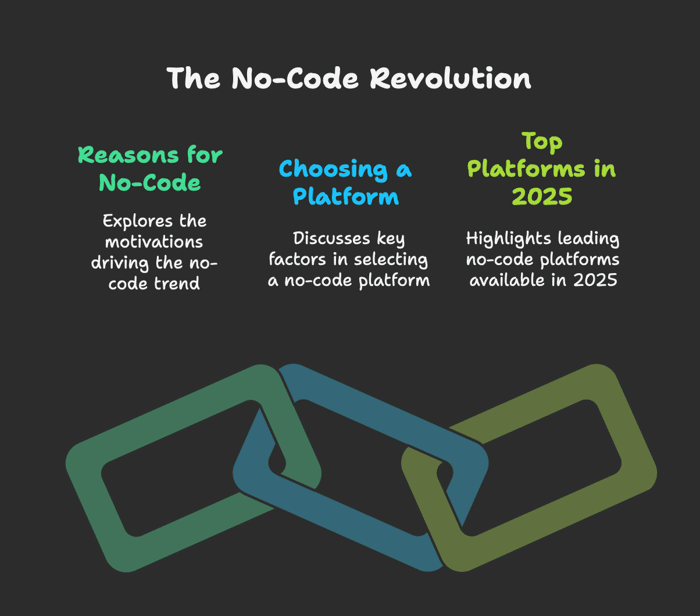
A few years ago, building a SaaS product meant spending months (or years) writing code, hiring developers, and burning cash on development before even launching.
Fast forward to today, and things look very different. Thanks to no-code app builders, you don’t need to know how to code to build a fully functional SaaS product or an internal business tool. You can launch your idea in weeks, not months, with a fraction of the cost.
But with so many no-code platforms available, *which one is the best for building an app?
Let’s break it down and find out.

Why No-Code?
Before diving into the best platforms, let’s talk about why** no-code development is growing so fast:**
📌 The no-code market is expected to grow to $45.5 billion by 2027 (Forrester Research).
📌 64% of companies are already using no-code tools to speed up development (Zapier).
📌 No-code reduces development time by up to 90% compared to traditional coding (Gartner).
In short: No-code is no longer just a trend—it’s the future of software development.
Whether you're a solo founder, a small team, or a business looking to automate internal processes, no-code lets you build without waiting on developers.
What to Look for in a No-Code App Builder?
Not all no-code tools are created equal. Before choosing a platform, here are a few things to consider:
✅ Ease of Use
If you’re not a developer, you want something intuitive. A good no-code platform should be drag-and-drop friendly, with minimal learning curves.
✅ Customization & Flexibility
Some no-code tools are rigid—you can only build within their limitations. Look for platforms that let you customize workflows, logic, and UI to fit your needs.
✅ Scalability
Your app might start small, but what happens when you get thousands of users? Some no-code platforms struggle with performance as your app grows.
✅ Integrations
Does it connect with the tools you already use? A good no-code platform should have API support, third-party integrations, and webhooks to expand functionality.
✅ Pricing
Some platforms charge based on the number of users, features, or transactions. Make sure the pricing structure aligns with your business model.
The Best No-Code App Builders in 2025
Now, let’s compare some of the best no-code app builders, based on ease of use, features, flexibility, and pricing.
1. Fuzen.io – Best for SaaS & Custom Business Apps
(Subtle plug here—since I built a SaaS usingFuzen.io.)
If you want to build a fully functional SaaS business or internal automation tool,Fuzen.ioprovides more flexibility than standard no-code builders. It focuses on:
✔ Workflow automation
✔ Backend flexibility
✔ Fast prototyping for SaaS
💰 Pricing: Custom pricing based on needs.
2. Bubble – Best for Web Apps & Marketplaces
Bubble is one of the most powerful no-code platforms out there. It’s great for building web applications, SaaS products, and even marketplaces.
🔹 Pros:
✔ Drag-and-drop interface
✔ Highly customizable workflows
✔ Active community and templates
🔹 Cons:
✖ Steep learning curve compared to other no-code tools
✖ Limited native mobile support
💰 Pricing: Free tier available; paid plans start at $29/month.
3. Adalo – Best for Mobile Apps
If you’re looking to build a mobile app, Adalo is a great choice. It allows you to create native iOS and Android apps without writing code.
🔹 Pros:
✔ Drag-and-drop UI for mobile apps
✔ Easy database management
✔ Can publish directly to the App Store & Play Store
🔹 Cons:
✖ Limited customization compared to Bubble
✖ Performance can slow down with complex apps
💰 Pricing: Free plan available; paid plans start at $36/month.
4. Glide – Best for Simple Internal Apps
If you need to build a quick internal tool or business app, Glide is the easiest option. It turns Google Sheets into functional apps without any coding.
🔹 Pros:
✔ Super easy to use (ideal for non-technical users)
✔ Great for internal business apps
✔ Affordable pricing
🔹 Cons:
✖ Not ideal for SaaS businesses or complex workflows
✖ Limited flexibility
💰 Pricing: Free plan available; paid plans start at $25/month.
5. Softr – Best for Building Client Portals & Marketplaces
Softr lets you build client portals, membership sites, and marketplaces using Airtable as the backend. It’s great if you’re building a low-code SaaS or business tool.
🔹 Pros:
✔ Fast and simple to set up
✔ Works well with Airtable
✔ No need to manage a separate database
🔹 Cons:
✖ Less control over UI customization
✖ Limited scalability for high-traffic apps
💰 Pricing: Free plan available; paid plans start at $29/month.
Which No-Code App Builder Is Right for You?
The best no-code platform depends on what you’re building:
🔹 Building a SaaS product? → Bubble or Fuzen
🔹 Creating a mobile app? → Adalo
🔹 Need an internal tool? → Glide
🔹 Building a marketplace or client portal? → Softr
If you’re serious about launching a SaaS business, you’ll need a platform that gives you flexibility, scalability, and automation capabilities. That’s where tools like Bubble or Fuzen stand out.
Final Thoughts: No-Code Is Changing the Game
No-code platforms have leveled the playing field. You don’t need to be a developer to build and scale a software business anymore.
🚀** What used to take months can now be built in days.**
🚀 Development costs have dropped by 80-90%.
🚀 More non-technical founders are launching SaaS businesses than ever before.
So, if you’ve been thinking about starting your own SaaS or app,** there’s no excuse to wait.** Pick a no-code tool, start building, and launch your idea.
If you’ve used any of these no-code platforms,** what’s been your experience?** Let’s discuss in the comments! 👇

Considering tools like Cursor, Bolt, Lovable, etc., why utilize No-Code tools for things other than a quick landing page?
I'm loving the new no-code solutions wave, it's fantastic to see the power of technology in simplifying complex tasks. Has anyone tried to build a native app with a no-code builder? I feel like all the ones mentioned are webviews but presented as native. Any fully native builders out there? I know it's quite rare to see.
Considering AI, templates and all the ressources a developer can access nowadays, I think the Gartner quote : "No-code reduces development time by up to 90% compared to traditional coding (Gartner)." is clearly outdated nowadays
Interesting Article about the No-Code Trend.
In my experience, no-code services don't give you full freedom to design your idea the way you want. They are restrictive for technical reasons.
In my opinion, to know how to Code, gives you a massive advantage building Ideas and it's fun too!
I have to agree with you, but at the same time, not everyone may want or require complete technical freedom when creating their application. For many ( including myself, unfortunately ), when solutions leave everything open, it can be very confusing and overwhelming.
I think it also depends on the quality of the app produced at the end. If the no-code limitations affect the quality of the app and you end up with a barely functional app, then I completely agree with you.
But if the final product is impressive and the process is easy... why not?
At this point, using no-code tools is more a lock-in, restrictive thing than something helpful.
Non-technical people can go from idea to functional app using Bolt, Lovable, or whatever it's the flavor of the month tool.
Bold
No-code is such a game changer It’s amazing how you can build something without needing to code. I’ve been thinking about trying Bubble, anyone here has experience with it?
I totally agree with you! Have you tried bubble? Im looking into creating my own app. I'd love to hear about your experinces with any no-code app builders (specifically native app builders).
I have built a number of functional app using bubble and other no code platforms.
If you don't mind i can share you my portfolio
Sure! I'd love to see what other platforms you have used and how they function.
fiverr.com/s/m5Ny9gZ
This link will direct you to my profile and portfolio
There is an option to send a message if you will like us to talk further
Just checked it out. Great work! You have some great sense for design and color schemes.
Quick question though, have you used an app development solution called nandbox by any chance? I came accross it in my research, seems really impressive but I wanted to get some real user reviews before subscribing. Let me know!
Yeah, I’ve actually used nandbox before, don’t use it all the time, but I’ve played around with it enough to get a feel for how it works. It’s definitely solid for a no-code platform, especially if you’re looking to build something quickly without getting into heavy development. The modules are pretty flexible, and the interface is user-friendly once you get the hang of it.
If you’re thinking of trying it out, I’d say go for it. Just depends on what kind of app you're aiming to build.
This was so helpful, thank you so much Ade! I'm def gonna give it a go because I wanna build an app quickly with absolutely no technical or development knowledge. Do you know if they have a mobile store module?
not certain, you can check it out
wanna talk outside indie?