Which LLM generates the best code at the moment?
I’m using LLMs to help me write code for my platform Launchpads, but sometimes I wonder if the model actually does a good job compared to others, at a lower cost. I haven’t run formal eval benchmarks or unit tests, but rather I turned to the dev communities on Reddit to ask those who use LLMs heavily for coding. Below is a summary of the learnings, including the pros and cons of each popular coding LLM.
LLM vs. AI Tool: What’s the difference?
For the ones out there who have recently played with vibe coding and products like Lovable, Cursor, Claude or V0, I want to explain that all of those are not LLMs. Let’s explain the basics step by step.
LLM stands for Large Language Model. These are powerful AI systems trained on huge amounts of text and basically everything that is published on the Internet (e.g. Wikipedia or Reddit). They can understand and generate human-like text, answer questions, and even write code.
Think of LLMs as very smart assistants that you can chat with — you give them a prompt, and they give you a helpful response.
Popular LLMs used today are:
Claude (by Anthropic)
Gemini (by Google)
ChatGPT (by OpenAI)
Qwen (by Alibaba)
LeChat (by Mistral, developed in 🇪🇺 )
Deepseek (Made in 🇨🇳)
LLaMA (by Meta )
These models are the brains behind many popular AI applications, but they’re not apps or tools by themselves.
An AI tool is a practical app or platform that uses one or more LLMs behind the scenes. These tools are built to help you do something — like writing code, designing UIs, or debugging projects — in an easy-to-use interface.
They often provide features like: smart code suggestions, real-time previews, UI components you can drag-and-drop or integration with GitHub or your local files.
Examples include:
Cursor
GitHub Copilot
Replit AI
Google AI Studio
V0
Which LLMs are preferred by engineers to generate best code?
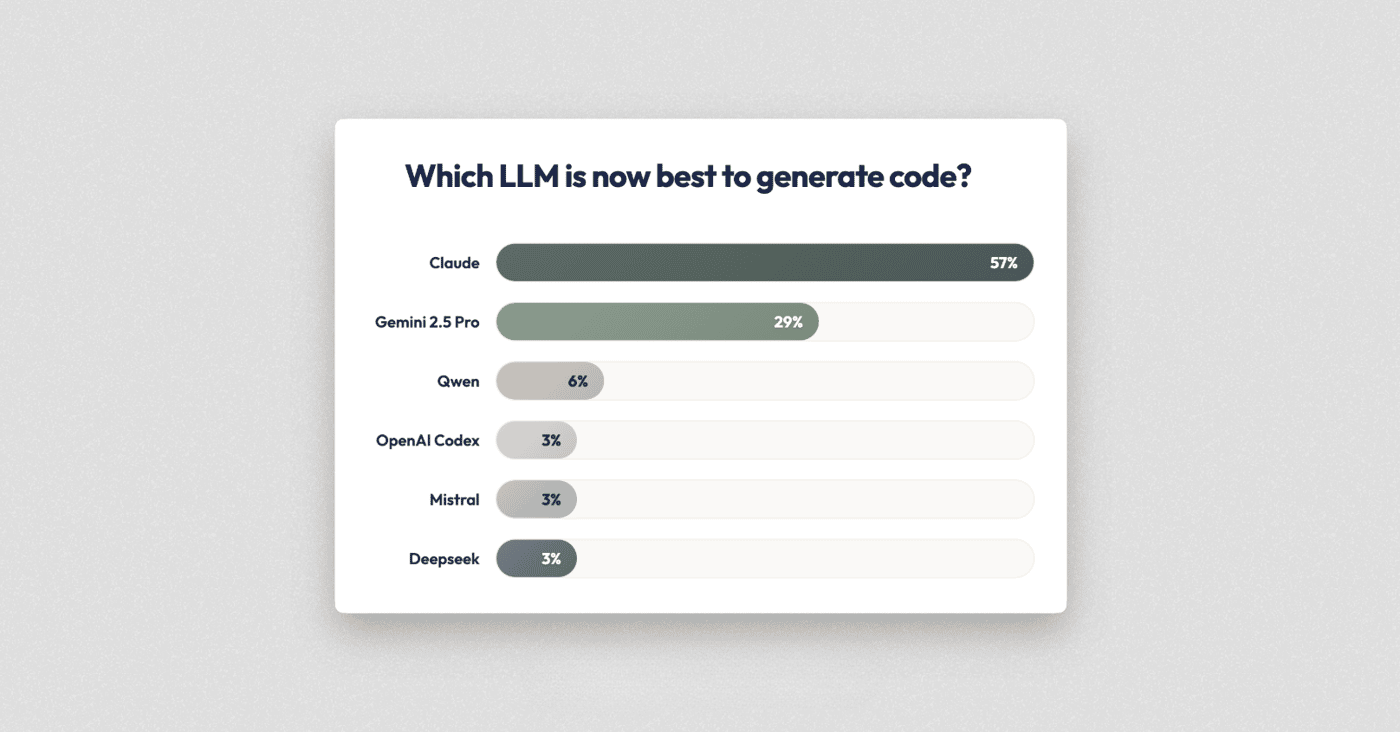
I asked engineers and AI specialists from development communities and subreddits about which LLMs they prefer for generating code. Based on input from 35K views and replies, Claude turned out to be their top choice for generating best code (especially Claude Code with Opus 4 and Claude Sonnet). Gemini 2.5 Pro was a strong second — slower, but generating solid, clean code. Very few mentioned OpenAI, Grok, or LLaMA as preferred for coding right now.
Best overall quality:
🥇 Claude Opus 4 — smartest and most reliable for complex code.
⚠️ But it has limits (e.g. usage caps), so not always available.
Best balance of power + availability:
🥈 Claude Sonnet — fast, accessible, and almost as good as Opus.
Strong second place with no limits:
🥉 Gemini 2.5 Pro — great for scripting and quick fixes, especially inside Google’s AI Studio. It also supports 1 million tokens, so it’s good for large projects.
To sum up, move into LLM-assisted coding to sharpen your dev skills when ready. Beginning with Lovable or Bolt is perfectly fine. Once you turn to LLMs and coding in your own code editor, Claude and Gemini are leading the pack right now for code generation.
