Which RAG method actually works best on YOUR data? (AutoRAG vs RAGBuilder vs Red Hat AutoRAG)
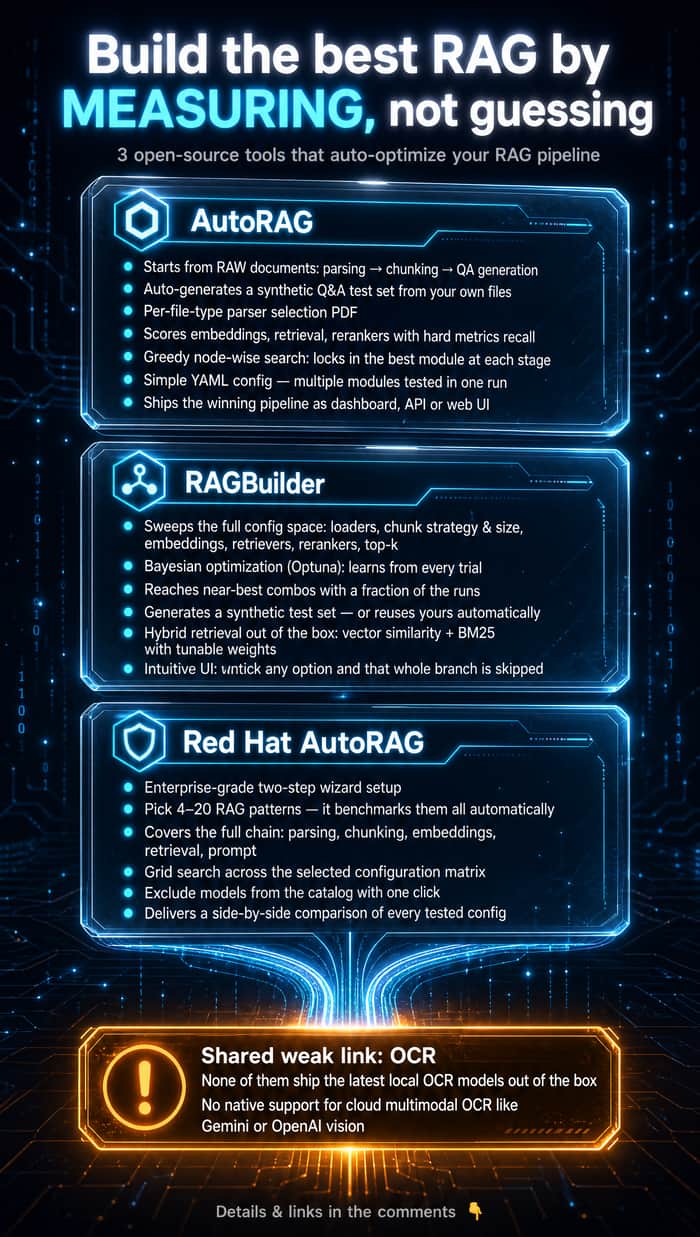
Want to build an AI assistant that talks to your company documents? First you need to answer one question: which RAG method actually works best on YOUR data?
RAG (Retrieval-Augmented Generation) works roughly like this: your documents are read, split into small pieces (chunks), and each piece is converted into a numerical vector (embedding) stored in a database. When a user asks a question, the system finds the most relevant pieces and feeds only those to the model. The model never sees the whole document — only what matters. Accuracy goes up, cost goes down.
The hard part: there are dozens of options at every step. Which parser? What chunk size? Which embedding model? Should you use a reranker? BM25, vector search, or hybrid? The answers change from dataset to dataset — there is no single "best for everyone" combination.
The good news: there are open-source tools that find the answer for you — by testing. I dug into three of them:
-
AutoRAG (Marker-Inc-Korea) — Starts from your RAW documents: parses, chunks, and even generates a synthetic Q&A test set. Then it scores different embeddings, retrieval methods and rerankers against your own data and tells you "this is the best pipeline for your data." YAML-configured, comes with a dashboard, and can deploy the winning pipeline as an API.
-
RAGBuilder (KruxAI) — Does the same job with Bayesian optimization: instead of brute-forcing every combination, it learns from previous trials and steers toward the most promising configs. It sweeps everything from chunk size to rerankers. Comes with an intuitive UI — untick any option and that whole branch is skipped.
-
Red Hat AutoRAG (OpenShift AI) — The enterprise take. A two-step wizard lets you pick how many configurations to test; the system benchmarks combinations across the full chain — parsing, chunking, embeddings, retrieval, prompt — and finds the best fit for your data.
With these three tools you can build your RAG system based on measurement, not guesswork. Don't decide without testing — these tools show you, in numbers, what actually works on your data.
So are they flawless? No — and the most critical gap is in document reading:
The shared and most visible weak link of all three tools is the document reading / OCR layer. Everything after chunking — embedding selection, retrieval, reranking, metric evaluation — is mature and automated. The OCR side, however, is locked to a handful of fixed, outdated engines.
The OCR these tools ship is pinned to old versions: for example, an old fork of PaddleOCR — created years ago for license-compliance reasons — is what actually runs under the hood. PaddleOCR's newest, multilingual, significantly more accurate models are NOT supported out of the box. Likewise, next-generation cloud OCR APIs are nowhere to be found in their documented module lists.
The vision/OCR capabilities of multimodal models like Gemini and OpenAI aren't directly supported either. Only AutoRAG offers an indirect, paid (token-based) channel through a third-party cloud parser — but that is not a first-class "Gemini OCR" or "OpenAI OCR" module, and RAGBuilder and Red Hat don't offer even that much flexibility.
Bottom line: the OCR/parse menu of these tools is a closed, fixed list of a few legacy local engines plus a handful of cloud parsers. They ship neither the latest local OCR models nor cloud multimodal OCR like Gemini/OpenAI vision out of the box — if you want those, you have to integrate the engine yourself.
In short: Finding the best RAG method is no longer guesswork — measure it with these three tools. But if you work with scanned or mixed documents, know from day one that you'll need to strengthen the OCR layer yourself.
🔗 Linkler / Links:
AutoRAG: https://github.com/Marker-Inc-Korea/AutoRAG
RAGBuilder: https://github.com/KruxAI/ragbuilder
Red Hat AutoRAG: https://docs.redhat.com (OpenShift AI → AutoRAG)
#RAG #YapayZeka #AI #LLM #AutoRAG #OCR #AçıkKaynak #OpenSource #MachineLearning

What I like about this breakdown is that it quietly exposes the real truth about RAG tooling right now: retrieval is mostly solved, but ingestion is not. Everyone optimizes embeddings, chunking, and reranking, but the system is still only as good as what survives the OCR + parsing step. In practice, that upstream layer is where most “RAG accuracy problems” actually originate, even if they get diagnosed downstream.
Exactly this. The industry benchmark culture is all downstream — MTEB scores for embeddings, recall@k for retrievers — but nobody publishes an "OCR/parsing accuracy on messy real-world PDFs" leaderboard, even though that's the step where information actually gets lost or corrupted before it ever reaches a vector store. A perfect reranker can't recover a table that got flattened into garbled text during parsing. I'd guess most teams that say "our RAG is inaccurate" would get more ROI from swapping their parser than from tuning retrieval.
Glad it resonated.
Your reply made me think there's one strategic decision sitting underneath that architecture which becomes much more significant as the product grows, but I don't think I can explain the reasoning properly in a thread without oversimplifying it.
If you're interested, what's the best email to reach you on?
Sure — you can reach me at ahmet.ozel@protonmail.com. Please include the strategic decision and the architecture context you have in mind; I’d be glad to discuss it.