# Who are the innovators, and why are the founders among them?
Many of you know what’s innovation. We mostly know it because we’ve seen what it does to the world. It’s associated with something new and something genius. That’s how we know it, and that’s how we used to think about it.
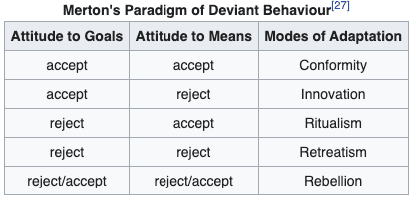
An American sociologist Robert Merton has done some work back in late 1930 detailing an interesting taxonomy that may have something to do with the innovators we know today.
In his work, Robert Merton argued that deviance is most likely to occur when there is a discrepancy between culturally prescribed goals and the legitimate means of obtaining them.
He defines culture as an "organized set of normative values governing behavior which is common to members of a designated society or group.” Social structures are the "organized set of social relationships in which members of the society or group are variously implicated." Anomie, the state of normlessness, arises when there is "an acute disjunction between the cultural norms and goals and the socially structured capacities of members of the group to act in accord with them.
In simple words, many people accept social goals, but not all accept (or have) social means, and the more the discrepancy between them, the more deviation in the behavior. But unlike the rest of the group, Innovation refers to attaining of those goals in unaccepted ways. Innovators find and create their own ways to obtain what they want, and a majority of the time, these new means are considered to be socially unaccepted and deviant.
That’s surely a little harsh explanation, but back in the 1930th, innovators were referred to as crime and gangsters. However, the concept is correct.
Now, according to Merton, innovation is when goals are achieved by unacceptable means. It does not specifically refer to something new, although we want the innovations to be new. But surely, when a founder builds up a startup, there is always that innovation in place. There is always something new that is better, faster, or cheaper.
I believe that Steve Jobs was in the rebellion category, however.
Rebellion differs from the other four approaches in a number of ways. Temporally, rebellion is a short-term response (unlike the other four). Like retreaters, rebels reject both existing societal goals and means, but unlike retreaters, rebels work at the macro level to replace those existing societal goals and means with new goals and means embodying other values.
Quick group examples:
Conformity - 9 to 5 workers
Innovation - startup founders
Ritualism - folks that love bureaucracy
Retreatism - people on the street and around :(
Rebellion - people like Steve Jobs (not necessarily that successful)
Innovations are great. Today’s world has so many accessible means for building a company. But still, lots of founders keep asking the same question:
How to build an MVP?
But it is not about the MVP itself, it is about how you hack it.
Hacking is your innovation in certain areas of business. It can be technology, operations, resource management, hiring, remote team management, outsourcing work, and intelligence.
So it depends more on those fundamental factors but not on whether you will use the outsourced dev team to get your MVP together or hire someone in-house.
It is about what kind of innovations you can do in business at the moment.
When painters paint, they first get it out there as a sketch and take it from there by iteratively improving it.
So as for BMW, check its BMW X3 first generation 2003 and see how it looks now. It’s a big difference.
So it’s more of a what kind of things are you going to be innovative enough to win with or without an MVP.
For example, software outsourcing is doing more with less. Technically fell into the innovation category of attaining goals with fewer means. I’m in the software outsourcing business and saw founders having trouble finding the agency. This challenged me to start a new venture and help founders attain more with less.
My first product is a founder’s guide to software outsourcing that I’m open-sourcing and launching on Product Hunt today.
To those who try hard every day, the application of imagination to technology and business is one step forward each one of those days.
Better products are built today. Keep building every day.
