Why AI Agents Are Becoming the New User Interface for Mobile Apps
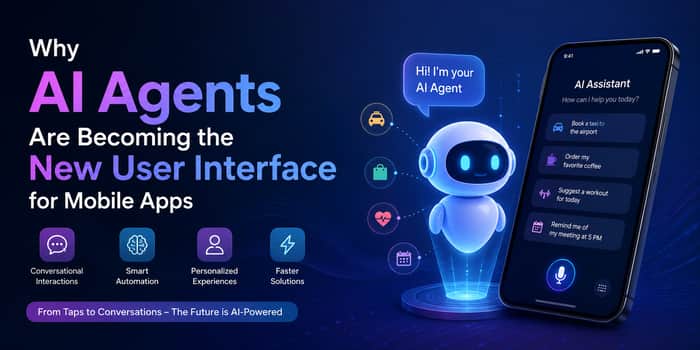
Mobile apps have traditionally been built around screens, buttons, menus, forms, filters, and search bars. Users open an app, navigate through different sections, select an option, enter information, and complete an action.
AI agents are beginning to change this interaction model.
Instead of asking users to figure out where a feature is located, an AI agent can understand what the user wants and help complete the task. A user might say, “Find me a healthy dinner under $20 and have it delivered by 8 PM,” or “Book me a ride to the airport tomorrow morning.” Rather than manually navigating through multiple screens, the app can interpret the request and coordinate the required actions.
This shift is one reason AI agents are becoming an important new interface layer for mobile applications.
From Screens and Buttons to Intent
Traditional mobile interfaces are designed around predefined workflows.
For example, ordering food may require users to:
- Open the food delivery app.
- Search for restaurants.
- Select a cuisine.
- Apply filters.
- Choose a restaurant.
- Select dishes.
- Add items to the cart.
- Enter delivery information.
- Make a payment.
This workflow works well when users already know what they want and understand how the application is structured.
But real-world requests are often more complicated.
A user may want to say:
“I need a vegetarian dinner for two, preferably under $30, delivered within 45 minutes.”
An AI agent can potentially interpret the intent, consider multiple constraints, search available options, compare results, and guide the user toward a suitable choice.
The interface therefore becomes less about where to click and more about what the user wants to accomplish.
What Makes an AI Agent Different?
AI-powered chatbots and AI assistants have existed for years, but AI agents go a step further.
A conventional chatbot may answer a question such as:
“What restaurants are available near me?”
An AI agent can potentially take the next steps by searching available restaurants, checking menus, applying preferences, and preparing an order.
The important distinction is that an AI agent can combine understanding, reasoning, tool usage, and action.
Depending on the application, an agent may interact with:
- Search systems
- Maps and location services
- Payment systems
- Booking platforms
- Inventory databases
- Customer accounts
- Recommendation engines
- Communication tools
- Internal APIs
This allows the agent to become an interaction layer between the user and the application's underlying services.
Why This Matters for Mobile Apps
Mobile apps have accumulated many features over the years.
A super app, for example, might include ride booking, food delivery, grocery shopping, payments, healthcare services, logistics, and other on-demand services.
While having more functionality creates opportunities, it can also make the user experience more complicated.
Users may not know which section they need.
An AI agent could provide a simpler entry point.
Instead of asking:
“Which service should I open?”
the user could simply describe the goal:
“I need to send a package across the city and then get a ride to the airport.”
The AI system could identify the relevant services and guide the user through the process.
This creates a more intent-driven application experience.
AI Agents Can Personalize the Experience
Another major advantage is personalization.
Traditional interfaces usually provide the same basic navigation structure to every user. Personalization often happens through recommendations, saved preferences, or recently viewed content.
AI agents can potentially use a broader context.
For example, a travel application could understand that a user frequently travels for business and prefers morning flights, specific hotel categories, and certain transportation options.
Instead of repeatedly entering these preferences, the user could simply say:
“Plan my usual business trip to Mumbai next week.”
The agent could use the user's saved preferences and present relevant options.
Similarly, a food delivery application could understand preferences such as vegetarian meals, calorie limits, favorite cuisines, delivery locations, and spending ranges.
The result is an experience that feels less like operating software and more like communicating with a digital assistant.
AI Agents Could Transform Search
Search is another area where AI agents can change mobile interfaces.
Traditional search depends heavily on keywords.
If a user searches for:
“healthy dinner”
the application may return restaurants or dishes containing related keywords.
An AI-powered system can potentially understand a more complex request:
“Find a high-protein vegetarian dinner for two, under ₹1,000, within 30 minutes.”
The system has to understand several requirements at once:
- Dietary preference
- Nutritional preference
- Number of people
- Budget
- Delivery time
This is closer to intent-based search than traditional keyword search.
For marketplaces, travel platforms, food delivery applications, and on-demand services, this could become a significant user experience improvement.
The Rise of Agentic Workflows
AI agents become even more interesting when multiple actions are required.
Consider a ride-hailing application.
A user could say:
“I have a flight at 6 PM tomorrow. Remind me when I should leave and arrange a ride from home to the airport.”
A more advanced application could potentially combine calendar information, estimated travel time, traffic conditions, and ride availability to help determine when the user should leave.
Similarly, in a home-services marketplace, a user might say:
“My air conditioner isn't cooling properly. Find a technician available this weekend and book the earliest suitable appointment.”
The agent could interpret the problem, identify the relevant service category, check provider availability, compare options, and assist with booking.
The underlying application still has traditional screens and APIs. But the AI agent becomes an additional layer that coordinates them.
AI Agents Don't Eliminate Traditional UI
It would be a mistake to assume that AI agents will completely replace buttons, menus, and visual interfaces.
For many tasks, traditional UI remains faster.
If someone wants to choose between three nearby restaurants, a visual list with images, ratings, prices, and maps may be more useful than a conversation.
The future is therefore more likely to be hybrid.
Users could interact through:
- Voice
- Text
- Traditional screens
- Buttons
- Cards
- Maps
- Conversational interfaces
- AI-generated recommendations
The AI agent can help users reach the right interface or perform actions, while visual components remain available for confirmation and control.
Trust and Control Will Become Critical
As AI agents move from answering questions to performing actions, trust becomes increasingly important.
There is a big difference between an AI agent saying:
“This restaurant has a 4.6-star rating.”
and:
“I've placed your order.”
The second action has real consequences.
Developers therefore need to consider permissions, confirmation steps, transaction limits, audit trails, and transparent explanations.
For sensitive actions such as payments, healthcare decisions, bookings, or account changes, users may need to approve the final step.
A strong agentic experience should make it clear:
What is the AI doing?
Why is it doing it?
What information is it using?
What action will happen next?
Giving users control will be essential for adoption.
What This Means for App Developers
Building an AI-agent-powered application requires more than simply adding a chatbot to an existing app.
Developers need to think about the application architecture differently.
Important components can include:
- Large language models or smaller specialized models
- Agent orchestration
- API integrations
- Tool calling
- Retrieval systems
- User context
- Authentication and permissions
- Real-time data
- Monitoring and logging
- Human approval workflows
- Security and privacy controls
The quality of the underlying data and APIs also becomes increasingly important.
An AI agent cannot reliably complete an action if the application does not expose accurate and structured information.
For startups, this creates an opportunity to design AI-native applications from the beginning rather than adding AI after the product is already built.
AI Agents Could Create New Mobile App Experiences
The most interesting possibility is that future applications may not be defined only by their screens.
A traditional app might be described as:
“An application with 30 different features.”
An agent-first application could instead be described as:
“An application that understands what users are trying to accomplish and coordinates the necessary services.”
This could be particularly powerful for marketplaces and multi-service platforms.
A single AI agent could potentially help users discover products, book services, compare prices, arrange transportation, schedule appointments, or manage recurring tasks.
That doesn't mean every application needs an autonomous AI agent.
Instead, developers should identify areas where users currently have to navigate complicated workflows and determine whether an agent can simplify them.
Final Thoughts
AI agents are changing the conversation around mobile app interfaces.
The next generation of mobile applications may not remove traditional UI. Instead, they may add an intelligent layer that understands user intent and connects that intent with the application's features and services.
For startups, this represents an important shift in product thinking.
Instead of asking only:
“What screens should we build?”
developers can also ask:
“What outcomes should our application help users achieve?”
That change in perspective could lead to simpler interfaces, more personalized experiences, smarter search, and more automated workflows.
As AI agents become better at understanding context and interacting with software systems, the mobile app may gradually evolve from something users navigate into something users can simply tell what they want to accomplish.

I think the interesting shift isn't just from screens to intent, but from intent to governed execution.
An agent can understand what I want, but once it starts acting, the harder question becomes whether that action is still appropriate given the current context, constraints, and previous decisions.
That makes trust less about “does the agent understand me?” and more about “can I understand why it decided to do this, and what evidence/context it used?”
I think that layer will become increasingly important as agents move from helping users navigate apps to actually acting on their behalf.