Why Are Practical Cybersecurity Skills Becoming More Important for Job Seekers in 2026?

Cybersecurity has become an attractive career option for students and professionals looking to enter the technology industry. As organizations face growing digital security challenges, learners searching for the best cybersecurity course in India are increasingly looking for programs that provide practical exposure along with theoretical knowledge. Understanding security concepts is important, but being able to apply those concepts through hands-on labs, projects, and realistic scenarios can make a significant difference when preparing for cybersecurity roles.
Cybersecurity is no longer a field where theoretical knowledge alone is enough. Employers value candidates who can understand security problems, work with relevant tools, analyze threats, and apply appropriate security practices. This has made practical learning an important part of preparing for a successful cybersecurity career.
For students and fresh graduates, this creates both an opportunity and a challenge. There are several cybersecurity roles to explore, but employers also expect candidates to demonstrate relevant technical skills. Completing a course or certification can provide a foundation, but practical experience can help candidates become more confident when applying for jobs.
This is why hands-on cybersecurity training is becoming increasingly important. Labs, security projects, vulnerability assessments, network analysis, and incident investigation can help learners understand how cybersecurity concepts work beyond textbooks and classroom discussions.
Why Is Practical Cybersecurity Knowledge Important?
Cybersecurity professionals are expected to solve problems rather than simply explain them.
For example, knowing what a vulnerability is does not necessarily mean that a person knows how to identify, assess, or prioritize vulnerabilities. Similarly, understanding the concept of phishing is different from being able to examine a suspicious email and recognize potential indicators of compromise.
Practical training helps bridge this gap.
Through controlled exercises, students can practice security techniques without being exposed to the risks associated with testing real systems without authorization. They can learn how different tools work, interpret results, investigate security events, and document their findings.
This type of experience can make technical concepts easier to understand and remember.
What Practical Skills Should Cybersecurity Students Learn?

Cybersecurity is a broad field, and beginners do not need to master every specialization immediately. They should first develop a strong technical foundation and then gradually explore areas that match their career interests.
Important skills can include:
● Computer networking
● Network security
● Linux and Windows fundamentals
● Vulnerability assessment
● Ethical hacking
● Penetration testing
● Web application security
● Security monitoring
● Threat analysis
● Incident response
● Digital forensics
● Security documentation
The skills required can vary depending on the role. A student interested in penetration testing may spend more time learning security testing, while someone targeting a SOC role may focus more on monitoring, logs, alerts, and threat detection.
How Do Hands-On Labs Help Students?
Hands-on labs give students an opportunity to practice cybersecurity concepts in controlled environments.
Instead of simply reading about a security vulnerability, learners can work through a simulated scenario and understand how the vulnerability is identified and addressed. This process can improve technical confidence and problem-solving skills.
Labs can also introduce students to commonly used cybersecurity tools. Repeated practice helps learners understand not only what a tool does but also when it should be used and how its results should be interpreted.
For beginners, this experience can be especially valuable because cybersecurity tools can initially seem complicated when learned only through theory.
Why Are Cybersecurity Projects Important for Job Seekers?
Projects can give students practical experience that they can discuss during interviews.
A candidate who says they completed a cybersecurity course provides limited information about their abilities. A candidate who can explain a project, the problem they worked on, the tools they used, the vulnerabilities they identified, and the recommendations they made can provide much stronger evidence of practical understanding.
Can Practical Skills Help During Cybersecurity Interviews?
Technical interviews often involve situations rather than simple definitions.
An interviewer may ask:
● What would you do after detecting suspicious network activity?
● How would you investigate a potential vulnerability?
● What steps would you take after identifying a security incident?
● How would you prioritize multiple security risks?
● What information would you look for when analyzing an alert?
Students who have completed practical exercises may find it easier to answer these questions because they have already worked through similar scenarios.
Practical experience also gives candidates examples they can use when answering behavioral and technical questions.
What Should Students Look for in a Cybersecurity Course?
Choosing the best cybersecurity course should involve more than comparing course fees or duration.
Students should examine whether the program provides a balance between concepts and practical learning. A useful course should help learners understand the fundamentals before introducing advanced security topics.
Before enrolling, students can consider:
● Does the curriculum cover relevant cybersecurity fundamentals?
● Are practical labs included?
● Does the program include projects?
● Will students work with cybersecurity tools?
● Are assessments included?
● Are certifications provided?
● Is interview preparation available?
● Does the program provide career guidance?
● Is placement support available?
A course that combines these elements can provide a more complete learning experience.
How Can the Right Training Institute Support Career Preparation?
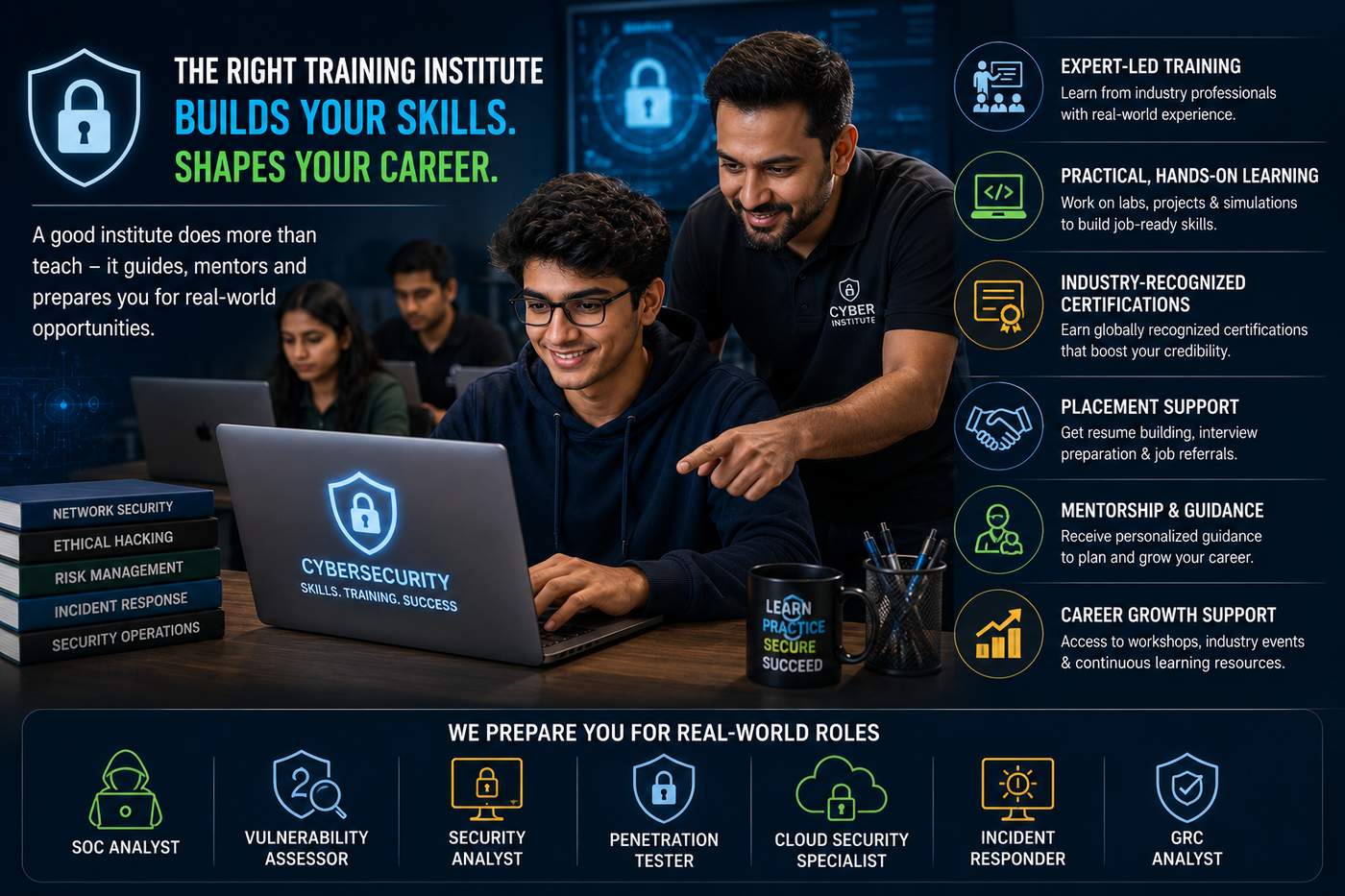
The quality of training can influence how effectively students develop their skills. When searching for the best cybersecurity training institute, learners should look beyond marketing claims and understand what the program actually provides.
A career-focused institute should ideally provide a structured curriculum, practical learning opportunities, knowledgeable trainers, projects, and guidance throughout the learning process.
Career preparation can also include resume development, mock interviews, technical interview practice, and guidance on suitable entry-level cybersecurity roles.
These services do not replace individual effort, but they can make the transition from training to job searching more structured.
Why Should Students Consider Live Projects and Simulated Environments?
Real cybersecurity environments can be complex, particularly for beginners. Simulated environments provide a safer way to practice security concepts and understand how different situations develop.
For example, a student might work through a simulated incident involving suspicious login activity. They could examine logs, identify unusual behavior, determine the possible cause, and prepare a basic incident report.
This type of exercise encourages students to think like security professionals rather than simply memorize concepts.
Over time, repeated practice can improve analytical thinking and decision-making.
How Do Certifications and Practical Skills Work Together?
Certifications can help demonstrate that a learner has studied particular cybersecurity concepts. They can also add credibility to a beginner's resume.
However, certification should not be treated as a substitute for practical knowledge.
When comparing a top cybersecurity training institute, students should consider whether certifications are supported by hands-on labs and projects. A learner who has both certification and practical experience can explain not only what they have studied but also how they have applied that knowledge.
A balanced learning approach can be represented as:
Fundamentals + Practical Labs + Projects + Certification + Interview Preparation
Each component serves a different purpose in career preparation.
How Can Students Build a Strong Cybersecurity Resume?
A beginner's resume should clearly communicate relevant skills and practical exposure.
Instead of simply listing the name of a course, students can include:
● Cybersecurity skills
● Relevant tools
● Certifications
● Practical projects
● Lab experience
● Internship experience, where applicable
● Academic projects
● Technical achievements
For projects, students should briefly describe the objective, technologies or tools used, their responsibilities, and the outcome.
This can give recruiters a better understanding of what the candidate has actually practiced.
Does Placement Support Matter When Choosing Training?
Placement support can be useful for students who are entering the job market for the first time.
Depending on the institute, placement assistance may include:
● Resume building
● Mock interviews
● Technical interview preparation
● HR interview preparation
● Career counseling
● Job search guidance
● Information about relevant openings
Students should understand exactly what an institute means by placement support. Assistance with the recruitment process is different from guaranteeing employment.
Ultimately, students still need to develop the technical skills and communication abilities required by employers.
How Can Boston Institute of Analytics Help Students Build Practical Skills?
Boston Institute of Analytics offers a Cyber Security & Ethical Hacking program that combines foundational cybersecurity concepts with practical learning. The program includes dual certification, live lab exposure, and practical projects covering areas such as networking, ethical hacking, vulnerability assessment, and penetration testing.
The program also provides placement support, including resume building and mock interview preparation. These features can help learners gain practical exposure while preparing for the recruitment process. For students and working professionals planning to build a cybersecurity career, combining technical training, hands-on practice, certification, and career support can provide a structured way to develop job-relevant skills.
What Should Students Do After Completing Cybersecurity Training?
Completing a course should not be considered the end of the learning process.
Students can continue developing their skills by practicing in controlled environments, completing additional projects, following cybersecurity developments, and exploring specialized areas.
A practical approach after training can include:
Revise the fundamentals:
Continue practicing networking, operating systems, security concepts, and other core topics.
Build more projects:
Create practical projects that demonstrate specific cybersecurity skills.
Improve your resume:
Update your resume with projects, certifications, tools, and relevant experience.
Practice interviews:
Work on technical, scenario-based, and HR interview questions.
Apply for suitable roles:
Search for entry-level opportunities that match your skills and interests.
Keep learning:
Cybersecurity constantly changes, so professionals need to stay updated with emerging threats and technologies.
Is Practical Cybersecurity Training Worth It for Beginners?
For beginners, practical training can provide an important bridge between theoretical knowledge and workplace expectations.
A student who understands cybersecurity concepts but has never used security tools or completed a practical project may feel less confident during technical interviews. Hands-on experience can help address this gap.
However, students should not expect a course alone to guarantee career success. Building a cybersecurity career requires continuous practice, learning, project work, communication skills, and persistence during the job search.
The goal should be to become capable of explaining and applying cybersecurity concepts rather than simply completing a course.
Conclusion
Practical cybersecurity skills are becoming increasingly important for people entering the security industry. While theoretical knowledge provides the foundation, hands-on labs, projects, security tools, and realistic scenarios help learners understand how cybersecurity works in practice.
Students looking for the best cybersecurity course in India should therefore evaluate more than certifications and course duration. Practical exposure, project experience, career guidance, and placement support can all contribute to better preparation for the job market.
With consistent practice and continuous learning, aspiring professionals can develop the skills and confidence needed to begin their cybersecurity career and grow with the changing demands of the industry.
Frequently Asked Questions
1. Why are practical skills important in cybersecurity?
Practical skills help learners apply theoretical concepts to realistic security situations. They can also make it easier to demonstrate technical knowledge during interviews and professional tasks.
2. Can beginners learn cybersecurity without an IT background?
Yes. Beginners can start with basic computer and networking concepts before moving into cybersecurity topics such as ethical hacking, vulnerability assessment, and security monitoring.
3. Are cybersecurity projects useful for job applications?
Yes. Projects can demonstrate practical knowledge and give candidates specific examples to discuss during technical interviews.
4. Is certification enough to start a cybersecurity career?
Certification can demonstrate knowledge, but practical skills are also important. Combining certification with labs, projects, and interview preparation can provide stronger career preparation.
5. What should I consider when choosing a cybersecurity training institute?
Look at the curriculum, practical labs, projects, trainers, certifications, career guidance, interview preparation, and placement support. Students should focus on the overall learning experience rather than choosing an institute based only on advertising or price.

