Why Every B2B Lead Generation Guide Fails Web Design Agencies (And What to Do Instead)
Open any lead generation guide in 2026 and you'll find the same advice: build a HubSpot funnel, run LinkedIn ads, use Apollo.io to find enterprise contacts, warm up your email domain.
This is a legitimate playbook. For a SaaS company selling $30,000 contracts to corporate procurement teams.
It is almost entirely irrelevant for a web design agency selling £1,500 websites to local business owners.
The problem isn't that web agencies don't do lead generation. The problem is they apply the wrong framework to the wrong market and wonder why nothing works.
The Core Mismatch
Standard B2B lead generation assumes your prospect is a corporate decision maker who reads cold emails, uses LinkedIn daily, and participates in a multi-stakeholder buying process.
Your prospect is a sole trader who answers their own phone, makes decisions in a single conversation, and has never heard of Apollo.io.
Here's what that actually means for your approach:
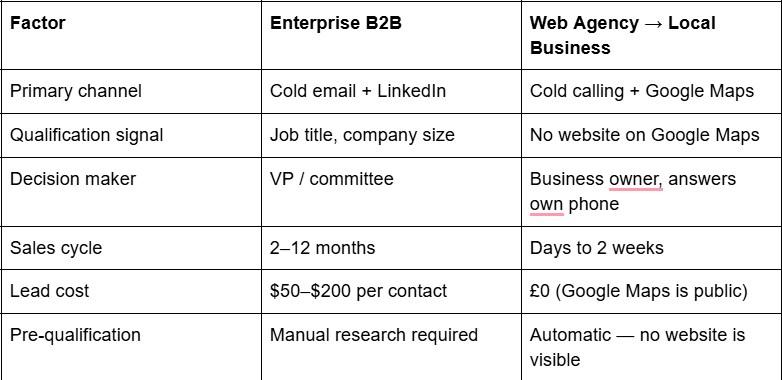
Understanding this table is not just academic. It determines which tools to invest in, which channels to prioritise, and which tactics will produce clients this month versus which ones will produce nothing for six months.
The Four Channels Worth Your Attention
1. Google Maps cold outreach (primary) The highest-converting channel for web agencies. Pre-qualified leads, publicly listed phone numbers, zero data cost, and a qualification signal — no website — that's visible before you make a single call. Produces clients within days of starting.
2. Referrals from existing clients (secondary) The highest-quality leads — pre-sold by a trusted recommendation. Can't be your primary channel when starting out, but should be systematically cultivated as your client base grows. Active asking beats passive hoping every time.
3. LinkedIn outreach (secondary) Works for agencies targeting slightly larger local businesses — accountants, solicitors, consultants — who are more active on LinkedIn. Lower volume than Google Maps but useful as a supplementary channel for professional services niches.
4. SEO and content inbound (supporting) Takes 3 to 6 months to produce meaningful traffic but compounds indefinitely. Blog posts targeting web design agency keywords bring in prospects who are already searching for what you offer. Not a short-term solution, but not optional either.
Your allocation at this stage should be roughly: 70 percent of acquisition effort on Google Maps cold outreach, 20 percent on systematically asking existing clients for referrals, and 10 percent on building the SEO foundation that produces inbound leads later.
The Google Maps System — Step by Step
This is where clients actually come from. Everything else is supporting infrastructure.
Step 1 — Choose one niche and one city. Not "local businesses." One business category, one city. Plumbers in Manchester. Hair salons in Birmingham. The discipline of starting narrow gives you consistent talking points, relevant case studies, and a calling rhythm that compounds with every conversation.
Start with trades. No-website rates in plumbing and electrical run 60 to 70 percent.
Step 2 — Scrape Google Maps. Search your niche and city. Use the Get Map Leads Chrome extension to capture every listing directly into your pipeline — business name, phone number, address, review count, and website status — in under two minutes. No CSV. No spreadsheet. 200 to 400 leads captured while you'd still be on page three manually.
Step 3 — Apply the no-website filter. One click. Every business with no web presence surfaces instantly. Your raw list of 300 businesses becomes 120 to 200 pre-qualified prospects who demonstrably need what you're selling.
You don't need to convince them they need a website. You call with a specific, visible reason. That changes the entire conversation.
Step 4 — Sort by review count. A business with 80 recent Google reviews is active, has budget, and will pick up the phone. A business with 3 reviews from two years ago may not be. Call the top 20 percent first. That's where 80 percent of closes come from.
Step 5 — Call, log, follow up. After every call, log the outcome in one tap. Set every callback with a specific date and time. Send the AI audit before every callback. Most closes happen on the second or third contact — the follow-up system is where your pipeline converts.
Building a Referral System That Runs Itself
Most web agencies treat referrals as passive. They do good work, hope the client mentions them to someone, and occasionally receive an enquiry months later. That's not a referral system — that's luck.
Three components make it systematic:
Ask at the right moment. Immediately after a client expresses satisfaction — when they first see the finished site, or when they tell you their own customers have commented on it. Their enthusiasm is at its peak. Ask directly: "I'm really glad you're happy with it. Do you know any other [business type] owners who might benefit from the same thing?"
Make the referral easy. Don't ask them to "spread the word." Give them a short paragraph they can paste into a WhatsApp message, your portfolio link, your phone number. Less friction means it actually happens.
Follow up on every referral within 24 hours. A referred name that sits uncontacted for a week loses most of its warmth. Call the same day when possible.
The Channel Hierarchy Is Simple
Google Maps cold outreach gets you clients this week. Referrals get you clients this month. SEO gets you clients in six months and then keeps going. Run all three, weighted toward outreach at the start, and you'll have a lead generation system that doesn't require you to figure out a new approach every quarter.
Get Map Leads is a Google Maps lead scraper and CRM built specifically for web development agencies doing cold outreach to local businesses. Start your free trial →

