Why Farming in India Is Slowly Shifting From Manual Work to Data-Driven Decisions
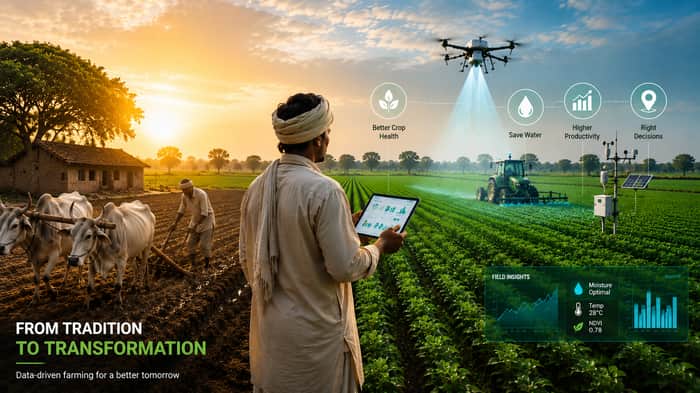
For generations, farming in India has relied on experience.
You observe the soil.
You read the weather.
You make decisions based on patterns you’ve seen over time.
And while that works, there’s always been a limitation:
You can only act on what you can see.
But farming is full of invisible factors:
- soil nutrient changes
- moisture variations
- early crop stress
- shifting weather patterns
This is where digital agriculture is starting to change things.
Not by replacing farmers—but by giving them better visibility and better control.
1. The Shift From Guesswork to Data
Traditional farming often depends on estimation.
- When to irrigate
- How much fertilizer to apply
- When a crop might face stress
But these decisions are often made after signs appear.
Digital agriculture changes this by introducing:
- sensors
- satellite data
- mobile-based insights
- real-time monitoring
Now, instead of guessing, farmers can act on actual data.
That’s a major shift—from reactive to informed decision-making.
2. Small Improvements Create Big Impact
One interesting thing about digital agriculture is that it doesn’t require massive changes.
Even small improvements can make a difference:
- better irrigation timing
- early pest detection
- optimized input use
These small adjustments add up.
Over time, they lead to:
- higher efficiency
- reduced waste
- better crop health
It’s not about doing more—it’s about doing things more precisely.
3. It Helps Manage Risk in an Uncertain Environment
Farming in India is becoming more unpredictable:
- irregular rainfall
- changing climate patterns
- rising input costs
Digital tools help reduce this uncertainty.
For example:
- weather forecasts improve planning
- soil data helps prevent overuse of inputs
- monitoring tools detect issues early
You can’t eliminate risk completely.
But you can reduce how often you’re caught off guard.
4. It Makes Resource Use More Efficient
One of the biggest challenges today is resource management.
- Water is limited
- Soil quality is declining
- Inputs are becoming expensive
Digital agriculture helps optimize all of these.
Instead of:
- over-irrigating
- over-fertilizing
- applying broad solutions
Farmers can:
- target specific areas
- apply exact quantities
- reduce unnecessary use
That improves both cost efficiency and sustainability.
5. Adoption Is Slow—But Direction Is Clear
Let’s be honest—digital agriculture is not everywhere yet.
There are challenges:
- cost of technology
- lack of awareness
- access to tools
- training requirements
But despite that, the direction is clear.
More farmers are slowly adopting:
- mobile-based advisory platforms
- precision farming tools
- digital marketplaces
And as these tools become more accessible, adoption will increase.
What Changed for Me
Understanding digital agriculture changed how I approach decisions:
- I started valuing data alongside experience
- I focused more on precision than effort
- I looked at farming as a system that can be optimized
- I became more proactive instead of reactive
It didn’t replace traditional knowledge—it strengthened it.
Farming in India is at a transition point.
Not because traditional methods are failing—but because new tools are making them better.
Digital agriculture is not about turning farms into tech companies.
It’s about giving farmers:
- better information
- better control
- better outcomes
And in a field where uncertainty is high, even small improvements in clarity can make a big difference.
If you want a deeper understanding of digital agriculture in India, its benefits, and how it is transforming farming practices, I’ve explained it in detail here:
Benefits of Digital Agriculture in India
This will give you both the concept and practical insights for real-world application.
