Why I Believe Most SaaS Free Plans Eventually Become a Monetization Problem
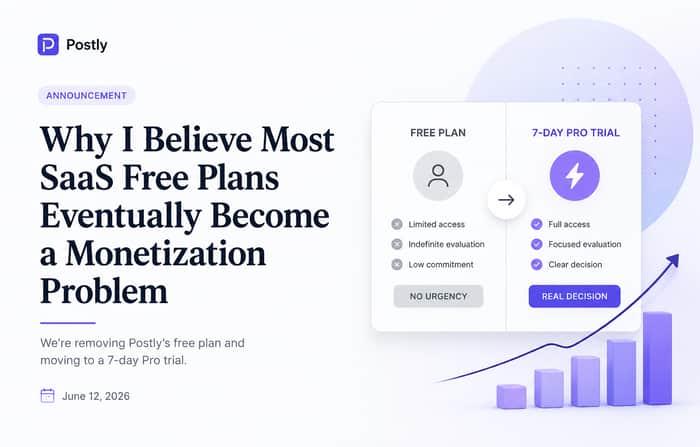
A free plan tells users that they can continue evaluating for as long as they want. A free trial communicates that they have a defined period in which to determine whether the product deserves a place in their workflow. One model optimizes for access. The other optimizes for decision-making.
Please continue reading: https://growthdiary.co/why-i-believe-most-saas-free-plans-eventually-become-a-monetization-problem/

No user will actually pay for what didn't work for them
"Free until the product actually delivers the thing you're buying it for" is a really clean way to put it. Hadn't thought about the trial clock creating anxiety instead of clarity, but that tracks.
Interesting perspective.I'm currently building an AI SaaS and still deciding between a free plan and a limited free trial.
Looking back, was there a specific metric or user behavior that convinced you the free plan was hurting growth rather than helping it?
This is something I'm thinking about early with AiCleanerText (a free text-cleaning tool I recently launched). Right now there's no monetization at all, partly because I built it to learn, and partly because adding paywalls felt premature before I even know if people find it useful.
But I can already see the tension you're describing. if it gets traction, do I gate features, add ads, or try a "pro" tier for power users? Each option changes the product's positioning.
Curious how you think about timing this. Is it better to bake monetization in from day one (even if minimal), or wait until you have real usage data to know what's actually worth paying for?
The delayed-value point is exactly my situation. I run a monitoring product, and its whole job is to catch the 2am incident that might not happen during a 14-day trial, so a trial clock undersells it. I landed on one month free with no card instead of a free plan, because a free tier on a monitoring tool can be worse than nothing. People connect it, see no alerts because nothing broke that week, and decide it doesn't work. The threshold model you describe is cleaner, but it's hard when the "aha" is an incident you're hoping never comes. My fix is to show value passively even when nothing's wrong: a nightly report that proves it was watching. Otherwise silence reads as the product doing nothing.
The third case worth naming: when the product's core value is immediate and narrow.
If someone can understand what they got within 5 minutes of use, a trial clock adds friction without adding clarity. And a free plan just trains users to live on the forever tier.
What I've seen work for tools that are single-purpose and low-cost: skip the trial entirely. Price low enough that the decision is cheap, and add a real refund policy instead. The buyer who is genuinely on the fence is not the same buyer who needs 30 days to know.
The free plan vs. free trial framing assumes the product takes time to prove. For some products, the friction is not time. It is willingness to pay at all. Those need a different conversation.
The framing of "free plan vs. free trial" sometimes misses a third option that works well for tools where the value is inherently delayed.
Some products can't demonstrate their core value inside a 7 or 14-day window because the outcome depends on something the user doesn't fully control. Think analytics that need a month of data, or marketplace tools that need a partner to show up first. For those, a trial clock just creates anxiety without creating clarity.
What I've seen work in that situation: charge nothing until the user hits a specific value threshold. Not "free forever with limits," but "free until the product actually delivers the thing you're buying it for." The user self-selects into paying because they've already received the outcome, and the conversion conversation is trivially easy. You never have to convince anyone the product works because they already proved it to themselves.
The risk is obvious. Some users take months to reach the threshold, and you're carrying their infrastructure cost until then. But if your unit economics can survive that, you end up with almost zero involuntary churn and a customer who feels no resentment about the price.
The question Paul raises about "access vs. decision-making" is the right frame, though. If your product can prove itself in a week, a trial is strictly better. The threshold model only makes sense when the aha moment is outside the founder's control.
This is something I'm actively wrestling with right now. Just launched a SaaS with a free plan and the argument here makes sense — free plan users have no urgency to decide anything.
But for my use case (Shopify analytics), the free plan serves a different purpose — merchants need to see real data from their actual store before they trust the product enough to pay. A 7-day trial might not be enough time to see meaningful patterns.
Wondering if the right answer depends on how quickly users can reach their "aha moment." If it's fast, trial works. If it takes weeks of real usage, free plan might be necessary.
I think a good pattern for you to employ is to either have a slightly longer trial like 14 days, and/or have an automated flow that allows the user to request a number of extensions of the trial while they evaluate. In both cases you can still capture a credit card and a potential customer with intent to buy,while still giving them the extra time to evaluate your product. That's far less likely to cost as much to maintain as a free tier is.
One thing I'd be careful with:
The interesting question may not be whether free plans or free trials monetize better.
It may be what behavior the product is actually trying to create before a user pays.
Those can look like the same decision on the surface, but they often lead founders in very different directions.