Why I built a SaaS for online front-end projects that need more than a playground
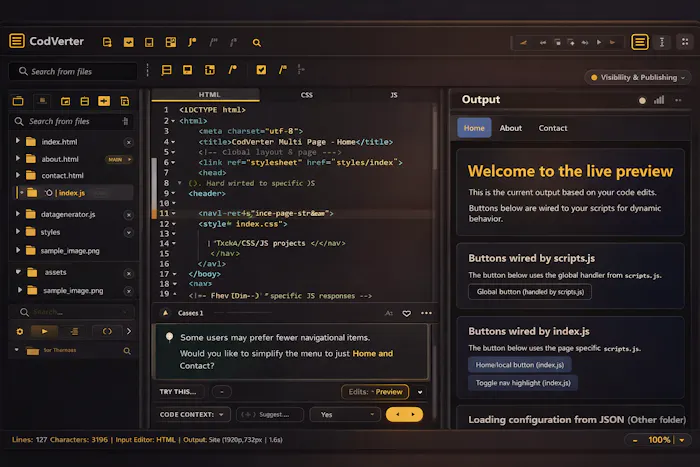
I kept running into the same gap with AI coding tools.
They are great at generating a first result, but much weaker once an online HTML, CSS and JavaScript project starts getting bigger, more iterative, and less like a quick demo.
That is what pushed me to build CodVerter.
A lot of existing tools are still great for snippets, experiments, and fast prototypes. But once you want to keep building, the workflow often starts to break down.
You generate in one place, edit in another, preview somewhere else, and then try to keep context, structure, and trust intact across repeated AI edits.
That gets worse once the project becomes multi-file or multi-page.
The problem I kept feeling was not "can AI generate code?"
It was "can this workflow actually help me continue the project once it stops being simple?"
For me, a strong AI-assisted front-end workflow needs a few things together:
- real HTML, CSS and JavaScript editing
- visible and editable code
- project structure that can grow beyond one file
- preview close to the code
- AI that helps with ongoing edits, not just first-pass generation
- enough control that the result does not turn into a black box
I also kept feeling that pricing was off in a lot of tools.
Not everyone wants another monthly subscription just to use strong models. Sometimes usage is sporadic, or concentrated around one project or one intense week. That is a big reason I wanted prepaid access to exist alongside the workflow.
So CodVerter is my attempt to build around that gap: an AI-powered online workspace for HTML, CSS and JavaScript projects that need more than a playground.
If anyone wants to see what I mean, here is the landing page: CodVerter
Still early, still learning, but this is the core problem I am building around.
Curious whether others here have felt the same shift:
AI generation is getting easier, but continuation, control, and trust still feel much harder than they should.

The gap between CodePen/Stackblitz and a full dev environment is real. What's the key differentiator you're seeing in user feedback — is it the persistence, the collaboration features, or something else entirely?
Still early, so I do not want to overstate the feedback.
My current sense is that the differentiator is not one single feature like persistence or collaboration by itself. It is the continuity of the workflow: project structure, code, preview, and AI editing all staying connected as the project grows.
That is the gap I kept running into with other browser-based tools. I think in a few more weeks I will be able to answer that with a lot more confidence.
Strong insight — most AI tools die after the first output.
But the real challenge isn’t generation, it’s whether people trust the tool enough to stay inside it as complexity grows.
Curious — are users actually continuing projects in CodVerter, or still defaulting back to their usual stack?
I think that is exactly the real test.
It is still early and traffic is still low, so I do not want to overstate anything. But I have already seen a few strong projects built over multiple days, which is encouraging because that continuation behavior is exactly what I care about most.
That’s a strong signal already — multi-day usage is where most tools break.
One thing I’ve seen: once projects cross a certain complexity, people don’t leave because of features — they leave when they stop trusting the output or structure.
Curious if you’re seeing that, or if the drop-off is happening earlier in the flow?
I think trust is a huge part of it.
It is still early on my side, so I do not have enough signal yet to say exactly where the drop-off happens. My current feeling is that the bigger risk is exactly what you described: once complexity grows, trust in the output and structure matters more than raw features.
That is a big part of what I am trying to solve. Good question.
Yeah, that’s exactly the layer most tools miss — trust compounds as projects grow.
Out of curiosity — are you planning to keep this under “CodVerter” long-term, or still flexible on branding as it evolves?
It will stay CodVerter.
At this point it feels like the right long-term name for the product and the direction I want to take it.
Got it — makes sense. It aligns well with the direction you're taking.
The transition from "AI generation" to "AI continuation" is where most projects fail, Jonathan. Solving the friction of multi-file structures and iterative edits is exactly what’s needed to move AI-assisted dev work from a gimmick to a professional workflow.
I’m currently running a project (Tokyo Lore) that focuses on high-quality business ideas just like CodVerter. Since you're tackling the gap in AI coding workflows, testing your "continuation over generation" logic in a competitive environment could be a perfect way to demonstrate your project's depth.
Quick question — have you ever had an AI workflow that slowly becomes inconsistent over time, even when nothing obvious changed?
I’ve been seeing that pattern a lot.
Working on something that stabilizes that kind of drift underneath systems — not replacing anything, just keeping behavior consistent.
Curious if that’s something you’ve run into.
I think that is exactly the transition point too.
Getting a first result is no longer the hard part. Keeping momentum once the project becomes multi-file, iterative, and harder to trust is where things start to break.
That is the gap I kept running into, and a big part of why I started building around continuation instead of just generation.
Tokyo Lore sounds interesting, what are you building there?
Thanks Jonathan! Spot on — the real gap is moving from “AI generation” to “AI continuation” once you hit multi-file, iterative edits.
Quick overview of Tokyo Lore: It’s a paid ideas competition where people submit Tokyo-connected business or creative ideas. For $19 you get a custom AI-generated artifact of your idea + a full SPEAR business analysis, plus entry into the round where the winner gets a real trip to Tokyo (flights + hotel booked by us).
Prize pool has started building with the first entries — so your odds are excellent right now while it’s still very early.
CodVerter-style AI coding workflow sounds like a perfect Tokyo-connected submission. Would you be interested in entering an idea? Happy to send you the direct $19 link and walk you through the whole process (takes under 2 minutes).
What do you think?
Appreciate it, and Tokyo Lore sounds like a creative concept.
I’m pretty focused on CodVerter at the moment, so I’ll pass for now, but thanks for taking the time to explain it.
Thanks Jonathan! Totally understand — building CodVerter is a strong focus right now.
Appreciate you taking the time to check out Tokyo Lore.
If anything changes or you want to test a Tokyo-connected idea later, the door is always open.
Wishing you huge success with CodVerter!
Can this workflow help me continue the project once it stops being simple?” is the right question. Most AI coding tools are optimized for the first 5 minutes, not the next 5 hours. The prepaid model and the multi-file focus are both smart choices for the solo builder audience. Curious to see usage numbers in a few weeks.
I think that is exactly the gap too.
A lot of tools feel optimized for the first few minutes, but the harder part is what happens once the project becomes multi-file, iterative, and easier to break.
And yes, the prepaid model came from the same thinking. A lot of solo builders do not want another monthly subscription for bursty usage.
If it is genuinely interesting to you, I would be happy to share a more concrete update in a few weeks once I have better usage data.
The multi-file gap is real. Most playgrounds treat every session like a demo, so the AI loses the shape of what the project is becoming by turn 15 or so, and you end up re-pasting entire files into the prompt just to get it un-stuck. That is where the actual wasted time lives.
The prepaid pricing angle is smart for the sporadic-use case. Monthly subscriptions punish the person who wants to hit the tool hard for a week and then step away for a month. If you can keep the UX snappy on the first tokens after a cold start, the prepaid audience is probably larger than a lot of SaaS tools realize.
Exactly.
That “by turn 15 the project shape is gone” problem is a big part of the pain. Once people start re-pasting files just to restore context, the workflow is already breaking down.
A lot of the work has really been around how to pass the model the right code slices, file references, and project structure at the right moment.
And yes, I think the sporadic-use case is underestimated. A lot of people do not want another monthly subscription just to have one intense week of building when they actually need it.
Quick question — have you ever had an AI workflow that slowly becomes inconsistent over time, even when nothing obvious changed?
I’ve been seeing that pattern a lot.
Working on something that stabilizes that kind of drift underneath systems — not replacing anything, just keeping behavior consistent.
Curious if that’s something you’ve run into.