Why I Ditched My $0.50/M Claude API Stack for the "Distillation King" Qwen (And Saved My Micro-SaaS)
Hey hackers, quick reality check.
If you’ve been following the AI space this week, your feed is probably blowing up with two types of news:
- The Drama:Anthropic just dragged Alibaba’s Qwen to the US Senate, accusing them of running a massive "Claude distillation campaign" using 25,000 fake accounts.
- The Tech:Simultaneously, Qwen just dropped Qwen-AgentWorld and Qwen 3.7 Plus on serverless platforms, specifically optimized for heavy-duty agent loops, long-cached context, and complex tool calls.
As an engineer, I don’t care about the political soap opera. But as a solo founder running a bootstrapped AI tool with tight margins, this news sent a very clear signal: The performance gap between Western frontier models and Chinese open-source/API models has officially vanished, but the price gap is wider than ever.
If you are still hardcoding anthropic/claude-3.5-sonnet or openai/gpt-4o into your production env without a fallback strategy, you are leaving thousands of dollars on the table—and risking a sudden ban if international AI sanctions tighten further this month.
Here is how I re-architected my stack to survive 2026, and why you need a "China-Model Gateway" in your workflow right now.
The 2026 Dilemma: "Vibe Coding" is Cheap, but Agent Loops are Drunk on Tokens
A month ago, I launched a micro-SaaS that automates lead enrichment using autonomous agent loops. In the era of "Vibe Coding," building the app took me less than a weekend using Cursor.
But then came the bill.
True AI agents don't just chat; they look at screenshots, evaluate code, write to terminals, and repeat the loop 50 times per task. A single user request can easily trigger 1,000+ agent calls and burn millions of tokens in cached reasoning.
Using Claude 3.5 Sonnet:My API costs ate up 70% of my subscription revenue. One heavy user could literally make my MRR (Monthly Recurring Revenue) go negative.
The Qwen Alternative:With Qwen 3.7 Plus live on serverless at a fraction of the cost ($0.50/1M input vs Western alternatives), switching was a no-brainer. Plus, let's be honest—if Qwen really did distill 29 million exchanges from Claude as the news alleges, it explains why its agentic reasoning feels identical to Sonnet for coding tasks.
But as a developer based outside of mainland China, trying to natively integrate Chinese frontier models (like Qwen, DeepSeek, or Moonshot) comes with its own set of nightmares:
KYC & Payment Walls: Good luck binding a standard Stripe-supported credit card to domestic Chinese cloud providers.
Compliance & Latency:** Routing traffic across the Great Firewall directly often results in random timeouts, high TTFT (Time to First Token), and potential compliance red flags for Western enterprise users.
Enter PandasRouter: The Missing Bridge for Global Hackers
I spent three days trying to solve this routing mess before a friend dropped a link to PandasRouter.
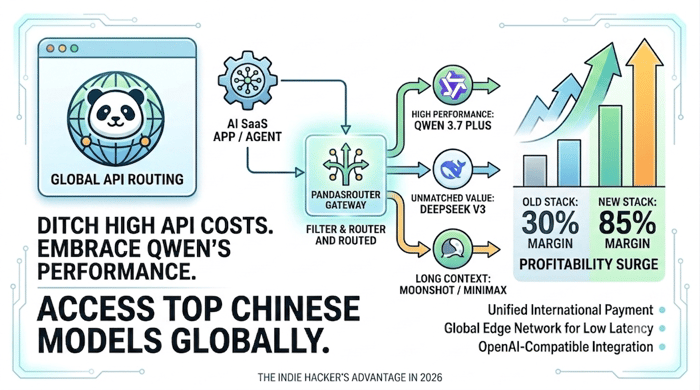
Think of it as the ultimate smart-routing proxy specifically built to help Chinese models go global . It acts as an international middleman that aggregate all top-tier Chinese LLMs into a single, global-compliant, OpenAI-compatible API.
[Your Agent App]
       │ (Standard OpenAI SDK / One API Key)
       ▼
[PandasRouter Global Edge Nodes]
       │
       ├─► Qwen 3.7 Plus (For complex agent reasoning)
       ├─► DeepSeek V3 (For dirt-cheap bulk processing)
       └─► Moonshot / MiniMax (For long-context translation)
Here is why it became the core infrastructure for my SaaS:
- Seamless Global Payments (No Chinese Bank Cards Needed)
You don't need a domestic identity card or corporate license to access China's best models. PandasRouter lets you top up using international payment methods (Stripe, Crypto, Global Credit Cards) and gives you a unified credit balance across all integrated models.
- Zero-Code Migration (
OpenAI-Compatible)
I didn't have to rewrite my LangChain or Cursor setup. I literally just changed two lines in my .env file:
# BEFORE: OPENAI_API_BASE="https://api.openai.com/v1"
# AFTER:
OPENAI_API_BASE="https://api.pandasrouter.com/v1"
OPENAI_API_KEY="pb-live-xxxxxxxxxxxxxx"
- Edge Routing & Privacy Compliance
PandasRouter handles the cross-border networking optimization. They route requests through global edge nodes, ensuring my server in US-East gets low-latency responses without worrying about direct IP blocks or regional network fluctuations.
The ROI: From 70% Burn to 80% Profit Margin
By migrating my background agent workflows to Qwen 3.7 Plus and DeepSeek via PandasRouter, while keeping a Western model purely as an optional frontend fallback, my unit economics flipped overnight:
| Metric | Old Stack (Pure Western API) | New Stack (PandasRouter / Qwen Mix) |
| --- | --- | --- |
| Cost per 1M Agent Tokens | ~$3.00 - $15.00 | $0.14 - $0.50 |
| Avg. Cost per User Run | $0.42 | $0.05 |
| SaaS Gross Margin| 30% |85% |
Stop Relying on a Single Monopolistic API
The biggest lesson of June 2026 is that AI infrastructure is now geopolitics. Relying 100% on a single US provider is a single point of failure for your business.
The smartest indie hackers right now are building hybrid, model-agnostic architectures. Use Western models where you absolutely need their specific compliance badges, but route your heavy backend logic, data parsing, and autonomous agent loops through optimized platforms like Qwen via an international gateway.
If you want to rescue your margins and play with the most powerful open-weight architectures without the cross-border headache, check out PandasRouter. It took me 5 minutes to set up, and it saved my startup's runway.
Have you experimented with Qwen 3.7 or other non-Western models for your agent workflows yet? Let’s talk about your stack benchmarks in the comments.
Disclaimer: Just a happy indie hacker sharing what works. No affiliation, just love for tools that keep bootstrapping alive in 2026.

The geopolitics angle is crucial and something most AI builders haven't fully internalized yet. The margin compression from Claude pricing is real, but what you've highlighted about vendor lock-in as a fundamental business risk is even more valuable. The PandasRouter approach of model-agnostic architecture feels like it'll become the new standard.
Thank you for your professional comments.