Why I launched an AI directory in 2026 despite the "market saturation" (and the pSEO strategy behind it
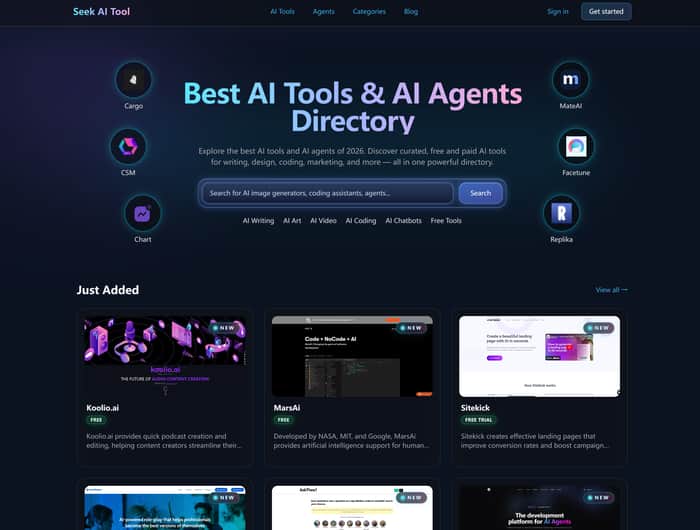
I know what you’re thinking. "Not another AI directory."
It’s true. The market is flooded with generic wrappers and "best 100 AI tools" lists that all look the same. Most are abandoned after three months because the founders realize that chasing high-volume keywords like "AI image generator" is a death trap against established giants.
But I still built SeekAI Tool. Here’s why and exactly how I’m doing it differently.
The Reality Check: Finding the Unfair Advantage
Most directories are ghost towns because they try to be everything for everyone. I'm positioning SeekAI Tool as a high-utility, clean-UI hub that focuses on execution-ready tools. No fluff, no broken links, and a heavy emphasis on tools that actually save business hours rather than just "cool toys."
The Strategy: Content-Driven Programmatic SEO
Instead of fighting for "Top AI Tools," I’m betting on Intent-Based Long-Tail clusters.
Here is my current workflow:
Automated Intelligence: I don't just scrape names. I use a custom script to analyze a tool’s pricing, API availability, and user reviews.
Dynamic Comparison Engine: My backend automatically generates "Tool A vs Tool B" pages based on the features extracted. This captures users who are at the very end of the decision funnel.
Semantic Tagging: Rather than generic categories like "Marketing," I use AI to tag tools by "Pain Point" (e.g., "reduce churn with AI" or "automate cold outreach without getting banned").
Transparency: The Starting Line
I'm keeping it 100% real. This site is brand new. I’m not going to claim 50k MRR or 100k UVs. We are at Day 0.
Build Time: 14 days (focusing on the CMS structure and SEO logic).
Tech Stack: Next.js, Tailwind CSS, and a proprietary Python script for data processing.
Current Focus: Indexing quality over quantity. I’d rather have 100 deeply categorized tools than 5,000 dead links.
Server Costs: ~$20/month (Vercel + Database).
The Goal
The goal of SeekAI Tool is to become the "decision layer" for AI adoption. I want a user to come in with a problem and leave with a specific tool and a workflow, not just a list.
The Ask: I need your "brutal" feedback
Indie Hackers, I need your eyes on this:
The UI/UX: Does the landing page feel trustworthy? Does it look like a tool you'd actually bookmark?
Monetization: For a fresh directory, do you think it's better to focus on Sponsorships (featured spots) or Deep Affiliate Partnerships that offer exclusive discounts to our users?
The "Hook": What is one niche category you think is currently underserved in the AI space?
Check out the site here: https://www.seekaitool.com/
I'm in the comments. Roasts are welcome. Successes are shared. Let's build.

I like the focus on indexing quality over publishing volume.
For a directory or tool hub, I think the risk is that many pages can look useful individually but still feel interchangeable as a site. What are you using as the threshold for deciding that a page has enough unique value to stay indexed?
The workflow angle sounds stronger than a pure list because it gives users a reason to return after the first visit.
You're solving the right problem,most directories die because they try to be everything. The execution-ready angle is solid. One thing I'd watch: pSEO gets you initial traffic, but monetization usually forces a choice. Either you gate depth behind sponsorships (kills organic velocity) or you stay lean but never charge enough to sustain growth. Have you mapped out what happens after month three when the pSEO pages are ranking but usage hasn't converted to revenue?
You nailed the core issue: most directories fail because they try to solve for breadth instead of depth. The real value isn't the directory itself, it's the decision layer you build on top of it. When we built Pick an Agency, we realized 47,000+ indexed agencies became useful only when you could filter by niche, team size, budget, and actual client reviews rather than self-reported claims. The "execution-ready" angle you mention is exactly right,people don't want to read; they want to shortlist. Your intent-based long-tail pSEO approach makes sense, but the monetization question in your ask is backwards. Don't optimize for affiliate fees or sponsorships first; optimize for which niches have the highest intent and smallest noise-to-signal ratio. The rest follows.
Love the transparency from day 0. I'm doing the same with StockMolt — launched a leaderboard for AI trading bots, keeping everything public. The "decision layer" framing for your directory is really smart btw.