Why I Stopped Trying to Be Everywhere Online
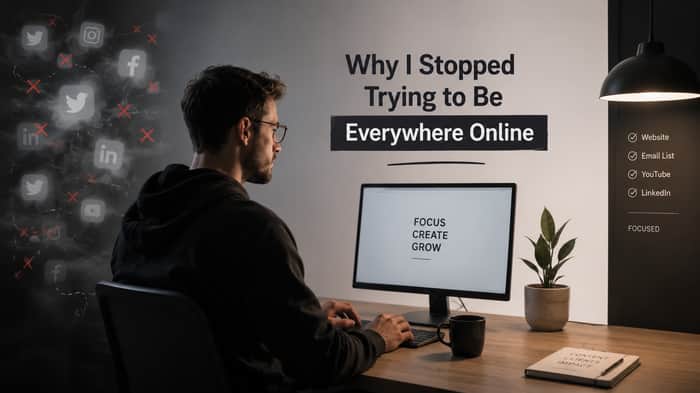
A few months ago, I had a simple goal:
Get more traffic.
Sounds reasonable, right?
The problem was how I tried to do it.
I convinced myself that growth meant being active everywhere.
So I started creating accounts on every platform I could find.
X.
Pinterest.
Reddit.
Medium.
Substack.
Mastodon.
LinkedIn.
Bluesky.
Indie Hackers.
And probably a few others I've already forgotten.
Every platform felt like an opportunity.
Every platform had success stories.
Every platform had creators posting screenshots of incredible growth.
It felt like I was missing out if I wasn't active everywhere.
So I tried to do everything.
And quickly discovered something.
Being everywhere is surprisingly exhausting.
The Productivity Illusion

At first, it felt productive.
I was:
- posting
- scheduling
- researching
- commenting
- testing
Every day felt busy.
But busy and productive are not the same thing.
When I looked at the actual results, I noticed something:
Most of my time was going into maintaining platforms.
Very little was going into building assets.
That realization bothered me.
Because I wasn't trying to become a full-time social media manager.
I was trying to build a business.
The Hidden Cost of Too Many Platforms
The obvious cost is time.
The less obvious cost is attention.
Every platform has:
- different audiences
- different content formats
- different expectations
Switching between them constantly creates mental friction.
One hour you're writing an article.
The next you're creating short-form content.
Then replying to comments.
Then researching trends.
Then checking analytics.
The work becomes fragmented.
What Changed My Thinking

At some point I asked myself a simple question:
If I could only keep one traffic source, which one would I choose?
That question forced me to think differently.
Instead of chasing every opportunity, I started evaluating platforms based on:
- sustainability
- long-term value
- compounding effects
The answer became much clearer.
The Difference Between Traffic and Assets
This was probably my biggest realization.
Some activities create traffic.
Other activities create assets.
An article can bring visitors months later.
An email subscriber can stay with you for years.
A social post often disappears within days.
That doesn't mean social platforms are useless.
But it changed how I prioritize my time.
Now I think more about what continues working after I log off.
Fewer Channels, Better Work
Once I stopped trying to be everywhere, something unexpected happened.
My content quality improved, and in turn, my new blog, Freqwebs, exploded. I have the same approach for my first blog, which already had a million views.
.webp)
.jpg)
Because instead of spreading attention across ten different places, I could focus on creating better work.
I had more time for:
- writing
- SEO
- improving articles
- testing ideas
Ironically, doing less started producing better results.
What I'm Focusing On Now
My approach today is much simpler.
I still experiment.
I still test platforms.
But I don't feel pressure to master everything.
Instead, I focus on a small number of channels that fit my strengths.
For me, that means prioritizing assets first and distribution second.
Not the other way around.
The Lesson
The internet constantly rewards novelty.
There's always a new platform.
A new algorithm.
A new growth strategy.
A new opportunity.
But I've learned that growth often comes from going deeper, not wider.
Doing more of what already works.
Building systems you can sustain.
Showing up consistently.
And accepting that you don't need to win on every platform.
Just a few.
I'm still experimenting, and I'm sure my approach will continue evolving.
But right now, focusing on fewer channels has made building online feel a lot more enjoyable.
And honestly, a lot more sustainable.
I also share the SEO, AI, affiliate marketing, and content-growth experiments I'm running on Freqwebs for anyone interested in following the journey and seeing what's working in real time.

This is the right shift.
Most founders treat distribution like platform coverage, but the real leverage is channel fit. If the business grows from search, articles, and compounding assets, then being “active everywhere” can quietly become a tax on the thing that actually works.
The useful question is not “where else should I post?” It is “which channel creates an asset I can keep improving?”
For Freqwebs, the strongest move might be turning the winning SEO/content patterns into a repeatable system: topic selection, article structure, internal linking, update cadence, and one or two distribution loops that feed the asset instead of distracting from it.
That is much more defensible than trying to win every platform at once.
Well said. I spent months optimizing for platform coverage instead of asset creation. Focusing on SEO and compounding content has been a much better use of time...
Exactly. If SEO/content is already showing signs of working, the next step is probably turning it into a repeatable system instead of spreading attention across more channels.
Drop your email and I’ll send over a tighter version. I’d map the content system, topic selection, update cadence, and the one or two distribution loops that actually support search.