Why Modular European Kitchens Outperform Traditional Kitchens in the UAE
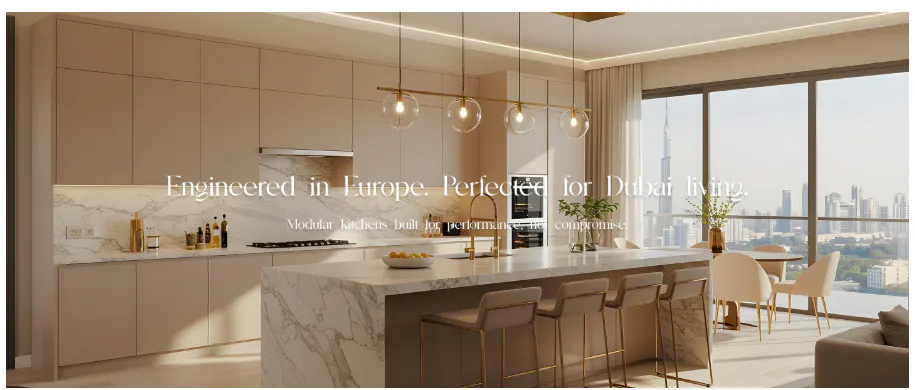
Have you ever wondered why some kitchens feel effortlessly refined while others simply feel built?
In Dubai’s most distinguished homes, the difference is rarely accidental. It is engineered.
Within the evolving landscape of Luxury Interior Design Dubai, modular European kitchens have quietly set a new benchmark, not just in aesthetics, but in precision, performance, and long-term value.
For elite homeowners in the UAE, a kitchen is not a standalone room. It is a central architectural element.
It anchors open-plan living spaces, influences property valuation, and reflects personal taste. Traditional kitchens, often fabricated through local carpentry methods, once dominated the market.
They delivered customization and decorative flexibility. But today’s luxury client expects more than visual appeal. They expect systems.
That is where modular European kitchens outperform.
Engineered Precision vs. On-Site Construction
Traditional kitchens in the UAE are typically built through on-site carpentry. While craftsmanship can be impressive, outcomes vary depending on installation conditions, environmental factors, and manual tolerances.
European modular kitchens operate differently. They are manufactured in controlled factory environments using advanced machinery, standardized tolerances, and precision engineering.
Cabinet panels are cut by CNC machines. Hardware alignment is calibrated. Load-bearing capacities are tested before installation even begins.
The result is structural consistency.
Doors align seamlessly. Drawers glide with engineered smoothness. Shadow gaps remain uniform across long elevations.
When installed in Dubai’s high-end villas or penthouses, the system performs exactly as designed, without improvisation.
Climate Compatibility in the UAE
The UAE climate is demanding. Heat, humidity fluctuations, and intensive daily usage place stress on cabinetry materials.
Traditional kitchens that rely heavily on untreated wood or lower-grade boards may expand, warp, or misalign over time.
Modular European kitchens are manufactured using moisture-resistant boards, high-pressure laminates, and climate-tested materials.
Hardware components such as hinges and runners are engineered to withstand repetitive use. These systems are built for durability, not short-term visual impact.
For elite homeowners, longevity is non-negotiable.
Design Integration in Modern Homes
Contemporary villas in Emirates Hills, Palm Jumeirah, and Dubai Hills Estate are designed with open-plan layouts.
Kitchens are no longer concealed. They are visually connected to living and dining areas.
Traditional kitchens often appear as separate furniture installations within these spaces. Modular European kitchens, however, are designed as architectural systems.
Handleless cabinetry, flush finishes, integrated appliances, and ceiling-height units create uninterrupted surfaces.
This level of integration aligns naturally with Premium Home Interiors Dubai, where design cohesion across spaces is critical.
When the kitchen mirrors the same precision as living rooms and dressing areas, the entire home feels curated.
Intelligent Storage Solutions
Luxury living demands functionality beneath elegance. Modular European kitchens excel in internal organization.
Deep drawers replace stacked cabinets. Pull-out pantry systems maximize vertical height. Hidden compartments maintain clean surfaces while increasing storage efficiency.
Traditional carpentry solutions may replicate some of these features, but they often lack the engineering sophistication that ensures durability and smooth performance over time.
In modular systems, internal fittings are not afterthoughts. They are core design components.
Seamless Appliance Integration
Today’s elite homeowners expect technology without visual clutter. Built-in ovens, steam units, warming drawers, concealed refrigeration columns, and induction systems are standard in premium homes.
Modular European kitchens are designed around these appliances from inception. Ventilation gaps, electrical channels, and structural allowances are pre-engineered. Appliances are often panelled to match cabinetry, preserving visual continuity.
Traditional kitchens may accommodate appliances, but integration is typically adapted on-site. The difference lies in foresight versus modification.
Performance Over Decoration
Traditional kitchens in the region often emphasize decorative detailing, moldings, carved shutters, ornamental hardware. While visually impressive, these details can date quickly.
European modular kitchens prioritize performance and timeless geometry. Clean lines age more gracefully. Neutral finishes allow flexibility in styling. Proportional balance replaces embellishment.
Elite consumers increasingly value discretion. Sophistication is communicated through precision, not ornament.
Installation Efficiency & Quality Control
Factory manufacturing reduces on-site construction time. Components arrive pre-finished and calibrated. Installation becomes assembly rather than fabrication.
This controlled process minimizes disruption within luxury residences. It also reduces variability.
Each module fits according to design specifications, maintaining alignment and structural integrity.
Traditional kitchens often require extended on-site carpentry, finishing, sanding, and polishing. The result depends heavily on craftsmanship consistency.
In high-value homes, predictability is preferred over uncertainty.
Sustainability & Responsible Manufacturing
Environmental awareness is rising among affluent UAE homeowners. European manufacturers often comply with strict environmental regulations, using low-emission boards and sustainable production processes.
Modular systems reduce material wastage through precision cutting and optimized factory workflows.
Traditional carpentry may generate higher material waste during fabrication.
For discerning clients, sustainability is no longer optional. It complements luxury rather than competing with it.
Long-Term Investment Perspective
While modular European kitchens may involve higher upfront investment, the long-term equation often favors them.
Structural stability, hardware durability, and timeless design enhance resale value.
A kitchen that maintains alignment, finish integrity, and smooth operation for years contributes positively to property perception.
Elite homeowners view kitchens as assets, not expenses.
The Psychological Edge of Precision
There is an understated confidence in a perfectly aligned kitchen. When drawers close silently and surfaces remain uninterrupted, the experience feels refined.
Minimalism in modular European systems reduces visual noise. It enhances spatial clarity. In a city as dynamic as Dubai, that clarity has value.
Traditional kitchens can certainly be beautiful. But beauty without engineered performance often requires compromise.
Why the Shift Is Accelerating in the UAE
Dubai’s luxury market is globally connected. Homeowners travel extensively. They experience residences in Milan, London, and Monaco. Exposure elevates expectations.
Developers in premium projects increasingly specify European modular kitchens as standard features. This reinforces market perception. What was once considered an upgrade is now baseline in high-end segments.
Elite buyers do not simply want a custom kitchen. They want a system that performs.
Why do modular European kitchens outperform traditional kitchens in the UAE?
The answer lies in engineering, durability, integration, and long-term value.
They offer:
Factory precision
Climate resilience
Seamless architectural integration
Advanced storage systems
Smart appliance compatibility
Timeless design language
For discerning homeowners in Dubai, the kitchen is not just a space for cooking. It is a reflection of discipline, sophistication, and global awareness.
In a market defined by excellence, modular European kitchens are not a trend. They are a standard.

