Why Most Email Outreach Strategies Fail (and What Actually Works in 2026)
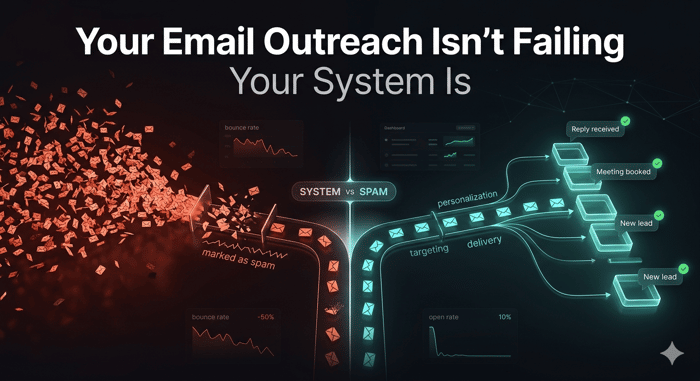
For a long time I thought my email outreach strategies were the problem, because the replies were low, conversions were inconsistent, and every campaign felt like starting from zero again, so I did what most people do, I kept rewriting emails, testing subject lines, and tweaking copy, but the more I worked on it the more it felt like I was optimizing something that wasn’t the real issue.
The uncomfortable realization was that most email outreach strategies don’t fail because of bad writing, they fail because the system behind them is broken, and that system includes targeting, data quality, deliverability, sequencing, and timing, not just the message itself.
What made this clear was looking at how top-performing campaigns actually work, because they are not blasting bigger lists or writing “perfect emails,” they are working with smaller, tighter segments, sharper targeting, and structured follow-ups, which is why some campaigns consistently hit 10–15% reply rates while most sit around 3–5%.
That gap is not about effort, it is about approach.
One pattern that shows up everywhere is that people try to scale too early, because sending more emails feels like progress, but without relevance, volume just kills performance, and this is something a lot of founders discover the hard way.
“Sending fewer emails to better people works way better than blasting cold lists.”
That single shift from volume to relevance changes everything, because now you are not trying to convince random people, you are starting conversations with people who actually have context.
Another mistake that quietly breaks email outreach strategies is ignoring deliverability, because even a great email won’t work if it never reaches the inbox, and things like bounce rates, domain setup, and list quality can quietly kill campaigns without obvious signals, which is why many teams think their messaging is failing when their emails are not even being seen.
What started working for me was thinking about email outreach as a system instead of a tactic, where each part supports the next.
Targeting became about defining a clear ideal customer profile instead of building large lists.
Data became about accuracy and validation instead of volume.
Emails became shorter, more specific, and written like a real conversation instead of a pitch.
Follow-ups became structured instead of random, because most replies actually come after the first email, not from it.
And once those pieces aligned, the results stopped feeling random.
If you’re trying to improve your email outreach strategies or build a system that actually converts instead of guessing what works, this breakdown goes deeper into the frameworks, tools, and real strategies behind it:
https://jarvisreach.io/blog/email-outreach-strategies/
What I keep coming back to is this, email outreach still works, but not in the way most people think, because it is not about sending more emails or writing better templates, it is about building a system where the right message reaches the right person at the right time, and without that, even the best strategy will feel like it is not working.
Curious how others here are approaching email outreach in 2026, especially what actually moved the needle for you. Was it targeting, messaging, or something deeper in the system?

The "targeting/data before messaging" ordering here is right, and it has a practical test I use before any send:
Can I name the trigger that put this person on my list? Hiring for a sales role, running paid ads, just raised, installed a specific tool, published something relevant. If the answer is "they matched a title filter," they're not a lead yet — they're a demographic.
Trigger-first lists are smaller (usually 200–300 instead of thousands) but they fix three things at once: reply rate (relevance), deliverability (engaged recipients train the filters in your favor), and copy (the trigger writes your first line for you).
Most "cold email doesn't work" stories are actually "no-trigger list" stories.
Sending fewer emails to better people is the whole game now. Deliverability is the silent killer — teams tweak copy for weeks when half the sends never hit primary. Seed tests weekly saved me from guessing.
Thanks for sharing this. I’m also learning how sales partnerships and appointment setting work for software/AI services, so this was helpful.
This resonates hard,the system is the bottleneck, not the email. When we built Pick an Agency's AI matching tool, we made the same mistake at first: we had 47,000 agencies indexed but no way to surface the right 5 for each buyer's actual needs. Turns out, the problem wasn't our data or our copy,it was that we were asking a buyer to do manual targeting work that should've been automated. Once we flipped that and made the system do the hard work (scoring, relevance, filtering), everything else became simpler. The lesson I'd steal for cold outreach is exactly what you said: fewer emails to better people, better system behind it, better results.
Hey Loved Reading through this personally for me i use my own site called huntivo that finds leads for me and tells me what service that business im targeting is personally missing and from that site im able to write ai personalized email and connect it to my email to be able to auto send to all those leads now im more focused on my software but when i used to run my agency this is what i would do
That’s actually a smart angle because the personalization comes from a real business gap, not just “Hi {{first_name}}” style customization.
When outreach is tied to an actual problem the lead already has, the conversation feels way more natural and relevant.