Why Most Good SaaS Products Don’t Sell (and How to Fix That)
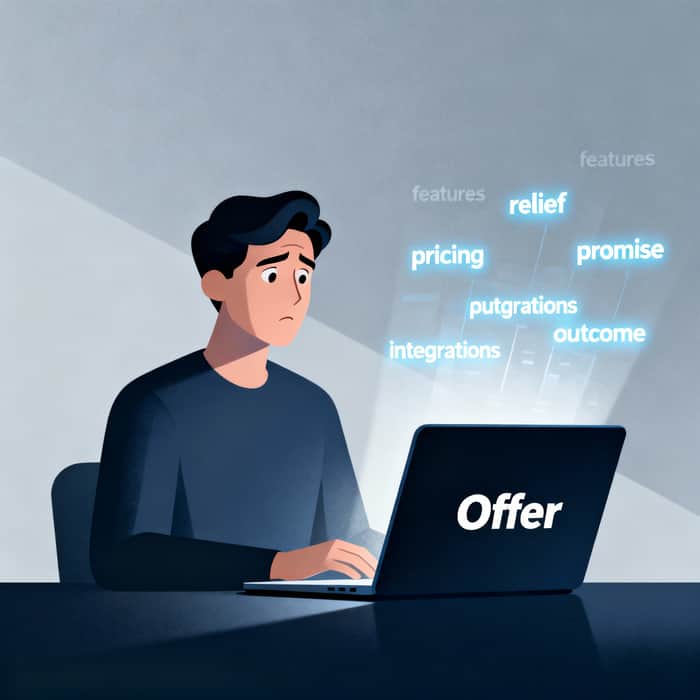
You know that gut punch:
you finally ship your SaaS after months of building… and almost nobody buys.
Not because it’s buggy.
Not because it’s overpriced.
But because your offer is invisible.
That’s the part most indie founders miss.
It’s not your product that’s off — it’s the framing.
Let me explain 👇
✅ When a Solid Product Still Fails
Diya (a founder I met last year) spent 8 months building a beautiful team tool.
Early testers loved it. Great UX. No bugs.
But once she launched publicly — nothing.
A few free trials, almost zero conversions.
The problem wasn’t the code. It was her copy.
She was describing features. Users were looking for outcomes.
And that mismatch kills good products quietly.
✅ The Feature Trap We All Fall Into
Check 10 SaaS homepages and you’ll see the same pattern:
“Boost productivity.”
“Seamless integrations.”
“Powerful dashboard.”
It all blends together.
People don’t wake up wanting dashboards.
They want less chaos.
They want more time.
They want to stop worrying.
You’re not selling features.
You’re selling relief.
✅ Turn Your Offer Into a Promise
Here’s a real example:
You’re selling a content calendar tool.
Your pricing page says:
“$49/month, 7-day free trial, cancel anytime.”
Okay. But that doesn’t make me feel anything.
Now try this:
“Never miss a deadline again. Publish 30% more consistently in your first two months — or it’s free. Includes templates + onboarding support.”
That’s an offer.
It sells a result, not a product.
✅ How to Build an Offer People Actually Want
No fancy framework. Just founder logic:
✔️ Find the right people
Pick users who feel the pain daily and can buy without endless approvals.
“Workflow tool for design agencies” > “project management for everyone.”
✔️ Make the result obvious
Show how life changes after using your product.
If setup is painful, offer done-for-you onboarding.
If learning is steep, add templates or coaching calls.
✔️ Share the risk
Offer real guarantees.
“See results in 30 days or it’s free” > “cancel anytime.”
Confidence sells faster than features.
✅ Offers That Already Prove the Point
Slack didn’t sell “chat.”
They sold fewer meetings.
Calendly didn’t sell “scheduling.”
They sold less back-and-forth.
A founder I know reframed his cybersecurity SaaS from:
“Compliance software for SMBs”
to
“Make your company unhackable in 30 days — or we pay for your next audit.”
Revenue tripled.
Same product.
Better offer.
✔️ Quick DIY Checklist
✔️ Talk to your happiest users — what changed for them?
✔️ Remove friction — setup, onboarding, doubts.
✔️ Add bonuses that get them to results faster.
✔️ Test your new pitch on 10 cold leads.
✔️ Track how it changes retention, not just signups.
Most indie founders obsess over building.
But the real leverage isn’t in what you built ➡️ it’s in how you frame it.
When your offer removes risk and promises transformation, people don’t need convincing.
They just need a link to sign up.
💬 Curious ➡️ what’s the biggest fear your users have before trying your product?
Let’s brainstorm how to turn that into part of your offer.

That’s an incredibly sharp breakdown, because you’ve nailed the shift from Feature Trap to a powerful Promise. The “unhackable in 30 days” reframe is a perfect 10/10 pivot.
The real leak isn’t vague feature copy, but rather the massive opportunity cost when a founder can’t turn that promise into a locked-in, guaranteed Revenue Per Subscriber (RPS) boost for the client.
We don’t just share risk, instead we embed a Conversion Certainty Contract into the pricing page and final closing email, making the financial outcome mathematically inevitable. That setup alone converts high-intent free trials 5X faster by removing the prospect’s need to crunch their own ROI.
Since you rightly saw that confidence sells faster than features, how are you pinpointing the one sentence that needs to go in to make the offer an irreversible financial scale for the client?
That’s a really sharp point and really like how you framed the conversion certainty contract.
completely agree, that one line can change everything. for me, it usually comes from talking to users and catching the exact phrase they use when describing what finally clicked or what problem finally went away. that’s the moment you turn reassurance into a promise that sells itself.
That’s a strong insight. You’re dead right, because the “exact phrase they use” is pure gold for building a winning promise.
The key is turning that phrase into a Conversion Certainty Contract that locks in the financial result.
So here’s the real question, are you forcing the client’s next revenue-driving action using that phrase, or are you still leaving them to connect the dots?
That gap is the Cognitive Tax, and it’s the same drag behind your $1.2k/month decision delay. The copy layer has to close the loop instantly.
Exactly.....cognitive tax compounds fast.
every unclear line adds friction....every precise phrase builds momentum.
the goal isn’t persuasion but it’s velocity.