Why Most Marketing Breaks Before It Even Starts
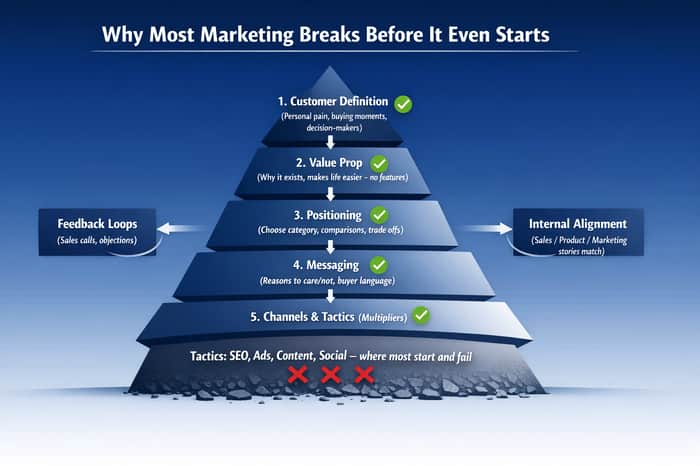
I keep seeing teams argue about tactics.
Should we do SEO or outbound?
LinkedIn or X?
Ads or content?
That argument usually means one thing:
they skipped the hard work upstream.
Marketing doesn’t fail at tactics.
It fails before tactics ever matter.
Here’s the mental model I use to diagnose where things actually break.
Step 1: Do you actually know who you’re building for?
Not a persona doc. Not “SMBs” or “startups.”
I mean:
who feels the pain personally
who is involved in the buying decision (and who isn’t)
what moment makes them start looking
If this is fuzzy, everything else becomes generic.
Most “bad messaging” is really bad customer definition.
Step 2: Can you explain why your product is valuable without selling it?
This is where value propositions usually fall apart.
Not:
feature lists
benefit stacks
clever one-liners
But a clear answer to:
“Why does this exist, and what problem does it make easier than before?”
If you can’t explain that simply, positioning won’t save you later.
Step 3: Have you chosen how you want to be compared?
This is positioning—and most teams avoid it because it forces trade-offs.
Positioning means deciding:
what category you want to live in
what alternatives you expect buyers to compare you against
what you’re not trying to win on
If you don’t choose this, the market chooses it for you. Usually poorly.
Step 4: Messaging is where most teams start (and where they get stuck)
Messaging is not strategy. It’s translation.
It turns your positioning into:
reasons someone should care
reasons someone should not
language buyers recognize as their own
If messaging feels hard, it’s often because the earlier decisions were never made.
Step 5: Only now do channels and tactics matter
Content, outbound, ads, social, newsletters—these are multipliers.
They don’t create clarity.
They amplify whatever clarity already exists.
Two teams can do the exact same thing and have totally different results.
What this model still misses (and most frameworks ignore)
Two things matter more than people admit:
-
Feedback loops
Positioning isn’t static. The market talks back. If you’re not listening—sales calls, demos, objections—you’re guessing. -
Internal alignment
If sales, product, and marketing tell different stories, no amount of consistency on the website will fix it.
The uncomfortable takeaway
If growth is stalled, the answer is rarely:
“we need better copy”
or
“we need more distribution”
It’s usually:
“We never made the hard decisions early enough.”
Marketing works best when it feels boring internally and obvious externally.
Most teams never get there because they start at the bottom and hope clarity shows up later.
It doesn’t.

Marketing breaks before it starts because the foundation it needs - a clear ICP, a tight value prop, a working delivery system - usually isn't in place yet. So the marketing just amplifies the confusion.
The solo founder version of this: you start posting on LinkedIn, building a newsletter, doing cold outreach - and none of it converts because you don't actually know who you're for or what they care about. The message is vague because the model is vague.
What fixes it isn't more marketing - it's getting ruthlessly specific about one person with one problem, and confirming it with evidence before any channel work begins. Workaround-first validation: who's already patching this problem manually, and what are they using instead?
Once that's clear, the ops layer matters too. A CRM that tracks which messages and channels convert. A decisions log that captures what you tested and what happened. Weekly reviews that close the loop. Marketing without that feedback infrastructure just burns cycles.
Building all of this into a Solopreneur OS: the system that makes marketing accountable before it scales.
Where does marketing typically break for you - positioning, wrong channel, or something earlier in the ICP definition?
Marketing breaks before it starts because the foundation isn't there. Most solopreneurs launch a campaign before they've answered: who exactly is the customer, what do I know about them, what did I try before and why did it stop, what's my current revenue baseline?
Without a system where those answers live, every marketing effort restarts from zero. You can't iterate on something you can't reference.
I've been building a Notion OS for solopreneurs (CRM, projects, decisions, revenue, client portal, weekly review) because the ops layer is what marketing scales from. It's usually not a marketing problem - it's a foundations problem.
What's the breakdown point you see most often?
Cold outreach scales linearly - same effort per reply every week. It's necessary for early traction but the founders who get to $10k+ MRR almost always layer in a compounding channel underneath it. SEO, community, partnerships, or product-led growth.
What's the channel you're betting on to build independently of your outreach?
The framing here is sharp — marketing doesn't break at execution, it breaks at the foundation: unclear positioning, undefined audience, or a message that means something different to everyone. The symptom is 'our campaigns don't convert', but the root cause is ambiguity baked in upstream.
Same thing happens with AI-assisted marketing: if you prompt an LLM with vague input, you get vague copy back. The output quality is only as good as the structure you bring to the input. That's why I built flompt — a visual prompt builder that forces you to define role, audience, objective, and constraints BEFORE the AI sees your brief. It's essentially a pre-flight checklist for prompt quality, so your AI marketing output doesn't inherit the same ambiguity that breaks the strategy upstream.
A ⭐ on github.com/Nyrok/flompt would mean a lot — solo open-source founder here 🙏