Why Most Startup Product Descriptions Fail (And How to Fix Yours)
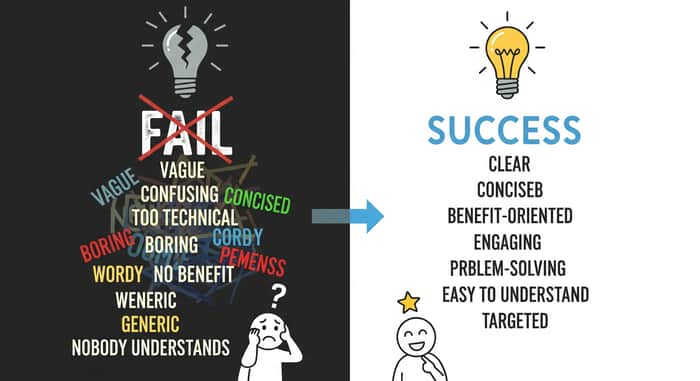
Problem:
Many founders spend hours crafting product descriptions—yet clicks and conversions remain low. Why? Most descriptions fail because they focus on features instead of benefits, use generic language, and don’t connect with the customer’s real problem.
Why It Matters:
A product description isn’t just words on a page—it shapes how customers perceive your brand. If it doesn’t capture attention quickly, potential buyers move on, often before giving your product a real chance.
How to Fix It:
Here’s a framework you can start using immediately:
-
Focus on the customer’s problem: Don’t just describe the product—show how it solves a real pain point.
-
Highlight benefits, not features: Customers care about results. Make it clear what they gain.
-
Use clear, persuasive language: Keep sentences short, impactful, and memorable.
Even small changes can dramatically improve engagement and conversions.
If you’re struggling with your product copy or need help crafting emails, brand names, or slogans that stick, Quratulain Creatives can help turn your words into revenue. Let’s make your startup shine—one sentence at a time.
💡 Founders — want to see these frameworks applied directly to your startup?
I run Quratulain Creatives, where we help early-stage teams turn confusing product copy into clear, conversion-ready messaging.
👉 If you’re curious, I’m offering one free consultation to founders from this thread. We’ll review your landing or emails and give you 3 actionable fixes you can test right away.
For those ready to go deeper, we also provide done-for-you product descriptions, email sequences, and tagline packages that sharpen your messaging and drive real results.
📩 Just reply here or drop me a quick note at quratulaincreatives@gmail.com — happy to help you turn attention into traction.

Nice article. I have been making this mistake. Thanks for the post and replies to post are valuable too.
Really well said. I’ve noticed firsthand how easy it is for founders to focus on what the product does instead of what it solves. I have now started demoing my product and I have reframed the pitch around the audiences' problem — not the features.
This is spot on 💯 most founders underestimate how much clarity and automation affect conversions.
As someone who helps businesses build GoHighLevel systems that turn interest into action, I can confirm: when your copy aligns with automation, results multiply.
Brilliant insights appreciate you sharing this.
Wow, this hits close to home! It’s like you’re talking directly about me. I really benefited a lot from your analysis and solutions. Moving forward, I’ll put these principles into practice to polish my product descriptions. Great share—much appreciated!
Badass: Making Users Awesome - Book by Kathy Sierra
This really changed my way of how I do product descriptions now.
Make THEM the heroes. Not your product.
Most startup product descriptions fail because they focus too much on features and technical jargon rather than addressing the real problems their customers face. Instead of highlighting how the product improves the user’s life or solves a pain point, many descriptions simply list what the product does. This creates a disconnect, making it hard for potential users to see the value. To fix this, founders should shift their messaging toward clear, benefit-driven language that speaks directly to the customer’s needs. Testing descriptions with real users and applying the “so what?” test can help ensure the message truly resonates.
User Intention (Describe the pain points - Highlight the benefit for how to resolve the problem - Understand the why they need it - Provide the features last) - its all about intention driven focus.
Knowing which stage of the product adoption curve you are on will really help craft your copy. Different stages care about different things. (Just google Product Adoption Curve and there's lots of great examples of how companies change their copy based on which stage they are at)
Spot on 👌 The adoption curve changes everything. Early adopters want vision and novelty, while the early/late majority need proof, outcomes, and clarity. Copy that ignores this usually falls flat because it’s speaking to the wrong stage.
That’s actually something I help founders with — tailoring their messaging to where their audience really is instead of blasting one-size-fits-all copy. If you’re curious, I’d be happy to share how I’d adjust your own product messaging for its stage.
I’m putting together a free SaaS Founder’s 7-Day Growth Blueprint — a step-by-step playbook to fix your landing page leaks, get traffic in 7 days, and turn trials into paying users.
Would you want early access?
Melanie Jumaga
I appreciate you for helping the entrepreneurs.
Yes let's talk in email
Can i DM? I am helping founders with any marketing they need help with for free for now.
Love that you’re also helping businesses 🚀 What kind of work do you usually do with them? Curious to see where our worlds overlap.
I have created frameworks for SaaS company ,From SEO to CRO.basically help converting visitors to customers funnel.I decided to do for free to test the funnel for a few months before charging.
Wow, that’s impressive, Melanie 👏 It’s awesome to see someone experimenting with funnels and testing real results—so many founders skip that step!
So many SaaS companies not able to survive after 2-3 years if no users.
You need to polish your social media profiles and give value to earn trust and to look like a reputable company,if you need my help email me I can give you one free suggestion,after seeing your links
It depends on who your target is, though. You need to have solid skills to be able to have people trust you. Havea great profile , but a lack of skills won't do anything. My business is B2B, so I mainly focus on LinkedIn. Thats why i am here to help SaaS companies get gain sign up through landing page, SEO and CRO.
You won't be taken here seriously untill you provide value in your field and look professional
Great post. I believe a lot of has to do with a lack of research and strategy adn building various touch points like websites in silos. Getting your strategy down will help you with a clear effective positioning framework and messaging based off a deep understanding of the target market.
I agree
great
Thank you
Yeah
It's great 👌
What has been your biggest roadblock to achieve success at the moment?
Great question 👌 Honestly, the biggest roadblock right now isn’t ideas — it’s visibility. We’ve seen that when founders do get the right copy (benefit-driven product descriptions, sharper emails, clearer slogans), results follow. The challenge is simply reaching more founders early enough so they don’t waste months with copy that doesn’t convert.
That’s part of why I started sharing here on Indie Hackers — to connect with people actually building and see where copy support is most needed.
What about you — what’s been the toughest part of pushing your own project forward lately?
Totally hear you visibility can be just as big a challenge as the product itself. Sharing here is a smart move, founders really need that clarity in copy. For me, the hardest part has been staying consistent while juggling multiple ideas. Curious when you first work with founders, how do you usually spot where their copy is holding them back?
I made an app that made my work easier and am trying to turn it into a pet project. How do I collect feedback?
That’s awesome 👏 Turning a personal solution into a product is how some of the best apps are born. For early feedback, I’d start small:
– Share it with 5–10 people who already feel the same pain you built it for.
– Ask them just 2 questions: “Was this easy to use?” and “What would stop you from using it again?”
You’ll get sharper insights from a handful of real users than from 100 random survey responses.
If you’d like, I can share a few frameworks I use with founders to structure early feedback and translate it into clear product messaging. Happy to send it over — what’s the best way to reach you?
What really does the app those and try to have a targeted audience.
What do you think is delaying you to achieve success at the moment?
It's hard to stand out among the large amount of information, but I understand that it is one of the best among competitors.
You’re right, standing out is tough with so much noise out there. The fact that you already see your offer as one of the best is a strong starting point. What have you found most effective so far in getting noticed?
I think every project should have something unique, something that makes it different. Convenience and simplicity
Absolutely uniqueness is what makes a project stand out, and pairing it with convenience and simplicity is a winning combo. How do you usually decide what that unique element should be for your projects?
I compare with competitors and use in practice
That makes sense benchmarking against competitors and testing in practice is a smart approach. Have you ever discovered a unique twist that worked unexpectedly well compared to what you saw in the market?
It’s like Mario Bros.
Too many people describe the flower.
But you’re not selling the flower....
you’re selling what Mario becomes after he gets it.
Customers don’t care about the product.
They care about how it transforms them.
Customer cares for the results alone.
What business do you run currently?
💯 Love that Mario analogy — it nails the point. Too many founders obsess over the flower itself, forgetting the transformation is what makes people care. Nobody buys products, they buy the “fireballs” it gives them. 👊
H
This is spot on, but it skips the most important part: Step 0.
We often treat copywriting like creative writing, but it's more like archaeology. The best copy isn't written; it's excavated from support tickets, customer reviews, and threads where your audience already lives. Your job isn't to be a novelist, but a curator of your customers' own words.
The "features vs. benefits" framework is powerful, but only after you've found the raw material.
So the real question is: are we spending more time in a text editor than we are digging through the goldmine of our user feedback?
Totally agree 👏 — Step 0 is everything. If the raw material isn’t grounded in actual customer language, even the sharpest benefit-first copy ends up sounding hollow. The best lines I’ve ever written weren’t mine at all — they came straight from user calls, reviews, or random DMs.
It’s wild how often founders sit in front of a blank doc, when their customers have already written half the copy for them. Copywriting really is more about excavating truth than inventing slogans
I totally agree with this take as a product designer I see the same mistake in UI copy all the time founders describe what the product does but forget to show how it makes the user’s life easier when design and words work together around the customer’s real problem the whole product feels more natural and conversions usually follow
So true 👌 — I’ve seen that exact same disconnect between design and words. A clean UI loses power if the copy still speaks in “what it does” instead of “why it matters.” When both design and copy are anchored in the user’s pain and transformation, the product feels effortless — and customers respond.
Super clear 👏
I’m in the middle of refining Kaelis’ copy and this reminder to lead with the customer’s problem really helps.
I also like the tip to frame the headline as “I want to ___” — keeps everything focused on what users actually need.
Thanks for sharing this framework — applying it to our landing today 🚀
🔥 Love hearing that, thank you for sharing 🙌. Refining copy is honestly one of those “small hinges swing big doors” moments — even a tiny shift to problem-first language can change how users see Kaelis instantly.
And yes, the “I want to ___” lens is such a cheat code for clarity. Excited to hear how your landing page sharpens after this — if you want, feel free to share a draft and I’ll give it a quick look. 🚀
This is such an important reminder. Too many founders fall into the trap of listing features instead of showing the transformation their product creates. Shifting the lens from what it does to why it matters is exactly what turns passive readers into paying customers. Thanks for breaking it down so clearly...
What has been your biggest roadblock to achieve success at the moment?
Exactly 🙌 — “transformation” is the keyword here. Features explain, but transformation sells. When someone reads your copy and immediately thinks “this is how my life/business will be different,” you’ve crossed the line from information to motivation.
That shift is what I try to bake into every project at Quratulain Creatives — because at the end of the day, clarity + transformation = conversions.
I really like this advice. I used to spend hours writing fancy product descriptions that sounded smart to me, but customers clearly didn’t care. What finally worked was flipping it: start with the customer’s headache, then show how my product makes that pain go away.
The trick is to keep it human. Imagine explaining it to a friend over coffee, not in a boardroom. And test everything, even the lines you think are boring. I was shocked when my “plain” copy got way more clicks than the clever stuff. Sometimes simple is what sells.
What do you think is your biggest roadblock to achieve success at the moment?
This is gold 👌. Love how you captured the exact shift — from “smart canvas” (your lens) to “save 3 hours + verified citations” (their lens). That’s the essence of benefit-first copy.
And you’re spot on about testing with real users. Copy isn’t a guessing game — customer interviews basically hand you the script. The language they use in frustration is usually the exact language that converts.
Your Catalystar example is such a great case study — proof that small wording shifts can unlock traction way faster than adding new features. 🙌
This resonates with what we learned building Catalystar. Our first product description was pure feature-speak: "AI-native smart canvas for scientific ideation." Crickets.
The breakthrough came when we talked to researchers and discovered their real pain: "I spend 3 hours jumping between tools just to write one paragraph with proper citations."
Now our description leads with the problem: "From scattered PDFs to verified drafts in 24 minutes" because time savings is what they actually care about, not our "smart canvas" tech.
One addition to your framework: test your description with actual users before launching. We thought researchers wanted "AI-powered workflows" but they really wanted "traceable citations." The language shift from our internal jargon to their actual words made all the difference.
The customer interview is often more valuable than the copywriting itself.
🙌 This is such a great example — exactly why talking to real users trumps any clever copy from inside the building. The shift from internal jargon to actual user language is the magic that turns features into benefits.
At Quratulain Creatives, we guide founders through the same process: uncovering the core pain, translating it into benefit-driven copy, and testing it with real users before launch. That way, the messaging doesn’t just sound good — it converts.
How would you talk about a huge nerdy tech product that is based on the fact the features are great enough to speak for themselves?
That’s a classic challenge! Even with tech-heavy products, the key isn’t to hide features — it’s to frame them in terms of the real-world impact. Instead of just listing “this feature does X,” lead with what it helps the user achieve or avoid.
At Quratulain Creatives, we often work with founders of complex tech products to translate “nerdy features” into clear, benefit-driven messaging that still shows off the innovation — it’s about letting the tech shine through the value it delivers.
Curious — if you had to pick one user outcome that everyone would immediately care about, what would it be? That’s usually the place to start.
As a founder, I’ve learned the hard way that writing about features almost always backfires.
I’m building a tool in the “coverage intelligence” space, and at first I described it nobody cared.
The moment I rewrote it as:
– “All your protections in one dashboard”
– “Check before trips so you don’t buy duplicate insurance”
– “Get plain-English answers from the fine print”
…signups picked up.
The tricky part for me has been balancing the multiple user promises (travelers vs. shoppers vs. cardholders). What’s worked is leading with the shared core promise: stop wasting money on coverage you already have.
🙌 Absolutely — leading with the shared core promise is key. At Quratulain Creatives, we often help founders map features to the biggest universal outcome first, then layer the secondary benefits. That way, everyone sees the value immediately.
Which promise do you feel hits your users hardest? Often it’s not what you expect
I don't know yet what would hit harder. The idea itself feels very validated, but what would make people convert the best is something I need to test. Planning a positioning test with meta ads to see what moves the needle.
Wow, I’m blown away by the discussion here 🙌. One thing I’ve noticed across all your replies: founders struggle less with writing words and more with deciding what matters most. That’s probably the real copy challenge. Curious — if you had to strip your product down to ONE promise, what would it be?
Nice!
Thank you 🙂
Spot on about the features vs benefits trap! When I was building my loyalty card app (55k+ downloads), I initially wrote descriptions like "Advanced barcode scanning with OCR technology" instead of "Never lose a loyalty card again - scan and store them all in one place."
The transformation in user response was immediate once I switched to benefit-focused messaging. What really worked for my app was following your framework but adding one more layer: the emotional outcome. Instead of just "organize your cards," I used "stop the embarrassing fumble through your wallet at checkout."
One challenge I faced that other founders might relate to: when you have multiple user types (casual shoppers vs deal hunters), which benefit do you lead with? I found success with A/B testing different pain points. The "never lose a card" message resonated with busy parents while "maximize rewards" worked better for deal hunters.
Your point about keeping sentences short is crucial too. I learned this the hard way when app store descriptions had character limits. Turns out, those constraints actually made the copy stronger.
For founders reading this - try the "so what?" test on every feature you mention. If you can't immediately answer why a user should care, rewrite it as a benefit. This framework could have saved me months of poor conversion rates early on.
That’s such a powerful example 🙌 — love how you turned “OCR technology” into “never lose a card again.” That’s exactly the shift most founders underestimate: people don’t buy tech, they buy the feeling of relief, confidence, or status it gives them.
Totally agree on layering in the emotional outcome — “stop fumbling at checkout” instantly paints a picture people recognize. Copy that makes you nod and think, “yep, that’s me” almost always wins.
The multi-user challenge you raised is huge too. What’s worked for me is building a “core promise” that speaks to the shared pain, then tailoring sub-messages for each persona (A/B testing like you did is 🔥). That way you’re not splitting your brand voice, but still meeting people where they are.
Your story nails why investing in copy early saves founders months of guesswork — curious, when you were testing benefits for your app, which message surprised you the most in terms of conversion?
Thanks for sharing Most founders aren't good at marketing and I think there are many things need to learn like SEO -_-'
So true 😅 — most founders dive deep into building but treat marketing like an afterthought. Copy, SEO, positioning… it’s a whole different skill set. The good news is you don’t need to master everything — just getting the product description and core messaging right already makes every other channel (including SEO) way more effective.
Curious — when you think about SEO, do you see it more as “get traffic” or “convert traffic”? The approach changes a lot depending on which one’s the goal.
That is true.
Apt.
This hit me. I’ve seen firsthand how easy it is to write a wall of features and forget that people just want to know how their life gets easier. Benefits really do cut deeper than specs.
Definitely where I was when I first started developing my C.O.I.N. (Compass of Inner Navigation) framework, I knew what I worked on & researched, so initially those were the bright & shiny things - features, research, the clever parts. But people didn't connect because I wasn't hitting the pain points they were living with. I had to pivot from talking about what I built to talking about why it matters - how it actually eases someone's life/struggle in their day to day. That's when the conversations changed. Now I use a simple rule: if I can't show the benefit in a single, plain sentence, I'm not ready to write anything. Specs are fine but benefits tell the story people remember.
Jason well spoken, I just hosted a project on Netlify and sent the link around and let’s just say even friends and family didn’t click 😂. It made me realize: if I can’t explain the benefit in one plain sentence, no one’s sticking around to figure it out for me. Lesson learned.
Exactly 💯 — features explain, but benefits connect. Specs tell the “what,” but benefits show the “why it matters” in someone’s day-to-day life. That shift alone can completely change conversions.
I’ve found it’s often about translating the feature into a mini-story: instead of “fast setup,” it becomes “get up and running before your coffee gets cold.” Same fact, but framed in a way that people instantly feel.
Have you tried reworking any of your own copy with that lens yet?
really liked your point about benefits over features. in saas, I’ve seen that even well-written descriptions fall flat if early users don’t see immediate value...solving the cold start problemby showing real impact to a small group can make copy much more persuasive.
Absolutely 🙌 — the “cold start problem” is so real in SaaS. Even the sharpest copy won’t land if people can’t see the impact right away. That’s why pairing benefit-focused messaging with a few real-world outcomes (case studies, screenshots, or even a quick testimonial from your first users) makes the value tangible.
In early stages, copy isn’t just selling the product — it’s selling proof. When you highlight how a small test group already saved time/money/headaches, it bridges that trust gap fast.
Curious — when you faced the cold start in your SaaS, what kind of proof point ended up working best for you?
thanks! i’m actually a saas content writer, so i don’t build the products myself, but i write for saas makers and sometimes provide insights based on their journey and requirements. in my experience, showing real impact to even a small group—like a screenshot, mini case study, or first-user quote—works best to make the value tangible. i’ve explored this in depth in one of my medium posts here:https://medium.com/@sonuarticles74/why-your-saas-product-fails-cold-start-problem-solutions-0ea627e4901e
his really resonates — I’ve noticed the same thing but from a slightly different angle. A lot of founders also spend hours trying to figure out what to even highlight in their product copy. If you don’t have a clear sense of the customer’s biggest pain, no amount of clever wording will convert.
That’s actually what pushed me to start working on Bugle. It scans Reddit threads, app reviews, Twitter/X, etc. to surface real user complaints, then distills them into short “problem briefs.” Instead of guessing at benefits, you’re literally seeing what customers are frustrated about and why it matters now.
I’ve found that once you start from the right pain point, writing benefit-focused copy becomes a lot easier (and way more effective).
Exactly 💯 — you nailed it: if the pain point isn’t clear, even the best wordsmithing won’t move the needle. Starting with real customer frustrations flips the whole process from guessing to targeting.
Bugle sounds super interesting 👀 — pulling insights straight from what people are already saying is like shortcutting weeks of discovery calls. Pairing that with benefit-driven copy feels like a killer combo.
I’ve also noticed when founders shift from “what do I want to highlight?” to “what are people already struggling with?”, suddenly the messaging writes itself. Have you found any specific pain points that come up again and again across projects?
Thanks do you have any data points to back up some of the things here? I'd love to see the underlying evidence and incorporate it into my own research
Great question 🙌 — I totally get the need for evidence instead of just “best practices.”
A couple of quick datapoints that back this up:
Nielsen Norman Group found that users typically leave a site within 10–20 seconds if they don’t understand the value right away — which shows why clarity in the first line matters so much.
CXL research showed that simplifying landing page copy (removing jargon and focusing on benefits) increased conversions by up to 27% in controlled tests.
And on the email side, HubSpot data highlights that emails framed around outcomes (not features) consistently outperform by double-digit percentages in CTR.
That said, I’ve also found that qualitative evidence — like asking a non-technical friend to summarize your product in one line — often gives the fastest reality check for founders.
I’m actually pulling together more structured examples at Quratulain Creatives, since this “clarity gap” comes up with almost every founder I work with. Happy to share once I’ve got it compiled — would that be useful for your research?
Thanks for sharing these insights! but curious, for products with many features, how do you decide which to highlight in the main description without overwhelming the user? Do you have a framework for balancing core benefits versus detailed functionality?
Great question 🙌 — this is honestly one of the biggest copy traps founders fall into. When you’ve got tons of features, the instinct is to list them all, but that usually overwhelms the reader.
The way I balance it is with a simple “core benefit → supporting proof” framework:
Lead with the #1 outcome your customer cares about (time saved, costs reduced, stress gone).
Use your strongest 1–2 features as evidence that you can deliver that outcome.
Save the full feature list for a secondary section (like “See all features”) so it doesn’t crowd the main story.
Think of it like an elevator pitch: if you only had 15 seconds, which benefit + supporting feature would actually hook someone to keep listening? That becomes your main description.
At Quratulain Creatives, I help founders cut through this exact problem — turning a laundry list of features into a clear hierarchy that customers can digest without zoning out.
Curious — when you think of your own product, which feature feels the hardest to “leave out,” even though you know it might be too much for the main copy?
I’d add that in some B2B or technical products, features still matter - but they work best when framed in terms of time saved, or costs reduced, or risks avoided, etc.
Absolutely — you’re spot on. In B2B especially, features aren’t “bad,” they just can’t stand alone. A CTO or ops lead might care about an API or integration, but only if it clearly ties back to reduced risk, faster processes, or lower costs.
I usually think of it as: features are the evidence, not the headline. Lead with the outcome, then use the feature to prove you can actually deliver it.
That balance is tricky, which is why so many founders either over-index on features or strip them out completely. At Quratulain Creatives, we try to help founders walk that middle line — showing the tech without losing the human reason to care.
Curious — when you look at your own product, what’s the feature you’ve struggled the most to frame in terms of outcomes?
Our VR/AR offering has definitely been the hardest to frame in terms of outcomes. It’s highly innovative and really helps us stand out, but adoption is still pretty early in the market. The technology itself is exciting, but translating that into operator-focused results - like attracting new demographics or boosting player engagement time - has been the real challenge. We’re learning to position it less as a “wow factor” and more in terms of measurable ROI.
That’s such a key challenge — when the tech itself is groundbreaking but the business case isn’t immediately obvious. VR/AR is a perfect example: the “wow factor” gets attention, but operators still ask, “What’s in it for me?”
Framing it around ROI (like attracting new demographics or increasing dwell time) is exactly the right direction. In emerging tech, the story usually has to move from novelty → utility → profitability.
One thing that helps is mapping each feature to a revenue lever: does it increase customer acquisition, retention, or spend? If you can connect your VR/AR offering to even one of those levers with real examples or pilot data, the copy practically writes itself.
Curious — have you seen differences in how early adopters vs. more traditional operators respond to the “engagement time” angle?
Logically, it makes a lot of sense, but I worry that excluding the solution to the problem you are trying to solve will not motivate users enough to engage with your product.
Great point 👌 — you’re absolutely right that if you leave out too much, people won’t feel motivated to try the product. The trick is balance.
Instead of giving every feature, give just enough of the solution to make them think ‘oh, that could actually fix my problem.’ Then you leave a little curiosity gap so they want to learn more.
Think of it like a movie trailer: it shows the highlights that hook you, but not the entire film. Same with product descriptions — enough solution to excite, not enough to overwhelm.
You pin point a pain point that Founders I speaks with are often not aware. Or sometimes not willing to be aware. Having a clear message that can resonate with your audience is the ultimate goal.
Exactly 🙌 — most founders I’ve spoken with are so close to their product that it’s hard for them to step back and see the clarity gap. They’re deeply aware of the features, but not always of how those features translate into a simple, resonant message.
That’s why testing your messaging with fresh eyes is so powerful. If a complete outsider can instantly tell who it’s for and why it matters, you know you’ve nailed it. Clarity isn’t just nice to have — it’s the difference between ‘cool product’ and ‘I need this now.
I agree, I have had the same problem, as my girlfriend read, description of my saas.
😂 Oh yes, that’s the ultimate test — if someone close to you (who isn’t in the trenches with your SaaS) reads the description and gets confused, it usually means customers will too.
Honestly, that kind of outsider feedback is gold. Most of us founders are too deep into the details to see the blind spots. If your girlfriend spotted the issue, that’s basically free user testing right there.
Super actionable framework — thanks for breaking it down so clearly.
I’m in the middle of refining Kaelis’s landing page and product copy, and this really hits home.
Focusing on the customer’s pain first and keeping the language sharp is something I’ll apply right away.
Love that 🙌 — refining copy is such a game of small tweaks making a big difference. Pain-first language instantly changes the way people see the product, because it tells them ‘this is built for you.’
If you’re in the middle of shaping Kaelis’s landing page, one trick I use is to literally write the headline as if it’s finishing the sentence: ‘I want to ___.’ It forces the copy to stay sharp and customer-focused.
That’s a clever trick — I’ve never thought of framing headlines as finishing “I want to ___”.
It makes the value instantly feel personal and actionable.
I’ll try rewriting a few Kaelis sections this way and see how it sharpens the copy.
Thanks for sharing such a practical approach 🙌
Love that! 🙌 The “I want to ___” lens works because it forces the copy to stay rooted in what your customer actually desires, instead of what we as founders want to say. It’s such a simple filter, but it instantly makes headlines feel personal and alive.
When you test it on Kaelis, don’t be afraid to write 10–15 rough versions first. The best ones usually show up after you get the obvious ones out of your system.
This is exactly the kind of exercise I do with founders at Quratulain Creatives — helping them cut through jargon until the message clicks with their audience.
Excited to see how your rewrites turn out — do you have one section in mind that’s been especially hard to nail?
Appreciate you breaking this down so clearly 🙌
I like the idea of pushing through 10–15 headline drafts — never thought of going that deep.
The hero section headline is definitely the hardest to nail so far.
I’ll test the “I want to ___” framing there and share how it turns out.
Thats great insights bro ! thanks for sharing
Appreciate that, Pratham 🙏. I’m curious — when you write product descriptions for your projects, what’s your biggest struggle? For a lot of founders I’ve spoken to, it’s choosing between being super detailed vs. keeping it short and benefit-driven.
My biggest struggle in product description is how can i fit my multiple features in short description? some of my projects have more than 8 feature so if i include them all its too long
That’s such a common challenge, Pratham 👌. You don’t need to squeeze all 8 features into the main description—think of the product description as the hook, not the manual.
A good flow is:
– Start with the core benefit (the #1 thing your product helps them achieve).
– Highlight 2–3 key features that support that benefit.
– Move the rest into a bullet list or a ‘Learn more’ section.
This way the reader gets the big picture instantly, but still has access to the full details if they’re interested. Clear, benefit-first messaging almost always converts better than long lists.
Curious—which of your features do you feel is the strongest one to lead with?
Thanks for suggestion bro
How is it going so far?