Why Open Farming Is Failing Us—and How Protected Agriculture Changes the Game
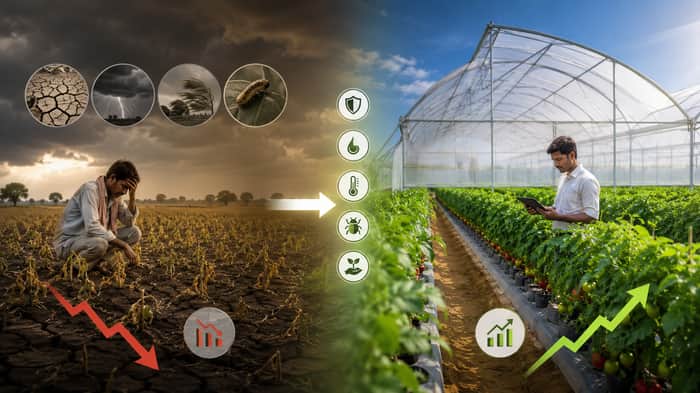
For a long time, farming has been exposed.
Exposed to weather.
Exposed to pests.
Exposed to uncertainty.
And most of us accept this as normal.
If rain fails, crops fail.
If temperature shifts, yield drops.
If pests attack, damage spreads fast.
It almost feels like farming is built on risk.
But over time, I started questioning this:
What if farming didn’t have to depend so heavily on unpredictable conditions?
That’s where protected agriculture started making sense to me—not as a high-tech concept, but as a way to bring control back into farming.
1. The Real Problem With Traditional Farming
Open-field farming works—but it comes with constant unpredictability.
You’re dealing with:
- changing weather patterns
- inconsistent rainfall
- pest exposure
- temperature fluctuations
And no matter how experienced you are, you can’t fully control these variables.
So most decisions become reactive.
You wait.
You adjust.
You try to manage damage.
That’s not a system—it’s survival.
2. Protected Agriculture Is About Control, Not Complexity
When people hear terms like:
- greenhouse farming
- polyhouse systems
- shade nets
they often assume it’s complicated or expensive.
But the core idea is simple:
Reduce external uncertainty and create a controlled environment.
Protected agriculture allows you to:
- manage temperature
- control humidity
- regulate water use
- limit pest exposure
Instead of reacting to the environment, you start designing it.
That’s a major shift.
3. Better Control Leads to Better Consistency
One of the biggest advantages I noticed is consistency.
In open farming:
- output varies
- quality fluctuates
- planning becomes difficult
In protected systems:
- growth conditions stay stable
- crop quality improves
- yield becomes more predictable
And consistency is powerful.
Because farming is not just about growing crops—it’s about planning outcomes.
4. Resource Efficiency Improves Naturally
Another thing that stood out was how efficiently resources are used.
Protected agriculture allows:
- precise irrigation (less water waste)
- controlled nutrient delivery
- reduced chemical usage
Instead of applying inputs broadly, you apply them where and when they’re needed.
This reduces waste and improves effectiveness.
Over time, this directly impacts cost and sustainability.
5. It Changes How You Think About Farming
This was the biggest shift for me.
Protected agriculture is not just a method—it’s a mindset.
You stop thinking:
“What will happen this season?”
And start thinking:
“What conditions do I need to create for the result I want?”
That’s a completely different approach.
It turns farming into a designed system, not just an activity.
What Changed for Me
After understanding protected agriculture more deeply:
- I started focusing on control instead of reaction
- Planning became more structured
- Output became more predictable
- Resource use became more efficient
But most importantly, I started seeing farming as something that can be engineered, not just managed.
Farming will always involve some level of uncertainty.
But that doesn’t mean everything has to be left to chance.
Protected agriculture shows that even small levels of control can make a big difference.
It doesn’t replace traditional farming—but it enhances it.
And in a time where climate, cost, and consistency are becoming major challenges, systems like this are not just useful—they’re necessary.
If you want a deeper understanding of protected agriculture strategies in India—including different systems, techniques, and practical applications—I’ve covered it in detail here:
Cultivating Creation: A Full Research of Protected Agriculture Strategies in India
This will give you a complete picture from concept to real-world use.
