Why ‘Organic’ Isn’t Enough—What Getting Certified Actually Changed for Me
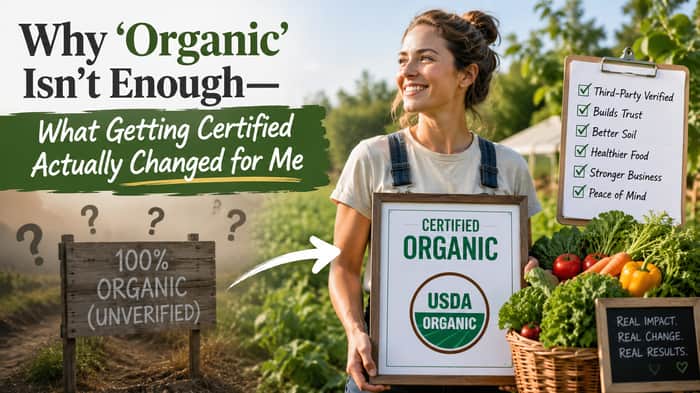
For a long time, I believed that if you’re doing organic farming, that should be enough.
You avoid chemicals.
You focus on soil health.
You follow natural practices.
That’s what organic farming is about.
But then I realized something important:
What you do on the farm and what the market trusts are two different things.
That gap is where organic certification comes in.
And once I understood it properly, I saw that certification is not just a label—it’s a system that changes how your farm operates and how your produce is perceived.
1. The Trust Gap in Organic Farming
One of the biggest challenges in organic farming is trust.
From a farmer’s perspective:
“I know my produce is organic.”
But from a buyer’s perspective:
“How do I verify that?”
Without certification:
- your claims rely on trust alone
- buyers hesitate
- premium pricing becomes difficult
- market access stays limited
This creates a gap between effort and reward.
Organic certification helps bridge that gap by providing verification, not just claims.
2. Certification Is More About Process Than Paperwork
Many people think organic certification is just documentation.
In reality, it’s about how you run your farm.
To get certified, you need to:
- follow specific organic standards
- maintain records of inputs and practices
- ensure traceability
- allow inspections
At first, this feels like extra work.
But over time, it forces you to:
- become more disciplined
- track your processes
- standardize your methods
And that actually improves farm management.
3. It Opens Access to Better Markets
One of the most practical benefits I noticed is market access.
With certification:
- buyers take you more seriously
- you can enter premium markets
- export opportunities become possible
- pricing improves
Without certification, even if your produce is organic, you’re often competing in the same space as conventional products.
Certification helps you differentiate clearly.
4. It Builds Long-Term Credibility
Certification is not a one-time achievement.
It requires:
- ongoing compliance
- regular audits
- consistent practices
This builds credibility over time.
Instead of proving yourself every time, your certification becomes a recognized signal of trust.
That matters especially when you want to:
- scale your operations
- build a brand
- work with larger buyers
5. It Forces You to Think Like a System, Not Just a Farmer
This was the biggest shift for me.
Organic certification makes you think beyond:
“Am I farming organically?”
And pushes you toward:
“Is my entire system structured, traceable, and consistent?”
You start focusing on:
- documentation
- repeatability
- accountability
- long-term compliance
That mindset is very different from casual or unstructured farming.
And it prepares you for scaling.
What Changed for Me
After understanding and moving toward certification:
- I became more structured in my approach
- Record-keeping improved decision-making
- Market confidence increased
- Opportunities expanded beyond local selling
But more importantly, I stopped thinking only like a farmer—and started thinking like someone building a reliable system.
Organic farming is about how you grow.
Organic certification is about how you prove it.
Both matter—but they solve different problems.
If you’re serious about building trust, accessing better markets, and creating a long-term farming system, certification is not just an option.
It’s a step forward.
If you want a deeper understanding of organic certification—its process, requirements, and how to get started—I’ve explained it in detail here:
Organic Certification: Process, Benefits & Requirements
This will help you move from understanding the concept to actually applying it.
