Why Publishing Tools Is Easy, but Building Trust Takes Time
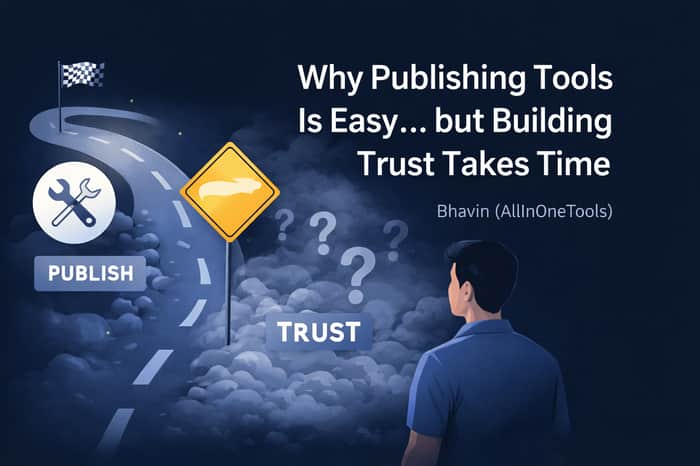
Building and publishing tools has never been easier.
Frameworks are mature. Hosting is cheap. UI kits are everywhere.
You can ship something useful in a weekend.
But trust doesn’t ship with your deploy.
I learned this the hard way while working on small, everyday tools.
On paper, everything was “right”:
- Clear functionality
- Fast performance
- No signup
- Free to use
And yet… usage didn’t automatically turn into repeat usage.
Tools are judged in seconds
When someone opens a tool, they subconsciously ask:
- Is this safe?
- Is this actually for me?
- Will this waste my time?
They don’t read explanations.
They don’t explore features.
They decide first, then act.
That decision is trust.
Shipping features ≠ earning confidence
It’s tempting to think trust comes from:
- More features
- Better copy
- More traffic
In practice, trust comes from absence, not addition:
- No friction
- No confusion
- No surprises
- No unnecessary asks
Every extra step chips away at confidence.
Small tools have a higher trust bar
Ironically, the smaller the task, the higher the expectation.
If a task takes 10 seconds, users expect:
- Zero setup
- Zero learning curve
- Zero commitment
Anything extra feels disproportionate.
That’s why many “useful” tools still feel heavy.
Trust compounds slowly
What finally made a difference wasn’t a redesign or new feature.
It was consistency:
- Same behavior every time
- Same expectations met
- Same outcome delivered
Over time, users stop evaluating and start returning.
That’s when a tool becomes something people rely on.
Curious how others see this
I’m interested in how other builders think about this:
- What makes you personally trust a tool quickly?
- Have you seen trust improve without adding features?
- Where do you think most products accidentally lose trust?
Would love to hear real experiences—especially from people building small, focused tools.

The pairing of 'runs locally' + 'no API keys' is undervalued positioning. It speaks to the technical buyer who has already been burned by SaaS tools that changed pricing, added rate limits, or went down at the wrong moment.
The one-time purchase model makes sense when the tool does a defined job well. What's the job this tool does?
I agree that “runs locally + no API keys” tends to resonate with people who’ve been burned by SaaS changes before. Once pricing, rate limits, or uptime become unpredictable, reliability becomes a feature.
In my case the “job” isn’t one single tool — it’s finishing small digital tasks quickly without needing a full app.
Things like resizing an image, merging a PDF, converting a file, generating a QR code, etc.
Individually these tasks are tiny, but they happen constantly. The goal is basically: open → do the task → close, without accounts, installs, or uploads when possible.
So the core job is really removing friction around these everyday utilities.
Nice launch — turning Reddit into a real-time keyword monitor + extractor could be a big time saver for people doing lead gen and market research without endless scrolling. The real value often comes from intent-rich threads where people are asking for solutions instead of just browsing.
One thing I’ve seen help early tools like this is making filtering and prioritization even faster — e.g., surfacing posts with high reply velocity or recent activity first so you can spot momentum trends.
Curious — do you have a sense yet of which kinds of keywords or subreddits generate the highest-quality lead signals for your early users?
Thanks — that’s a really sharp observation.
We’re seeing exactly that: intent-heavy threads (people actively asking for help) are where most of the real value is, not passive browsing.
Early on, broader keywords tend to surface more noise, while narrower “problem + context” phrases perform better. Still learning which subreddits consistently produce high-signal conversations, but momentum signals like reply velocity are something we’re actively exploring.
That makes a lot of sense.
The “problem + context” phrasing is a strong filter — it usually correlates with people already feeling urgency, not just curiosity.
One thing I’ve seen help in similar tools is tagging threads by decision stage (exploring vs evaluating vs actively choosing). Reply velocity often spikes right before a decision window opens.
Sounds like you’re on the right path — curious to see which subreddits end up consistently producing those high-signal moments.
Publishing tools is easy.
Earning trust is the hard part most builders underestimate.
This really hits home — features ship fast, but confidence builds slowly through clarity, consistency, and frictionless experiences.
Trust isn’t added later… it’s designed from day one.