Why Relying on One Crop Is Risky—And How Mixed Farming Creates Real Stability
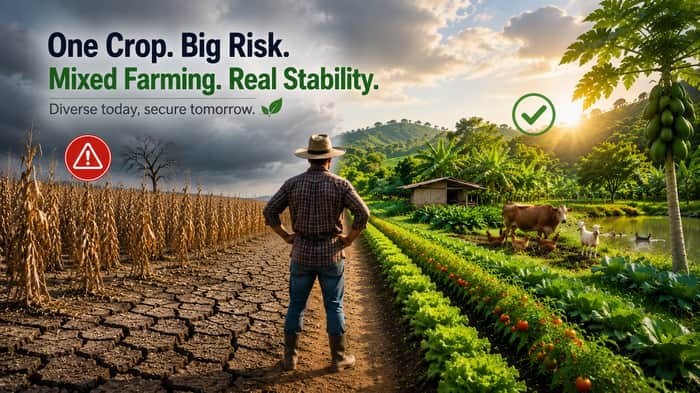
For a long time, I believed that focusing on one crop was the smartest way to farm.
It felt efficient.
It felt easier to manage.
And it felt like the fastest way to scale.
But over time, I started noticing something uncomfortable:
The more dependent I became on one crop, the more vulnerable my entire system felt.
One bad season, one price drop, or one pest issue—and everything gets affected.
That’s when I started understanding mixed farming—not as a traditional method, but as a risk management system that’s been around for years.
1. The Problem With Putting Everything in One Place
When you rely on a single crop, everything is connected to one outcome.
If it works, you win big.
If it fails, you lose everything.
This creates:
- income instability
- higher stress
- dependency on market conditions
- increased risk from weather and pests
It’s efficient—but fragile.
And fragility is dangerous in farming.
2. Mixed Farming Spreads the Risk Naturally
Mixed farming is simple in concept:
you combine crops, livestock, or multiple farming activities within the same system.
This creates diversification.
So instead of relying on one source:
- crops support income
- livestock adds another layer
- by-products get reused within the system
If one part underperforms, the others help balance it.
It’s not about avoiding risk completely—it’s about not letting one problem collapse everything.
3. It Builds a Self-Sustaining System
One thing I found interesting about mixed farming is how connected everything becomes.
For example:
- crop residues can be used as animal feed
- animal waste can be used as manure
- manure improves soil fertility
- better soil supports better crops
This creates a cycle.
Instead of depending heavily on external inputs, the farm starts supporting itself.
And that reduces:
- cost
- waste
- dependency
Over time, this system becomes more stable and efficient.
4. Income Becomes More Predictable
In farming, unpredictability is one of the biggest challenges.
Prices fluctuate.
Yields vary.
Conditions change.
But when you have multiple outputs:
- you’re not dependent on one market
- income flows from different sources
- losses in one area don’t stop everything
This creates a more balanced financial system.
It may not always give the highest peak income—but it provides consistency, which is often more valuable.
5. It Changes How You Think About Growth
Mixed farming forced me to rethink growth.
Instead of asking:
“How do I maximize output from one crop?”
I started asking:
“How do I build a system that keeps working no matter what happens?”
That’s a different mindset.
It’s less about speed and more about structure.
And in the long run, structure wins.
What Changed for Me
After understanding and applying mixed farming principles:
- I felt less dependent on a single outcome
- Resource use became more efficient
- Waste reduced naturally
- Income became more stable
- Farming felt less risky overall
But more importantly, I stopped chasing short-term gains and started building a system that lasts.
In today’s world, uncertainty is increasing—not decreasing.
And systems that depend on one variable are the first to break.
Mixed farming may look traditional, but its core idea is very modern:
Diversify, connect, and stabilize.
Because in farming, success is not just about how much you produce.
It’s about how well your system survives over time.
If you want a deeper understanding of mixed farming, its advantages, and how it contributes to food security, I’ve explained it in detail here:
Mixed Farming, Its Advantages & Food Security
This will give you both the concept and practical insights on applying it.
