Why Smart Farmers Are Investing in Irrigation Before Anything Else
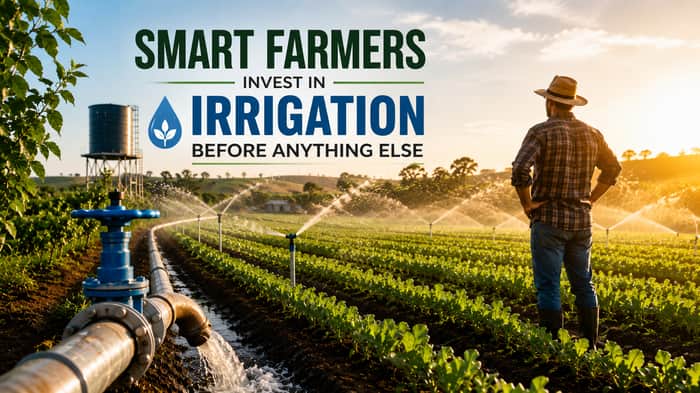
For a long time, irrigation felt like a secondary decision to me.
The real focus was always:
- seeds
- fertilizers
- equipment
- labor
Water was just assumed to be available when needed.
But over time, I realized something important:
Most farming problems don’t begin with crops. They begin with inconsistent water management.
Poor irrigation affects everything:
- soil health
- nutrient absorption
- crop quality
- yield stability
- operational cost
And once I started looking at irrigation as a system instead of just a utility, my entire perspective changed.
1. Farming Becomes Unpredictable Without Water Control
One of the biggest challenges in traditional farming is inconsistency.
Rainfall changes.
Temperatures shift.
Water availability becomes uncertain.
And when irrigation depends on manual timing or outdated systems, crops suffer quietly before the damage becomes visible.
Modern irrigation systems solve this differently.
Instead of broad, uneven watering, systems like drip irrigation deliver water directly to the root zone with precision.
That changes farming from:
reactive watering
to:
controlled resource management
And that’s a major difference.
2. Water Efficiency Is Becoming a Survival Issue
A lot of people still think irrigation is mainly about convenience.
It’s not.
Water efficiency is becoming one of the biggest factors in long-term farming sustainability.
Modern commercial irrigation systems can significantly reduce water waste by minimizing:
- evaporation
- runoff
- uneven distribution
In many cases, drip irrigation systems use far less water compared to traditional flooding methods while maintaining strong crop performance.
That matters because agriculture already consumes a major share of global freshwater resources.
The farms that learn to optimize water early will likely have a major advantage in the coming years.
3. Better Irrigation Improves More Than Just Yield
This surprised me.
Initially, I thought irrigation investment was mainly about producing more crops.
But the real impact is broader.
Good irrigation systems improve:
- nutrient delivery
- soil moisture balance
- root development
- crop consistency
- labor efficiency
And when crops receive stable moisture levels, stress cycles reduce, leading to healthier and more uniform growth.
Consistency is underrated in farming.
A slightly lower but predictable output is often more valuable than unpredictable highs and lows.
4. Automation Is Quietly Changing Agriculture
One thing I’ve noticed is that irrigation is no longer just pipes and pumps.
Modern systems now include:
- moisture sensors
- automated scheduling
- smart controllers
- remote monitoring systems
Some advanced systems even adjust water delivery based on field conditions in real time.
That’s important because farming is moving toward:
precision over excess
Instead of applying more water “just in case,” farmers can now apply exactly what’s needed.
That saves:
- water
- energy
- labor
- cost
all at the same time.
5. The Initial Cost Scares Many Farmers—But Short-Term Thinking Costs More
Let’s be honest:
commercial irrigation systems require investment.
That’s why many farmers delay them.
But what I’ve learned is this:
The cost of inefficient irrigation is often hidden:
- wasted water
- unstable yields
- over-irrigation damage
- higher labor requirements
- unnecessary input loss
Modern irrigation systems are not just an expense. They’re infrastructure.
And infrastructure changes how efficiently the entire farm operates.
What Changed for Me
Once I started viewing irrigation as a core farming system instead of an accessory:
- planning improved
- water usage became more controlled
- crop stress reduced
- operational decisions became easier
But most importantly, farming started feeling less uncertain.
And reducing uncertainty is one of the most valuable things any system can do.
The future of agriculture will not depend only on who has more land or bigger machinery.
It will depend on who manages resources more intelligently.
Water is becoming too important—and too limited—to waste through outdated methods.
That’s why commercial irrigation is no longer optional for serious farming operations.
It’s becoming foundational.
If you want a deeper understanding of commercial irrigation systems, their benefits, and how they improve long-term farming efficiency, I’ve explained it in detail here:
Why Invest in a Commercial Irrigation System?
This covers both the practical advantages and the long-term strategic value of modern irrigation systems.
