Why the hero section decides if your tool even gets a chance
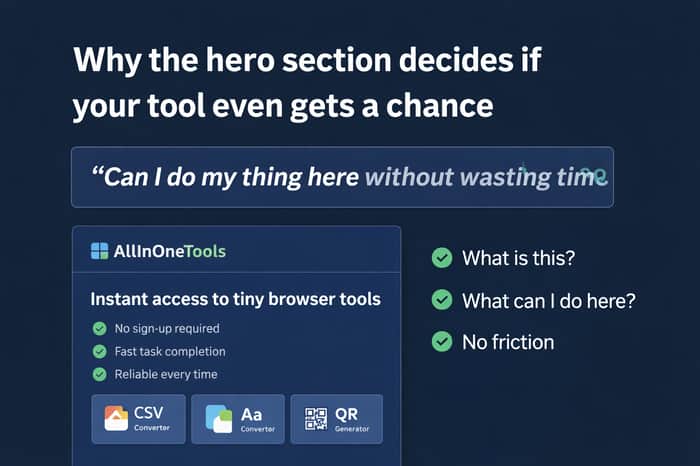
When I started building AllInOneTools, I treated the hero section like marketing space.
Big headline.
Nice copy.
Explaining what the site does.
But after watching real users, I realized something uncomfortable:
Most people never read it.
They decide before they finish the first sentence.
Here’s the mental model that changed everything for me:
The hero section is not there to explain everything.
It’s there to answer one question instantly:
“Can I do my thing here without wasting time?”
That’s it.
What users actually do in the hero
When someone lands on a tiny-task tools website, they’re not curious.
They’re already busy.
They scan for:
- Is this safe?
- Is this fast?
- Do I need an account?
- Can I start now?
If the hero answers those questions clearly, they scroll.
If it doesn’t, they leave.
No matter how good the tools are.
What I changed on the AllInOneTools hero
I stopped trying to explain the platform.
Instead, I focused the hero on three signals:
- Instant action → tools visible immediately
- No friction → no login, no signup mentioned upfront
- Predictability → “this will work the same way every time”
The hero isn’t convincing users to stay.
It’s giving them permission to start.
The mistake I see (and made myself)
As builders, we use the hero to reassure ourselves:
- branding
- positioning
- features
- credibility blocks
But users don’t need reassurance.
They need relief.
The moment they feel:
“Okay, I can just use this”
Trust is already building.
A simple hero checklist I now use
Before shipping anything, I ask:
- Can a user start within 3–5 seconds?
- Is the primary action obvious without reading?
- Does this feel like a tool or a pitch?
- Am I explaining… or enabling?
If the hero needs explanation, it’s already too heavy.
What I learned
For tiny tools, the hero section isn’t about storytelling.
It’s about removing doubt.
If the hero answers:
“Can I do my thing here without wasting time?”
Everything else becomes optional.
Curious how others here think about this:
Do you design hero sections to explain the product…
or to let users start immediately?

The pairing of 'runs locally' + 'no API keys' is undervalued positioning. It speaks to the technical buyer who has already been burned by SaaS tools that changed pricing, added rate limits, or went down at the wrong moment.
The one-time purchase model makes sense when the tool does a defined job well. What's the job this tool does?
Exactly. The main job is simple: open → do the task → close. No accounts, no API keys, no friction. Just quick tools for small daily tasks.
100% agree. For tool-y products I think of the hero as an activation surface, not a narrative.
What’s worked well for me:
Curious: did you measure the change via first-click (CTA) / time-to-first-action, or just qualitative sessions?
Love how you phrased it — “activation surface” is exactly how it feels in practice.
I didn’t start with hard metrics like CTA conversion at first. The signal came from qualitative sessions: people stopped hesitating and just clicked into a tool immediately. Time-to-first-action dropped noticeably just by removing explanation and making the action obvious.
I’m now starting to track first interaction + bounce more deliberately, but honestly the biggest shift was seeing users not think anymore — which was the whole goal.
For tiny tools like AllInOneTools, the hero’s job isn’t to explain everything.
It just needs to make three things clear instantly:
what this site is, what you can do here, and that you can start without friction.
Details can come later — the hero is about permission to begin.