Why "We build fast with AI" isn't winning dev clients anymore (and what buyers actually want)
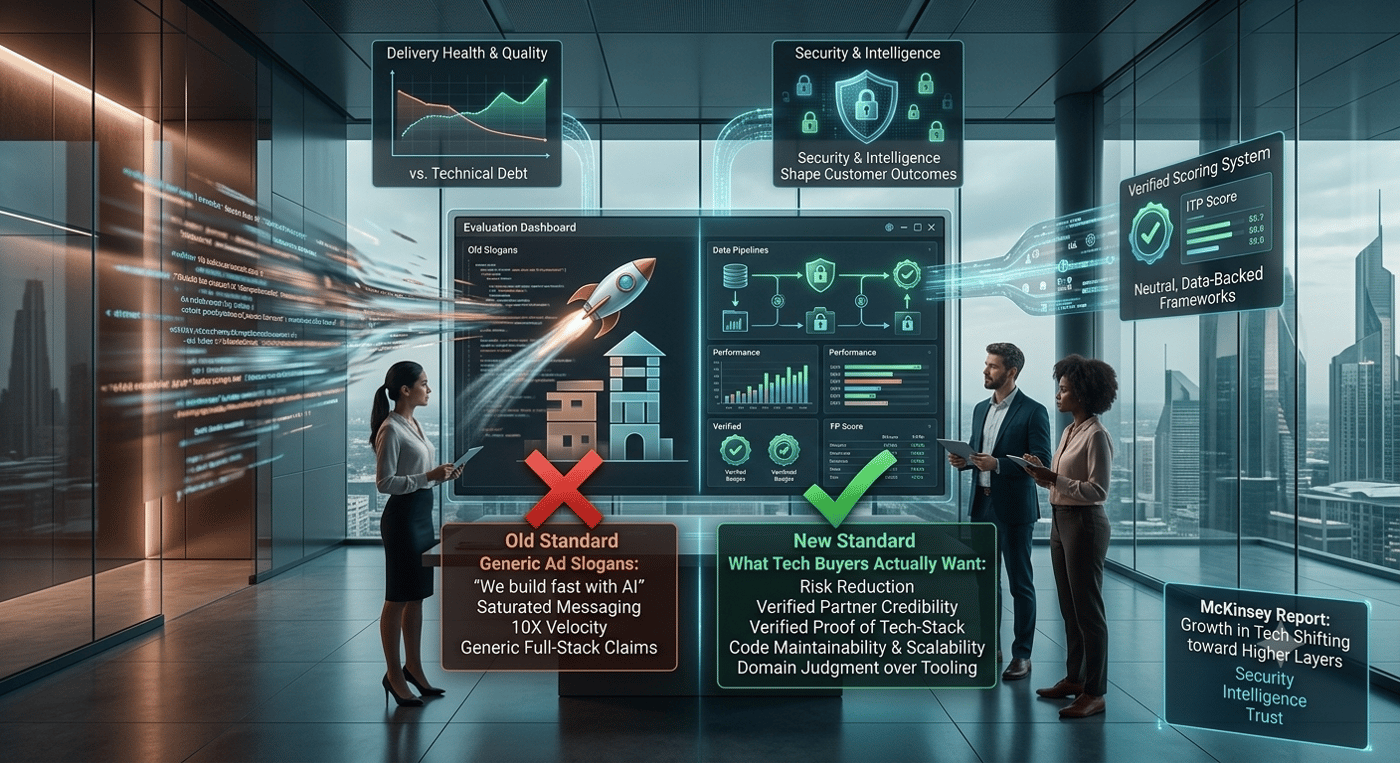
Over the last couple of years, the agency and dev consultancy space has become completely saturated with identical messaging. Almost every development shop pitch now leads with some variation of “AI-accelerated development", “10x velocity”, or “full-stack transformation”. But when speed of execution becomes table stakes, claiming you build fast isn't a competitive differentiator anymore - it’s just the baseline expectation. Generative AI and automated code synthesis have democratized technical execution, meaning anyone can spin up a prototype or API wrapper in a weekend.
If you are running a dev agency, freelancing, or trying to hire technical partners without getting stuck, the decision matrix has fundamentally shifted. I was digging into this recently and read a deep dive on technology agency buyer expectations by ITProfiles, which highlighted exactly how enterprise and startup buyers are abandoning traditional directory browsing. Buyers are moving away from ad-heavy, pay-to-play vendor listings and instead demanding neutral, data-backed evaluation frameworks that prioritize actual execution history over marketing budgets.
When execution is cheap, buyer expectations pivot from raw technical capability to risk reduction. CTOs, founders, and procurement leaders are no longer looking for someone who can merely write code. They are looking for partner credibility. In an ecosystem flooded with noise, the agencies winning high-value contracts are the ones structured around eliminating delivery risk rather than just maximizing output.
Here is what modern technology buyers are actually prioritizing during the vetting process:
Verified Proof Over Self-Reported Stacks: Anyone can list Python, React, AWS, or OpenAI on their landing page. Modern buyers want third-party verification. They are looking for authenticated client outcomes, documented performance benchmarks, and verified engineering credentials before they even take a discovery call.
Domain Judgment Over Tooling Access: Access to LLMs and dev tools is universal. What buyers value now is domain-specific judgment - knowing what architectural decisions will scale, how to secure data pipelines, and specifically, when AI shouldn't be used at all.
Transparent Execution Records: Exceptional outsourcing partners don't just passively complete tickets. Buyers look for agencies that identify flaws in project specifications, propose cost-effective technical alternatives, and flag potential delivery bottlenecks before they impact production environments.
Code Maintainability Over Speed: Enterprise leaders are terrified of inheriting unmaintainable, AI-generated spaghetti code. They care far more about test coverage, defect density, security compliance, and how you mitigate long-term technical debt than how fast you can deliver a minimum viable product.
Understanding these dynamics is critical for independent developers, boutique agencies, and massive IT consultancies alike. If your primary value proposition is still centered around "we can build this faster", you are competing in a race to the bottom on price.
Instead, the pivot needs to be toward operational maturity. You have to sell certainty. How does your team handle incident escalation? What is your daily standup clarity like? Are you providing steady, predictable delivery velocity, or just sporadic bursts of hyper-productivity followed by missed deployment dates? Buyers know that high friction or delayed communication during minor issues early on is almost always a leading indicator of massive management failures later in the project lifecycle.
Furthermore, building an authentic brand in this commoditized era means stepping away from generic case studies. The agencies that thrive showcase objective, data-backed listings rather than sponsored directory badges. They lean heavily into deep industry specialization. A boutique agency that deeply understands healthcare compliance or fintech security protocols and has the verified tech stack to back it up will always outperform a generalized development shop making broad claims about AI transformation.
This isn't just an anecdotal observation from the agency trenches; the data backs it up at the enterprise level. According to McKinsey’s latest Global Technology and Telecommunications B2B Survey, growth in the tech sector is increasingly shifting away from core connectivity and raw execution toward higher layers of the stack, where security, intelligence, and trust shape customer outcomes. The report emphasizes that customer loyalty is becoming highly conditional, anchored primarily in security and verifiable trust rather than pure technical delivery.
Ultimately, as AI continues to lower the barrier to technical output, human judgment and verified trust become your primary economic drivers. If you are pitching technical services today, shifting your messaging from “what we can build” to “how we eliminate your delivery risk” is the highest-leverage change you can make.
For those of you running dev agencies or regularly hiring technical partners right now - what’s been the biggest shift in how you vet vendors or win deals lately? Are you seeing this exact same push for risk reduction over speed?


The shift from “build fast” to “reduce delivery risk” is a strong observation. Once execution becomes easier to commoditize, the buyer’s criteria naturally become more important.
True, when anyone can write 5,000 lines of code in a few minutes using an LLM, the code itself drops to near-zero value. The buyer's criteria naturally evolve from "Can you build this?" to "Can I trust that what you build won't collapse, leak data, or create an architectural nightmare?"
The winning agencies in 2026 aren't selling the "factory" anymore; they are selling the "insurance policy" of a predictable outcome.