Why We Built a Shopify Store That Is Not Meant to Maximize Sales
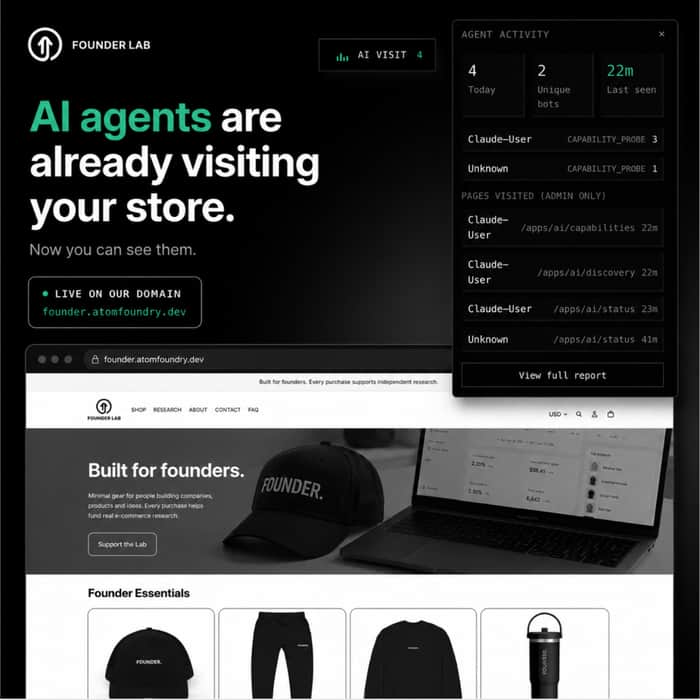
When we launched Founder Lab, selling products was never the main goal.
We wanted something much more valuable.
A real e-commerce environment where we could test ideas, validate research, and understand how AI is changing online commerce.
Founder Lab is our public AI commerce laboratory.
Every product page, collection, article, and design change gives us an opportunity to run real experiments that would be impossible to validate on someone else's store.
Over the past few months we have been using it to test how AI understands e-commerce websites, how different changes affect AI behavior, and which signals actually matter when AI evaluates a store.
Recently we built the first version of AI Agent Snapshot.
It allows us to see when AI agents visit our Shopify store, which pages they access, how often they return, and how AI activity changes over time.
For us, this is only the beginning.
We are not interested in simply counting AI visits.
We want to understand AI behavior.
Which pages attract AI attention.
How AI responds when we change product descriptions.
Whether AI discovers new products after technical improvements.
How different changes influence AI evaluation over time.
Every experiment helps us answer another question that eventually becomes part of our research.
Some ideas work.
Some fail completely.
Both outcomes are valuable.
Everything we publish through Atom Foundry starts here.
We believe that if we cannot validate an idea on our own store, we should not recommend it to anyone else.
Founder Lab gives us the freedom to test continuously without affecting client projects and without relying on assumptions.
It allows us to measure instead of guess.
As AI becomes a larger part of e-commerce, we expect this laboratory to become even more important.
Some of the internal tools we build, including AI Agent Snapshot, may eventually become Shopify apps if they prove valuable for other merchants.
Others will remain internal because they exist to answer research questions that no existing tool can answer today.
Our goal is simple.
Keep experimenting.
Keep measuring.
Keep publishing what we learn.
Because the future of e-commerce will not be built on assumptions.
It will be built on evidence.

Using your own project as a testing ground makes a lot of sense.
That's one of the reasons I enjoy building my own projects. I can try ideas, see what happens, and learn from the results.
Sometimes a change that seems important has almost no effect, while a small change ends up making a much bigger difference than I expected.
I'm curious whether you've already seen any clear differences between how AI bots explore the site and how real visitors do.
Thanks! That has been one of the biggest surprises so far.
AI agents explore stores very differently than people do. They care much less about design and much more about structured, trustworthy information. We are still collecting data, but the patterns are already really interesting.
I'm curious what would convince you that AI Agent Snapshot is solving a meaningful problem rather than just exposing an interesting metric.
What kind of finding would make you confident it's worth becoming a standalone product?
That's exactly what we're validating. The snapshot is just the starting point (metric). Every new finding from our research gets tested on our own Shopify store first. If it consistently helps explain or improve AI recommendations, it becomes part of the app. If it doesn't, we don't ship it. :)
Appreciate the context.
The distinction between tracking a metric and proving it changes decisions is the interesting part here.
Would be good to continue the conversation around what you're learning from those experiments.
What's the best email to reach you on?
Thanks, I'd be happy to continue the conversation.
You can reach me at founder@atomfoundry.dev
Looking forward to hearing your thoughts. :))
The "public AI commerce laboratory" framing is clever content marketing, but the most valuable thing in this post is buried and you're almost giving it away: AI Agent Snapshot. "See when AI agents visit your store, which pages they hit, how they respond when you change descriptions" is a real product with a timely pain behind it, and you've filed it under "internal tool that may eventually become a Shopify app."
Here's the thing worth staring at. Every Shopify merchant in 2026 is anxious about the exact question your tool answers: are AI agents and answer engines finding my store, and how do I show up when someone asks ChatGPT "best X to buy." Nobody can see that today. You built the instrument that makes AI behavior on a store visible. That's not a byproduct of your research, that might be the actual business, and the lab is the credibility engine that sells it.
The reframe: right now Founder Lab is research that produces content, with tools as occasional spinoffs. Flip it. The tools are the product, the lab is the proof. "We don't guess about AI commerce, we measure it on our store, and here's the tool to measure it on yours" is a far sharper wedge than "we publish evidence-based insights." Merchants don't buy research, they buy the instrument that removes their anxiety.
The risk of the current framing: "public lab that publishes learnings" is a content play, and content monetizes slowly and indirectly. If AI Agent Snapshot solves a pain merchants feel right now, leading with the lab buries the thing they'd actually pay for today.
That research-vs-product positioning tension is what I spend my time on, I'm part of the team building Hivemind, an AI strategy copilot. If you want to pressure-test whether the tool or the lab should be the front door: https://hivemind.myosin.xyz. Either way, treat AI Agent Snapshot like the asset it is.
Quick update: we shipped the waitlist page, https://atomfoundry.dev/ai-agent-snapshot :))
One thing worth sharing given your point about positioning: we deliberately did not build a dashboard for it, even though that was our first instinct. Once we sat with your comment, we realized a dashboard is exactly the kind of thing merchants say yes to and then never open again.
So instead: one small icon in the admin, click it and a few separate dials fan out at the edge of the screen, click again and they're gone. The actual product lives in your inbox, an email the moment an AI agent reads your store, saying exactly what happened and what changed. You're not meant to check it. It's meant to find you.
Still very early and still just a waitlist, but wanted to close the loop since your comment is basically why it looks like this now.
Thanks for taking the time to write such thoughtful feedback!!! I really appreciate it.
I think you're absolutely right that AI Agent Snapshot is becoming much more than an internal experiment. It started as a research tool, but the more we use it, the more we realize other merchants would probably want the same visibility.
Where our thinking differs is that we don't believe AI agent detection is the end product. We see it as the first layer.
Knowing that ChatGPT, Claude or Perplexity visited your store is interesting. Understanding how they evaluated your store, what they understood, what influenced their decision, and ultimately why they recommended one brand over another is the problem we're trying to solve.
Founder Lab exists because we need a real store where we can validate those ideas before we turn them into products. Every tool we build has to prove itself there first.
That said, I think you're right that we probably underplayed AI Agent Snapshot in this post. It may deserve to stand on its own much sooner than we originally expected.
Thanks again. This is exactly the kind of feedback we were hoping for.