Why we’re shifting our AI dev stack to terminal-native agents (Claude Fable 5.1 Breakdown)
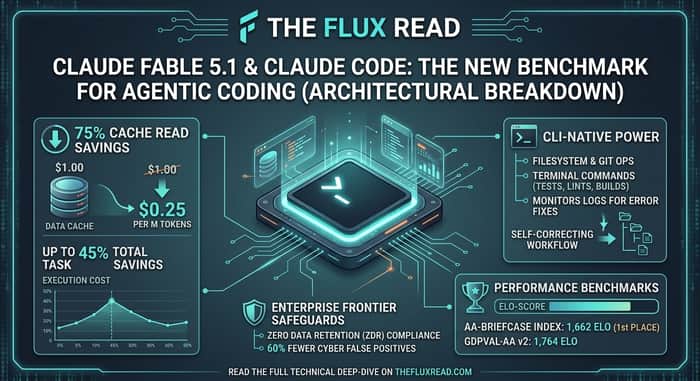
Over the past two years, most of us relied on inline autocompletion or sidebar chat panels inside VS Code. While great for single functions, these tools usually hit a hard ceiling when refactoring monorepos or handling multi-file terminal operations.
Anthropic’s recent release of Claude Fable 5.1 and Claude Code changes the approach entirely by running autonomous agent loops directly inside your local terminal environment.
We just published a full architectural deep-dive on The Flux Read, but here are the three biggest takeaways for bootstrapped founders and solo dev teams:
-
Massive Cost Reductions:
Context cache reads dropped by 75% ($0.25/M tokens). For multi-hour debugging loops, total API spend drops by up to 45%. -
Terminal Execution:
The agent doesn't just write code; it runs your test suite (pnpm test), checksgit diff, and fixes errors autonomously based on terminal outputs. -
Project Rule Persistence:
You can define aCLAUDE.mdin your root repo so the agent never forgets build rules, coding standards, or stack constraints.
How are you handling AI cost optimization and developer workflows in your products right now?
Read the full technical breakdown here: [https://thefluxread.com]

The ceiling with sidebar chat panels is real once changes cross a few files. I’m curious how you keep terminal-native agents from making broad edits that are hard to review. Do you give them a tight task boundary and run tests after each step, or rely more on git checkpoints? The cost and latency angle is interesting too, especially for long refactors.
Absolutely—that context boundary issue is exactly where standard IDE chats break down.
To keep terminal agents from making broad or destructive edits, combining a strict root CLAUDE.md with explicit Git worktrees/checkpoints works best:
Scoped Task Boundaries via CLAUDE.md: Set rules like "Do NOT modify database migration schemas or core interface types without explicit confirmation" right in the root instruction file. This stops the model from re-architecting files outside the prompt scope.
Atomic Git Checkpoints: Create a clean feature branch before handing off a multi-step prompt. Instruct the agent to commit after passing specific test suites (pnpm test path/to/module). If step 3 goes off the rails, a quick git reset --hard saves the session without losing earlier progress.
The /compact Command: Running /compact periodically keeps token latency down and prevents the model from getting confused by stale log outputs.
The 75% prompt caching discount ($0.25/M tokens on cache reads) is really what makes this workflow viable—otherwise, continuous test loops on a large repo burn through API credits fast.
Are you relying more on automated test runners in your CLI setup, or manual human-in-the-loop diff reviews before committing?