Why We Split Memory Into "Vaults" Instead of One Big Store
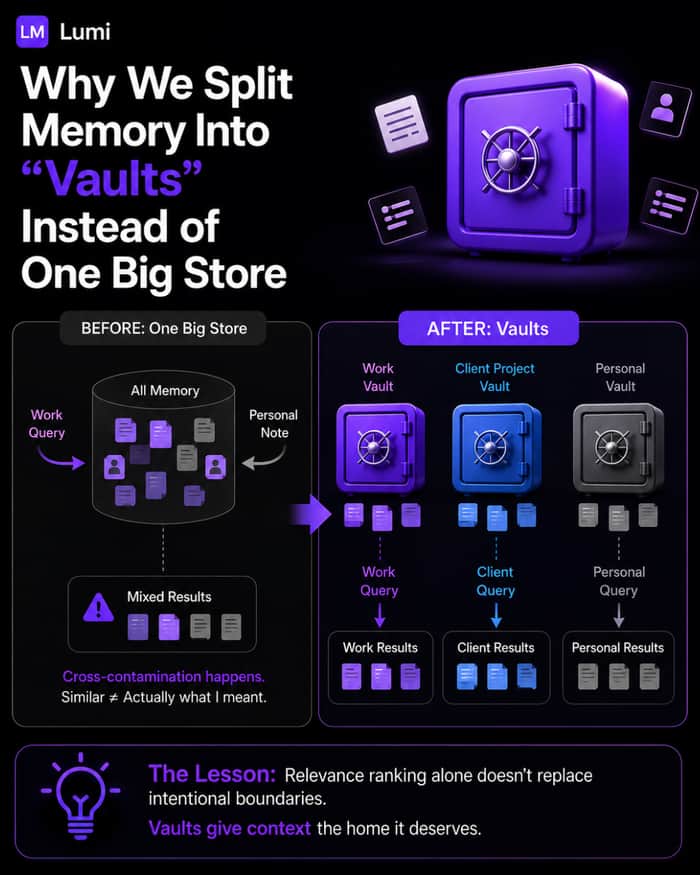
Early on, Lumi stored everything in one flat memory pool. Save something, it went in, retrieval pulled from the whole thing based on relevance.
Worked fine in testing. Fell apart the moment real users had more than one context going at once, someone using it for both a client project and personal research kept getting cross-contamination: a work-related query pulling back a personal note because the embeddings happened to be similar enough.
The fix wasn't a smarter retrieval algorithm. It was giving people an explicit scoping mechanism, Vaults. Business context stays in one vault, personal stuff in another, a specific client project in its own. Retrieval only searches within the vault you're working in unless you ask it to cross-reference.
The lesson that generalizes past memory tools: relevance ranking alone doesn't replace intentional boundaries. "Most similar" and "actually what I meant" aren't the same thing, especially once someone's using the same account for genuinely separate parts of their life.
Anyone else building retrieval systems run into this? Curious how others are handling scope vs. just relying on ranking to sort it out.
