Why your "cheap" VC money is actually a high-interest tax on your engineering team
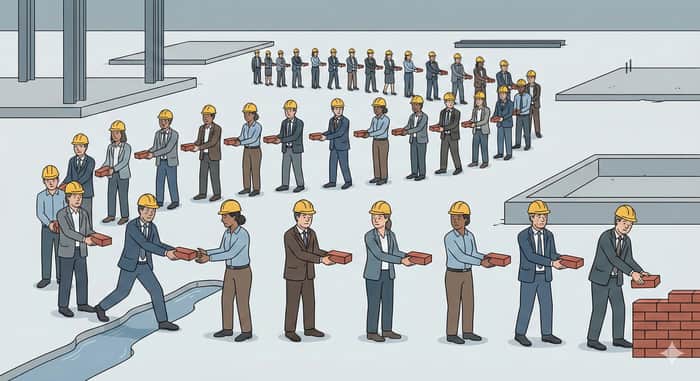
The "Bad Money" Trap: Why your growth is masking a structural mess
We’ve been taught that capital is just fuel. But after looking at the internal mechanics of how most startups actually scale, I’ve realized there’s a massive difference between Good Money and Bad Money.
If you're wondering why your team of 20 developers is shipping at the speed of a 2-person garage shop, you’re likely paying the Sync Tax, and your funding is the subsidy keeping it alive.
The Cold Logic: Patient vs. Impatient Capital
In the world of sustainable engineering, the math looks like this:
- Good Money: Patient for growth, but impatient for profit. This forces you to be efficient. You can't hide a messy, interdependent architecture because you actually need to make more than you spend.
- Bad Money: Impatient for growth, but patient for profit. This is the VC classic. It rewards "shipping fast" at the cost of "building right."
How "Bad Money" Creates Sync Hell
When you have a massive capital subsidy, you don't feel the pain of structural inefficiency. You just hire more people to throw at the problem.
But here’s the "Hacker" reality check: Capital acts as a sedative. It masks the Sync Tax, that invisible overhead where every new feature requires three different teams to hop on a Zoom call to coordinate "integration." Because the money is patient for profit, you don't notice that your cost-per-feature is skyrocketing. You’re just happy the graph is going up.
The Subsidy of Inefficiency
Bad Money allows you to ignore Interdependence.
In a lean setup, if two systems are too tightly coupled, the friction kills your burn rate immediately. You're forced to decouple. With Bad Money, you just hire a "Project Manager" to manage the friction.
You aren't scaling a product; you're scaling a plumbing project. You are subsidizing a "Run-rate Killer" that will eventually trap you when the funding environment shifts and suddenly profit matters again.
The Hard Truth
Efficiency isn't about working harder or "automating" your Jira tickets. It’s about the Strategy of the Cut: Decoupling your systems so a single developer can ship a feature without needing a permission slip from the rest of the org.
The Question for the Makers:
At what point do you stop adding "growth" features and start the 'Strategy of the Cut' to fix your underlying architecture? Have you ever seen a team successfully transition from "Bad Money" habits to "Good Money" efficiency without a total rebuild?

This is a really interesting way to frame it. Capital may look “cheap” financially, but the real cost often shows up in how it shapes priorities and execution.
When engineering teams are pushed toward aggressive timelines or narrative-driven goals, the hidden cost is usually complexity and technical debt that compounds over time.
The first $500 MRR is the hardest milestone because everything is manual and nothing compounds yet. The founders who get through it are usually the ones with conviction about a specific problem rather than a general vision.
What's the specific problem you're most confident about solving?
Scaling by subtraction, that's my obsession. I help product companies get rid of their waste so they can scale efficiently.
What's yours?