"Why your SaaS pricing page is your biggest conversion leak (and how to fix it)"
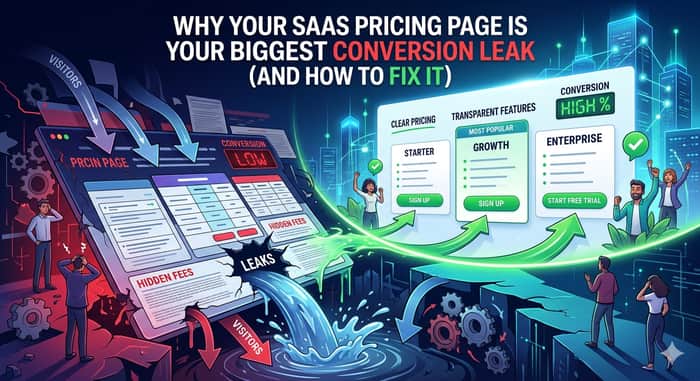
I’ve audited dozens of SaaS websites over time, and the pattern is almost always the same.
The homepage? Clean, impressive, and thoughtfully designed. The product itself? Genuinely solid. The founder? Smart, capable, and clearly invested in what they’re building.
And then I open the pricing page.
That’s where things quietly fall apart. That’s where conversions start leaking — not because the product isn’t good, but because the page that’s supposed to close the deal isn’t doing its job.
Let’s break down what’s actually going wrong — and more importantly, how to fix it.
The problem isn’t your price
When conversions are low, the instinctive reaction is almost always the same: “Maybe we should lower the price.”
In most cases, that’s the wrong move.
What looks like a price objection is usually something else entirely — a value clarity problem. When a visitor doesn’t fully understand what they’re getting, or what their life will actually look like after they buy, every price feels random. And when something feels random, it also feels expensive.
But when the outcome is clear — when they can picture the before and after — that same price suddenly feels justified, even like a bargain.
Mistake 1: Feature names instead of outcome-driven language
Most pricing pages list features in a way that sounds impressive internally but means very little to the buyer.
“Advanced Reporting” sounds good — but it’s vague.
Compare that to:
“See exactly which campaign drove revenue last month — so you stop guessing where to spend.”
Same feature. Completely different impact.
One describes the tool. The other describes the transformation.
When someone is scanning your pricing page, they’re not asking, “What does this product have?”
They’re asking, “What will this do for me?”
A simple rule: go through every bullet point and ask yourself — does this help the customer imagine their life after buying? If not, rewrite it until it does.
Mistake 2: Generic plan names that don’t guide decisions
“Starter.” “Pro.” “Enterprise.”
These are everywhere — and they waste one of the most valuable opportunities on the page.
Your plan names are often the first thing a visitor reads. If those names don’t immediately help them recognize where they belong, they start reading the rest of the page with uncertainty.
Instead, name your plans in a way that helps people self-identify:
Solo Founder
Growing Team
Scaling Company
Now the visitor doesn’t have to think. They instantly know where to look. And that clarity reduces friction before they even read a single feature.
Mistake 3: Weak, generic CTAs
“Get Started” is one of the most overused — and least effective — calls to action.
Because the natural question is: get started… on what?
A strong CTA should complete a sentence in the buyer’s mind:
“I want to ______.”
For example:
“Start closing more demos this week”
“Get my first automated pipeline live today”
“See my team’s performance in 60 seconds”
Specificity wins. Every time. No exceptions.
When the action is clear and tied to a result, clicks feel like progress — not commitment.
Mistake 4: Showing the price before building value
The order of information on your pricing page matters more than most founders realize.
If you show the price before the visitor fully understands what they’re getting, you trigger immediate resistance. It feels expensive because the value hasn’t been established yet.
But when you first build context — clarify outcomes, reduce uncertainty, and help them visualize the result — the exact same number lands very differently.
Now it feels reasonable. Even obvious.
Nothing changed except the sequence — but the emotional response shifts completely.
Mistake 5: No real cost to staying on free
If your free trial isn’t converting into paid users, the issue usually isn’t the upgrade offer.
It’s that staying on free doesn’t feel costly enough.
Most pricing pages focus on: “What do I get if I upgrade?”
But the more powerful question is:
“What am I losing by not upgrading?”
For example:
“On the free plan, you’re still manually following up on every lead — which quietly costs you 6 hours every week you never get back.”
Now inaction has a price. And that’s what creates urgency.
The most overlooked sentence on the page
Right above your pricing table is a small piece of real estate that carries disproportionate weight.
And most founders waste it.
They write something like: “Simple, transparent pricing.”
That’s not persuasive. It’s just descriptive.
That line should act as the final nudge — the moment where the visitor thinks, “I’d be stupid not to at least try this.”
Test that sentence. Refine it. It can move your numbers more than you expect.
The bigger picture
Your pricing page isn’t just another page on your site.
It’s the page where intent is highest. People who land there are already interested. They’re not looking to be convinced — they’re looking to understand.
And most pricing pages fail because they introduce confusion at the exact moment clarity is needed most.
Your homepage earns attention.
Your pricing page closes the sale.
If you’re serious about conversions, that’s where your best copy effort should go.
I’m Quratulain. I help SaaS founders fix pricing pages and conversion copy that quietly lose revenue.
If you want a fresh set of eyes on your page, drop your link in the comments — I’ll show you exactly where it’s breaking.

This matches what I see when I tear down SaaS pricing pages for founders — the homepage sells the dream and the pricing page quietly undoes it. Two patterns that leak hard: (1) feature-matrix plans with no outcome framing, so buyers can't self-select, and (2) price before proof, so the number feels expensive before value lands. One practical fix: put a single 'who this plan is for' line under each tier, then one proof point (screenshot/metric) above the price. I published a free sample of how I tear down Linear's pricing this way: https://www.indiehackers.com/post/i-tore-down-linear-s-pricing-the-way-i-d-tear-down-yours-0-sample-76b6f2449f — happy to compare notes if anyone's mid-rewrite.
Quratulain, this is a masterclass. The "cost of staying on free" point just reframed how I think about my pricing page.
I'd love your eyes on my product. It's an API for SaaS pricing data. Free tier works. Paid tier has more. I'm probably making every mistake you listed.
The site is saaspricedb (just type it in).
If you're open to a deeper conversation about fixing it together, I'd love to talk. I build. I don't write copy. Looking for someone who does.
Let me know what you think.
Thank you — really glad this resonated!
"I build. I don't write copy." — that's exactly who I work with.
I'd love to take a look at your pricing page and show you where the copy is costing you conversions. You can see my work and case studies here:
🔗 quratulaincreatives.carrd.co
For business inquiries, drop me an email — contact details are on the site. Let's fix that page.
This is genuinely useful — especially the point about showing price before building value. I just launched IronCaption and I'm pretty sure my pricing page is guilty of exactly that.
The 'cost of staying on free' point hit hardest for me. My free tier is 1 caption per day and I haven't once framed what that's actually costing people who stay on it. Going to rework that language today.
Would love your eyes on it if you're still looking at pages
Glad it landed — and yes, I can already see the leaks just from your pricing structure.
Here's what's quietly bleeding:
Your free tier says "same caption quality as Pro." You wrote that to feel generous. But what it actually does is remove the main reason to upgrade. If the quality is identical, the only upgrade trigger is volume — and most people don't feel like they need more than 1 caption a day until they're already in the habit. You've accidentally made free feel sufficient.
The second leak: your Pro page has no consequence language. "Unlimited captions, caption history, priority support" — those are features. None of them answer the question a free user is actually asking: what am I missing out on by not upgrading right now? There's no cost of staying free. No urgency. No specific outcome that Pro unlocks that free doesn't.
Third: £7/month is a low-friction price point — but your copy isn't doing the work to make it feel like an obvious yes. "For creators who post often" is too vague. Often means different things to different people. You need a specific person in a specific situation feeling a specific pain.
These are fixable. But the fixes require getting clear on something first — and that's where the audit earns its keep.
My Copy Audit is $250. Full breakdown of every conversion gap with specific rewrites. Reply here or find me at Quratulain Creatives.
quratulaincreatives@gmail.com
This is incredibly useful — especially the point about 'same quality' accidentally making free feel sufficient. Going to fix that today.
Really appreciate you taking the time to break that down. The consequence language point in particular is something I wouldn't have spotted myself.
Not in a position to invest in an audit right now but this free breakdown has already given me plenty to work on. Thank you.