Why your scaling feels like driving with the handbrake on
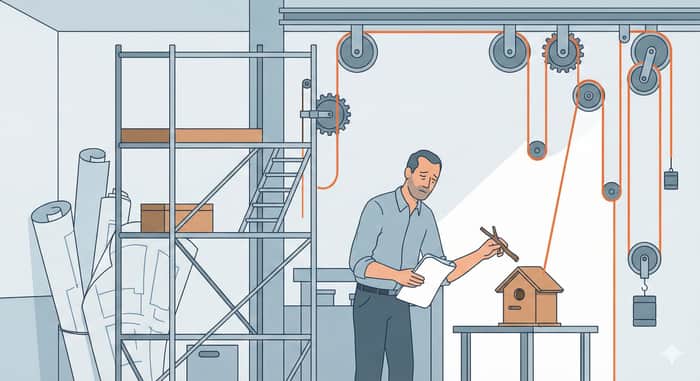
Why your 2-week feature now takes 2 months
As a founder, the friction you feel as you grow is rarely a talent problem. It is a timing problem. Your most critical job is navigating the cycle between discovery and discipline. Most of us fail because we apply the wrong management model to the wrong growth phase.
The Era of Pragmatism: Focus on Performance
In the beginning, your only goal is finding a product that works. You need an "emergent strategy." This is a period of messy discovery where you must prioritize raw product performance above all else.
At this stage, building complex, modular systems is a waste of your capital. Defining modules and interfaces has a high upfront cost in terms of time and resources. You should only invest in what makes the product "good enough" to win. Staying interdependent is a strategic choice: it allows you to allocate all your resources toward product performance rather than architectural overhead.
The Decoupling Point
The game changes the moment your product starts to win. You will see three unmistakable signs:
- Market demand skyrockets.
- Users demand more specialized features and flexibility.
- Competitors arrive to underprice your success.
The Scaling Trap
A common mistake is trying to scale an interdependent system by simply adding more rules and management discipline.
If you try to scale a "messy" product with rigid rules, you create massive internal friction. Because everything is still connected, every small change requires constant manual coordination across your entire team. You will move slower and slower, and the cost of managing your own internal complexity will eventually eat your entire profit margin.
The Shift to Dogmatism
Once you hit the decoupling point, you must pivot. You move from an exploratory strategy to a "deliberate strategy." This requires you to do two things at the same time:
- You switch to a disciplined, top-down strategy to scale what works.
- You migrate your product to a modular architecture so parts of the system can move independently.
The CEO’s Permanent Cycle
Your job is to recognize when the "explorer" phase is over and the "builder" phase begins. But you cannot stop there.
Navigation is a permanent cycle. What works today will not work forever. You must constantly look ahead, ready to drop the rules and return to pragmatism when the market shifts. If a new discovery phase is needed to stay competitive, you must be willing to abandon the dogmatic structure and return to an emergent strategy.
Are you still treating a winning product like a prototype, or are you building the foundation required to defend your market share? More importantly, are you watching for the next market shift that will require you to tear those rules down and start the cycle over?

The hardest thing about B2B is that you're often selling to someone who didn't budget for your category. They need the result you provide but never planned to pay for it.
The products that win here usually create a new budget line (by being categorically new) or steal from existing budget by making the ROI comparison obvious. Which of those are you trying to do?