Xtreme HD IPTV: 25,000+ Live Channels & VOD Access 2026
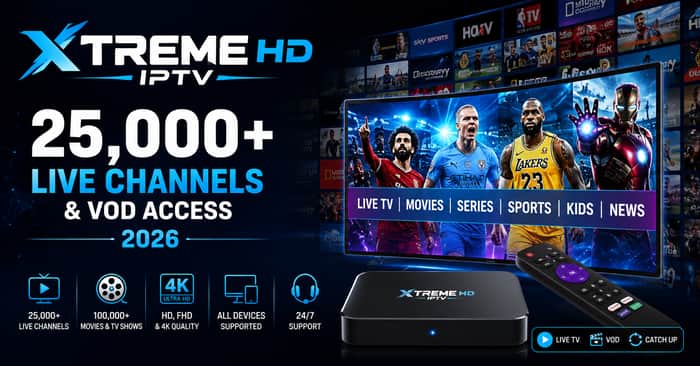
Enjoy premium entertainment with Xtreme HD IPTV, featuring HD & 4K streaming, reliable performance, and access across multiple devices.
Finding a streaming platform that combines extensive content, reliable performance, and broad device compatibility isn't always easy. Xtreme HD IPTV is designed to simplify entertainment by bringing live television and on-demand content into one convenient service. With access to 25,000+ live TV channels, a large VOD library, and support for HD, Full HD, and 4K streaming, it caters to viewers who enjoy sports, movies, TV series, news, and international programming from a single platform.
The service supports a wide range of devices, including Smart TVs, Firestick, Android TV, smartphones, tablets, Windows PCs, and macOS, making it easy to watch your favorite content wherever you are. An intuitive interface, Electronic Program Guide (EPG), and multi-device compatibility further enhance the viewing experience while keeping navigation simple for both new and experienced users.
In this guide, we'll explore Xtreme HD IPTV in detail, covering its key features, subscription plans, supported devices, streaming performance, and the factors you should evaluate before subscribing. By the end, you'll have a clear understanding of what the service offers and whether it aligns with your entertainment preferences.
The Hidden Economics Behind IPTV Channel Lists
When comparing streaming platforms, many buyers immediately look at the total number of available channels. However, the economics behind these numbers are often misunderstood. Providers such as Xtreme HD IPTV don't simply compete by adding more content—they compete by increasing the perceived value of their service. A larger channel list attracts attention, even though most subscribers regularly watch only a small fraction of the available content.
Another overlooked factor is that maintaining thousands of channels is not equally expensive. Popular sports, entertainment, and news channels require higher bandwidth and stronger server resources because they attract the most viewers. In contrast, many regional or niche channels generate minimal traffic, making them relatively inexpensive to include. As a result, expanding a channel list can improve market appeal without increasing operating costs at the same rate.
This strategy explains why two services with similar prices can advertise vastly different channel counts while delivering comparable viewing experiences. Instead of judging a platform solely by its numbers, evaluate streaming stability, picture quality, channel availability during peak hours, and customer support. Xtreme HD IPTV, like any service, should be assessed on overall performance rather than the size of its playlist alone.
Why IPTV Reviews Become Outdated Faster Than Smartphone Reviews
A smartphone review can remain relevant for years because the hardware rarely changes after launch. IPTV or Internet Protocol Television services work differently. Their performance can improve or decline within weeks due to server upgrades, content changes, traffic fluctuations, infrastructure expansion, or network optimization. This means a review published months ago may no longer reflect the actual user experience.
Another reason is that IPTV providers frequently adjust their channel lineup, VOD library, streaming servers, and supported applications without making major announcements. Even customer support quality and streaming stability can change as the subscriber base grows. Because of these ongoing updates, relying on a single old review can lead to unrealistic expectations.
When evaluating Xtreme HD IPTV, it's better to look for recent user experiences, trial opportunities, and performance tests rather than depending solely on articles written months or years ago. The same approach applies when searching for the Best IPTV Service Provider. Instead of focusing on outdated ratings, compare current streaming quality, uptime, device compatibility, and support responsiveness. IPTV is a dynamic service, so the most valuable review is one that reflects its latest performance rather than its past reputation.
IPTV Stability Depends More on Geography Than Internet Speed
Many people believe upgrading to a faster internet plan will automatically improve IPTV performance. In reality, geography often has a greater impact than raw download speed. Your data doesn't travel directly from the IPTV server to your screen—it passes through multiple networks, exchange points, and routing paths before reaching your device. The longer or more congested that route is, the greater the chance of increased latency, buffering, or slower channel loading.
This explains why two users with identical 300 Mbps connections can have completely different streaming experiences. One may enjoy uninterrupted playback, while the other encounters delays because their Internet Service Provider follows a less efficient route to the streaming server. Factors such as regional network congestion, international cable routes, and nearby server locations all influence stability.
When evaluating Xtreme HD IPTV, it's worth considering where the provider's infrastructure is optimized rather than focusing only on internet speed requirements. A service with well-distributed servers and efficient traffic routing can often deliver smoother playback than one relying on a limited network footprint. That's why experienced users searching for the Best IPTV Service Provider pay close attention to consistent performance across different regions, not just advertised bandwidth recommendations.
Xtreme HD IPTV: A Complete Streaming Solution
Xtreme HD IPTV is designed for viewers who want a single platform for live television and on-demand entertainment without juggling multiple streaming services. It brings together more than 25,000 live TV channels, an extensive VOD library, and support for HD, Full HD, and 4K streaming, making it suitable for a wide range of viewing preferences. Whether you're interested in live sports, movies, TV series, news, or international channels, the service offers a diverse selection of content that can be accessed from one subscription.
Compatibility is another major advantage. The platform works with Smart TVs, Amazon Firestick, Android TV, smartphones, tablets, Windows PCs, macOS, and IPTV-compatible applications, allowing users to stream across multiple devices with ease. Features such as an Electronic Program Guide (EPG), intuitive navigation, and stable playback contribute to a more convenient viewing experience.
Beyond its content library, Xtreme HD IPTV focuses on delivering reliable performance through optimized streaming infrastructure and regular service updates. Instead of simply advertising a large number of channels, the platform emphasizes accessibility, smooth playback, and flexibility for everyday users. For anyone looking to replace traditional cable with a modern streaming solution, it provides a practical combination of entertainment variety, device compatibility, and consistent performance.
Why IPTV Buffering Often Starts Before the Match Begins
Many viewers assume buffering occurs because millions of people start watching after the match kicks off. In reality, the biggest traffic surge often happens 15–30 minutes before the event begins. During this period, thousands of users open the same live channel simultaneously, forcing authentication servers, channel directories, and streaming nodes to process a sudden wave of requests. This brief spike can temporarily slow channel loading, even before the first whistle.
For this reason, Xtreme HD IPTV users may notice that opening a sports channel earlier often provides a smoother experience than joining at the last minute. Once connected, the stream usually remains stable because the initial authentication and stream allocation have already been completed.
High-quality providers prepare for these demand spikes by distributing viewers across multiple servers, balancing traffic, and optimizing network routing. These behind-the-scenes measures reduce the risk of congestion when thousands of fans tune in at the same time. While internet speed is still important, the provider's infrastructure plays a much larger role during peak events.
This is one reason Xtreme HD IPTV emphasizes reliable streaming architecture rather than relying solely on high channel counts or marketing claims. Stable infrastructure is often what separates a consistent viewing experience from one interrupted by unnecessary buffering.
IPTV Has a Supply Chain Most Users Never Realize Exists
Most people think an IPTV provider simply streams TV channels directly to their screen. In reality, every stream passes through a complex supply chain before it reaches the viewer. The process typically begins with content acquisition, followed by encoding, server processing, content distribution, authentication, and finally playback on your chosen device. A delay or failure at any stage can affect the overall viewing experience.
For example, a live sports channel may first be captured from its original broadcast source, compressed into a digital format, distributed across multiple servers, and then routed through content delivery networks before reaching subscribers. If just one link in this chain becomes overloaded, users may experience buffering, slower channel switching, or temporary interruptions—even when their internet connection is stable.
This is why Xtreme HD IPTV places importance on maintaining reliable streaming infrastructure rather than relying only on a large channel lineup. Strong backend systems help deliver content more consistently, especially during periods of high demand.
Understanding this supply chain also changes how you evaluate a streaming service. Instead of judging quality solely by the number of available channels, consider how efficiently the provider manages the technology behind every stream. Xtreme HD IPTV demonstrates that dependable performance often comes from a well-optimized delivery process, not just an impressive playlist.
IPTV Reliability Is Really a Probability Problem
Many people judge an IPTV service by a single number, such as 99.9% uptime, assuming it guarantees uninterrupted streaming. In reality, IPTV reliability is the result of several independent systems working together. Your internet connection, router, DNS server, ISP routing, authentication server, content delivery network (CDN), streaming server, and playback device must all function properly at the same time. If any one of these components experiences an issue, your viewing experience can be affected.
Think of it as a chain rather than a single system. Even if every component is highly reliable on its own, the overall experience depends on all of them performing successfully at the same moment. This explains why two viewers using the same IPTV provider can have different experiences despite having similar internet speeds.
Xtreme HD IPTV benefits from strong infrastructure, but like any streaming platform, its real-world performance also depends on factors outside the provider's direct control, including local network conditions and device configuration. Instead of expecting perfect reliability, users should look for services that minimize potential points of failure through redundant servers, optimized routing, and efficient load balancing. Understanding IPTV as a network of interconnected systems provides a more realistic way to evaluate Xtreme HD IPTV than relying solely on uptime claims or marketing promises.
Frequently Asked Questions About IPTV
1. Does internet speed guarantee smooth IPTV streaming?
Not always. While a stable connection is important, factors such as server location, network routing, and regional congestion can have an even greater impact on streaming quality.
2. Why do IPTV services update their channel lists?
Providers regularly add, remove, or replace channels due to licensing changes, source availability, server optimization, and viewer demand.
3. Can IPTV quality vary between different locations?
Yes. Two users with similar internet speeds may experience different streaming performance because of geographic distance, ISP routing, and nearby server availability.
4. Is Xtreme HD IPTV compatible with multiple devices?
Yes. The service supports Smart TVs, Firestick, Android TV, smartphones, tablets, Windows PCs, macOS, and many IPTV player applications.
5. What should I check before buying an IPTV subscription?
Instead of focusing only on channel count, evaluate streaming stability, picture quality, device compatibility, customer support, and whether a free trial is available to test the service under your own network conditions.
