You don't need a better agent. You need something watching the ones you've got.
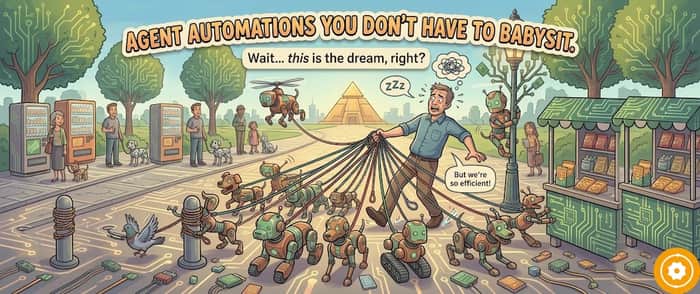
At my last company we burned a month trying to automate one outreach pipeline in n8n. Two weeks non-technical, two more with engineers, and it still broke overnight and went red before anyone noticed. Sold as no-code, it became the most fragile thing we owned.
A few months ago I gave the same kind of task to an agent in plain English. It wrote the schedule, wired the connector, done. The whole integration layer that made n8n valuable had evaporated.
But I would never let that agent run unwatched against anything that mattered. That is the gap. Setup is solved, trust is not. The agent will happily do the work. What is missing is anything that notices when a run quietly goes wrong, and usually the output will not tell you. I had a weekly research job emailing me clean-looking summaries while the work behind them went shallow. Nothing in the email ever gave it away.
So I built Golemry. You add it to the agent you already use (Claude, Claude Code, anything that speaks MCP) and describe a recurring task in plain English. It runs in the cloud on a schedule, sandboxed, scoped to its tools, with an overseer reviewing every run. Super simple setup, and it addresses the reliability gap agents have on their own. You stop babysitting.
Honest state: V1 launched yesterday. 134 visitors, 2 signups, nobody paying yet. Deliberately minimal.
If you are running agents against real, recurring work, the kind you would hesitate to leave unwatched, put Golemry on it and tell me where it breaks. It is live at https://golemry.com

The interesting part is that your post makes a strong case that agents need supervision.
What I'd be careful with is assuming buyers wake up wanting an "agent overseer."
The trust problem is real, but the first buying decision may sit somewhere earlier than that.
I wouldn't make the actual positioning call casually in-thread because it changes who Golemry should speak to first, what proof matters, and why someone signs up instead of just agreeing with the idea.
Thanks for the input, I am still trying to find the right positioning / messaging for it.
It might be sufficient to have a human-in-the-loop tool call rule, my overseer idea is basically "how to get you out of that", but might be a step ahead.
That's exactly why I'd be careful making the call casually in-thread.
The useful part isn't whether the overseer idea is right or wrong. It's deciding which problem should own the positioning and what buyers should care about first.
That tends to work better as a proper written pass than scattered thread advice.
If you'd like the tighter version, drop your email and I'll send it over properly.
What a wonderful post
"Setup is solved, trust is not" is the most accurate one-liner I've read about production AI this month. The silent-degradation example is the scary part — a job that keeps emailing polished summaries while the actual work rots is so much worse than a job that just errors out, because the failure looks like success.
The thing I'd push on: an overseer reviewing every run is itself an AI judging AI. So the obvious question is what watches the watcher? A few failure modes I'd worry about:
The overseer and the worker share the same blind spot (same model family, same misunderstanding of the task), so it green-lights a bad run.
The overseer is strict enough to catch real degradation but starts crying wolf, and people learn to ignore it — same way they ignored the n8n red status.
Curious how you're approaching this: is the overseer a different/stronger model than the agent it watches, and is its judgment grounded in something objective (expected output schema, checks, ground-truth samples) or is it mostly "does this look right"?
We work on the model-access side, and the pattern we keep seeing is that the "watcher" benefits from being a deliberately different model than the "worker" — diversity catches failures redundancy doesn't. Either way, monitoring being the bottleneck instead of capability feels very right.
Separating watcher and worker is the biggest lever, agree with the diversity point. Right now they are separate agents but on the same model. I could put a stronger model on the watcher, just did not add it yet.
It works better than expected like that. It did have one FP when I was using it so far. The overseer read the instructions too literally and flagged a run that was fine best effort wise. I fixed it by adjusting the task prompt.
But the real fix is letting a human tell the overseer "this was fine" and tune from that. That is on my roadmap. So an actual feedback loop and the overseer learning from that feedback. This should align the overseer, so the false positives stop piling up and getting ignored, same as the n8n red status I complain about.