You have the dashboard, not the decision
Churn signals sit there. Nobody built the wiring that turns them into action.
Most SaaS teams already have the data.
Activation dropped. A champion stopped logging in. Usage is trending down for three accounts. It's all sitting in a dashboard somewhere.
None of it acts.
A dashboard tells you something changed. It never decides what happens next. That gap is where growth quietly stalls, and it doesn't look like a gap. It looks like a normal Tuesday. Someone opens the churn dashboard, sees three accounts trending down, makes a mental note, gets pulled into a meeting. The note evaporates. Nobody did anything wrong. The system simply never asked anyone to act, so nobody did.
The fix isn't more data or another tool. It's four layers, always in this order.
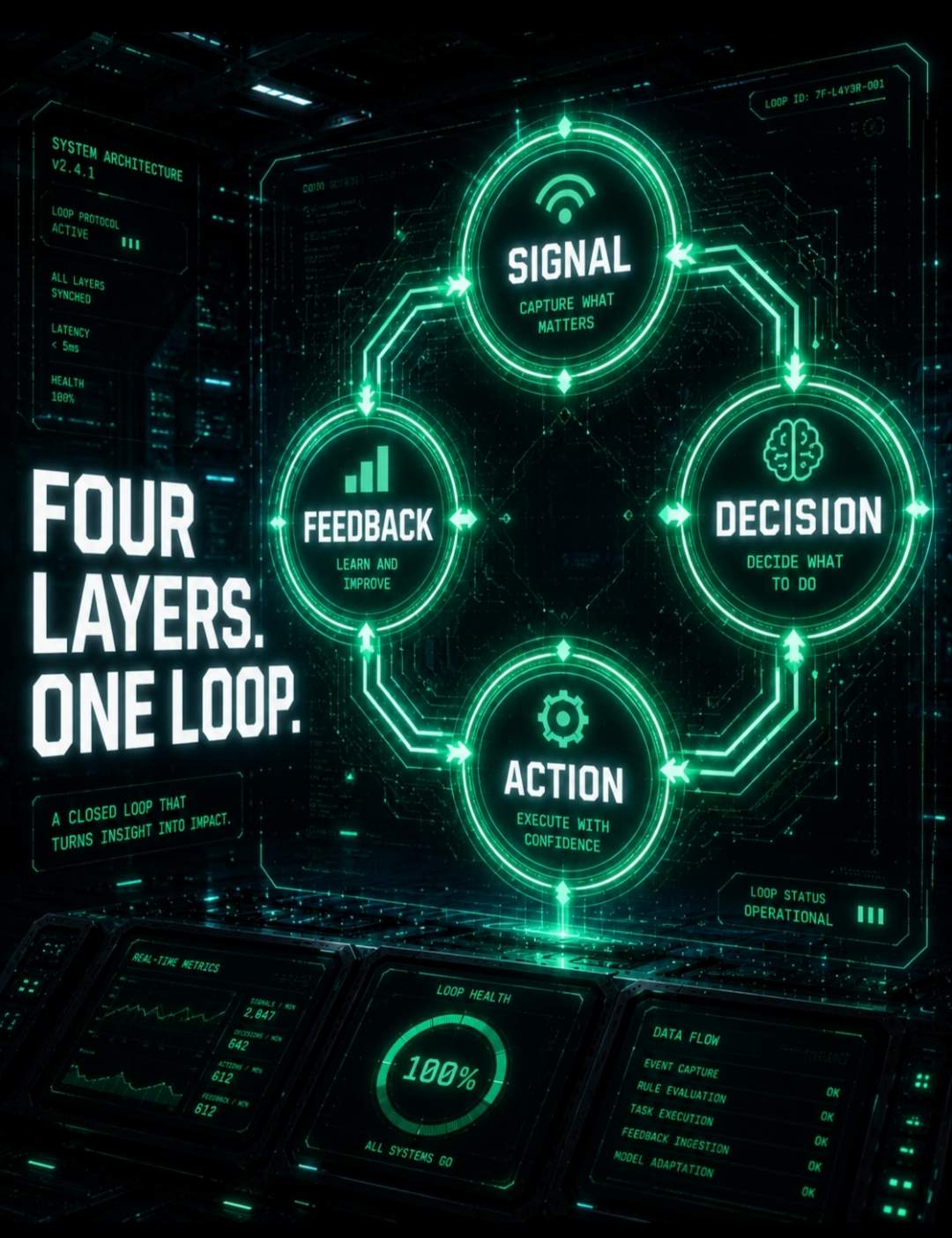
Signal. What changed, the moment it changes. Not a metric on a dashboard, an event: activation dropped for a cohort, a lead went cold, a champion stopped logging in. Fired the instant it happens, not the next time someone opens a report. Target latency under 5 seconds, or you're back to relying on someone noticing.
Decision. The rule that decides if it matters. Not "look at the number and think about it." A codified rule, written once instead of re-made from scratch every time: if a paying account has 0 logins in 7 days and has used the product for 30+ days, flag as at-risk and route to the account owner within 1 hour. This is the layer most teams skip. They go straight from signal to a person's gut feeling, so the decision changes depending on who's on shift.
Action. What happens without you in the room. A message sent, a ticket created, a sequence triggered. The same way, every time, without a person clicking send. Everyone assumes they have this because they own automation tools. Owning the tool and wiring it to a real decision rule are two different things. The line that matters most: safe to automate is sending the alert, drafting the outreach, creating the internal task. Never automate blind is pricing changes, refunds, anything a customer sees with no human check first.
Feedback. Did it work, does the rule learn. Did the action change the outcome? If not, the decision rule was wrong, not the tool. Without this layer you're running the same broken rule forever and calling every fix a one-off. With it, every cycle is a small experiment, and the rule gets sharper each time instead of drifting stale.
Skip one layer and the loop breaks silently. It looks like it's working right up until the day it doesn't, because nothing ever alerted anyone that a step was missing. Most teams stop at two layers, usually Signal and a half-built Action, and wonder why the automation "doesn't feel smart." It isn't supposed to feel smart on its own. Decision is where the intelligence lives, and Feedback is what makes that intelligence compound instead of going stale.
Drop your email, get the full four-layer breakdown, and check which layer is missing in your own stack.
Get the breakdown → https://strategicflow.tech/landing-architecture-layer.html


The four-layer loop that closes the gap: Signal detects what changed, Decision applies a rule, Action executes without a human in the room, Feedback checks if it worked and adjusts the rule.