You keep the copyright. The license is the part that hurts.
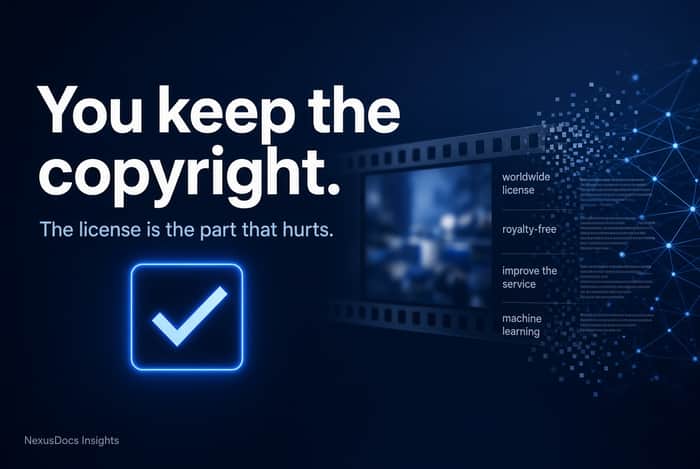
Creators are flooding YouTube with the same complaint: the platform used their work to build models or run promos, and the terms still say “you own your content.”
Both can be true. Ownership is the copyright line. The grant of rights is the next paragraph — worldwide, royalty-free, sublicensable, “operate and improve the service.” Hosting has to exist, or the video cannot play. Promotion and training are the extra width, and companies have been stuffing that width into updates.
I wrote this up because TermsGuard users keep hitting that clause and reading it as “they stole my video.” That is the wrong frame. The more useful question is: if they train a model tomorrow or drop your clip in a promo, does the license you already clicked cover it, and does delete stop it?
Article: https://nexusdocs.ai/insights/content-you-license-when-you-agree
If you ship a UGC product, this is also a trust test for your own terms. If the only honest answer is “improve the service means whatever we build next,” say that in plain English. Creators have already figured out the slogan version.
A practical test
After you paste the terms into a reader, ask one question:
If this company trains a model tomorrow, or puts my clip in a promo, does the license I already granted cover that — and does deleting the post stop it?
If the answer is “probably yes, and delete is not a full stop,” that is the deal you are in. You can still use the platform. You should not be surprised later.

The distinction between copyright and grant of rights is exactly where I think most small teams get tripped up. When you review a clause, do you look first for the scope of use or for how long the permission survives deletion?