Your AI Fallback Works. Is It Allowed to Receive the Request?
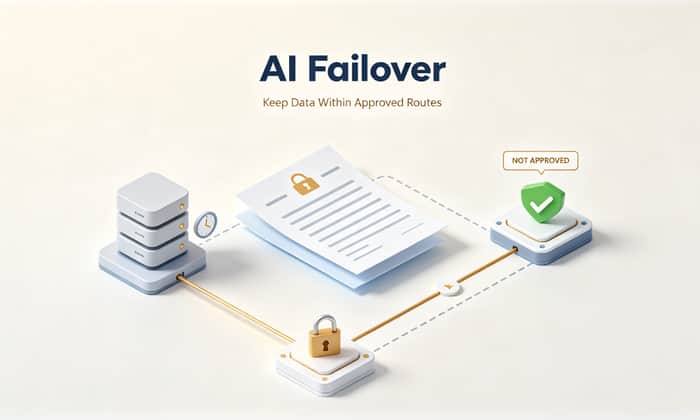
A question we care about while building AIKEY: when a model call fails, does the fallback stay within the original data permissions?
Consider a hypothetical contract assistant. The primary model times out. A backup returns a usable summary. The user gets an answer, and the request looks successful. But the contract was supposed to stay on an internal endpoint, and the backup is an external service.
The output can be correct while the routing decision is wrong.
Define what makes a backup eligible
For a small team, a global list of backup models is tempting. It keeps configuration simple. But if every request can use the whole list without a separate permission check, the routing rule treats all destinations as equally acceptable.
An endpoint approved for public documentation might not be approved for customer contracts. Even the same model name can represent different providers, regions, accounts, or intermediary services. Those details can change the data handling conditions. Internal endpoints also need approval for the material they receive; location alone does not establish permission.
We would start with a narrow question: which destinations are allowed to receive this request? Compare availability, latency, cost, and output quality within that set.
Check everything that will be sent
The last user message might say “summarize this.” The sensitive material may be in the attachment, conversation history, retrieved passages, or tool output.
If the context changes, review the destination before the next send. Removing names does not automatically make a document safe to share: amounts, dates, and project details can still identify a customer or reveal confidential information.
Unknown classifications need a defined outcome, too: pause the task, apply an approved conservative rule, or ask an authorized reviewer. Otherwise, missing information can quietly become permission.
Measure attempts, not just successful tasks
A timeout does not prove the first provider never received the request. Sending it to a backup may create a second recipient, even if the user sees only one answer.
For a useful review, track the task, each attempt, the endpoint, the reason for switching, and the permission decision. Keep “processing status unknown” as a possible state. Avoid putting raw documents or API keys into these records by default.
Useful signals include the number of tasks with multiple destinations, how often no approved backup is available, and how many attempts have an unknown upstream status. Track these alongside task success rate to see how recovery changes data exposure.
Decide what users see when no approved backup is available
If every approved endpoint is down, decide what the user should experience: a queued task, a clear temporary failure, an authorized manual handoff, or a limited result that does not require the restricted material.
A permission rejection should not automatically trigger a search for a less restrictive provider. Service recovery should preserve the request's data rules.
A small exercise can make this concrete. Use a synthetic document marked internal-only. Make the primary endpoint unavailable. Check both the route decision and the actual outbound attempts in an isolated test environment. Then repeat with no approved backup available. The second case tests whether the boundary survives the outage.
Start with one workflow
This is a question we focus on at AIKEY: how to connect AI access, authorization, routing, and audit records around the systems a team already uses.
You can start without rebuilding your stack. Pick one workflow, list the data it handles, identify its approved destinations, and agree on what happens when none are available. Then use an outage exercise to check the assumptions.
If this is a problem your team is working through, you can learn about AIKEY. Business Inquiries: aikeyfounder@gmail.com. We welcome conversations about the access and routing constraints in your own setup.
