Your content becomes a reflection of momentum, not a source of stress.
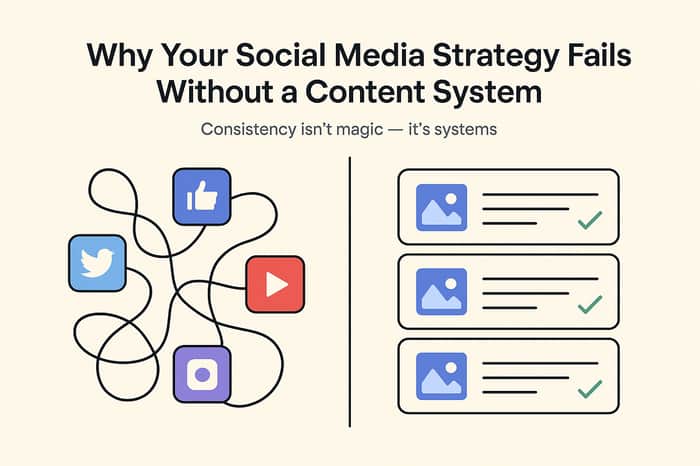
Every founder knows the feeling.
You've got a product you believe in, a few customers who love it, and a sense that if you could just stay active on social media, more people would discover what you're building.
So you block out time, write a few posts, maybe even schedule a week's worth of updates. Then something comes up - a bug, a new feature, a customer issue - and your posting streak ends. Weeks go by before you remember you even had a "strategy."
And that's the problem.
Most small businesses don't have a strategy for social media.
They have a to-do list.
The myth of consistency
You've probably heard that "consistency is everything" when it comes to social media. And sure, that's true - but most advice stops there, as if consistency were just a matter of willpower.
It's not.
Consistency doesn't come from motivation. It comes from systems.
Every founder I know has had that week where posting felt like another full-time job. The ideas are there, but turning them into shareable posts drains your focus. You end up overthinking wording, second-guessing tone, or scrapping half-finished drafts.
You're not lazy - you're overloaded.
Without structure to catch your ideas, every post becomes a new decision. And decision fatigue silently kills consistency.
Why random posting fails
Let's be honest: most of us post reactively. We share updates when something happens, inspiration strikes, or guilt creeps in. It's all vibes, no rhythm.
The result?
- Long gaps followed by flurries of posts
- Repeating the same messages without realizing it
- Losing track of what actually performs
Algorithms don't like inconsistency, but neither does your audience. When your content rhythm is unpredictable, people forget you exist between posts.
And when every post starts from zero - blank doc, new idea, new caption - it's impossible to scale.
What you need isn't more creativity. You need a system that makes creativity repeatable.
The shift: from creativity to systems thinking
The best creators and brands don't just make great content - they run great content systems.
A content system turns "I should post more" into "Here's exactly what to post next."
It's not about killing creativity; it's about giving it rails.
Think about how you build product features or manage code. You have processes, templates, and automation - not because you hate creativity, but because they help you move faster without breaking things.
Your content should work the same way.
When you treat social media like part of your operations, not an afterthought, you stop relying on motivation. You build momentum.
What a real content system looks like
Here's what separates founders who post consistently from those who burn out:
- Scenarios - Instead of chasing ideas, define 3–4 recurring themes. For example: product updates, lessons learned, behind-the-scenes, and customer stories. Suddenly, you're not asking what to post - only which theme fits today.
- Templates - Reuse proven structures. "Feature → Problem → Benefit," or "Before → After → Lesson." Templates turn creative chaos into plug-and-play workflows.
- Tone and Voice - Decide once how you speak. Do you write like a founder in the trenches or like a brand guide? Writing it down saves hours of indecision later.
- Timing - Pick posting slots and stick to them. Batch content weekly or monthly so the hard work happens once, not every day.
- Feedback Loop - Track what resonates. Your system should evolve with data, not guesswork.
Put these together, and you no longer "wing it." You're running a repeatable loop: plan → create → publish → learn → refine.
Less decision fatigue. More output. Better growth.
Why systems drive growth
Social media rewards predictability.
When you show up regularly with content that looks and sounds familiar, people start to recognize you - and algorithms take notice.
But the biggest benefit isn't algorithmic. It's mental.
Once your system runs, posting stops feeling like a chore. You start to enjoy it again because the hardest part - deciding what to say and how to say it - is already done.
Your content becomes a reflection of momentum, not a source of stress.
Start small
You don't need a fancy setup or a marketing team to build a content system.
Start simple:
- Pick one theme per weekday
- Create three reusable post formats
- Keep a running list of ideas that fit those themes
- Block one hour each week to fill the next week's slots
That's it. You've already built a system.
And once you see how much easier it feels, you'll never go back to posting reactively.
That's exactly what we built Postomatic's free content planner to help with - turning the chaos of "what should I post today?" into a repeatable process you actually stick to.
Because you don't need more motivation to stay consistent.
You need a system that makes consistency effortless.
