Your Customer Isn't Stupid. Your System Has a Stupid Gap™
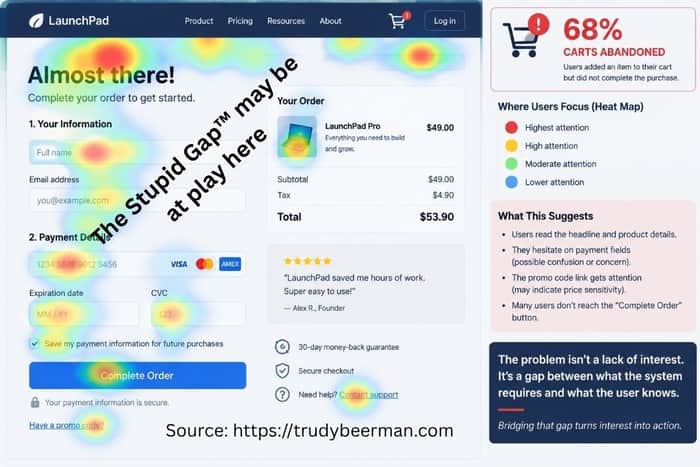
Have you ever watched someone struggle to use something that seemed perfectly straightforward? The button is right there. The instructions seem clear. The next step should be obvious. Yet the user doesn't do what the designer expected.
The problem may not be the user.
Strategic leadership expert Dr. Trudy Beerman calls this disconnect the Stupid Gap™, which she defines as the distance between what someone currently knows, understands, believes, or can do and what they must know or do to achieve the desired result.
Despite the deliberately provocative name, the Stupid Gap™ isn't about stupid people. It identifies a weakness in systems that require people to possess knowledge the system never adequately provided.
For founders, that distinction can have significant consequences.
Founders Have a Knowledge Problem
There is an established cognitive phenomenon known as the "curse of knowledge." Researchers Colin Camerer, George Loewenstein, and Martin Weber showed that better-informed people can struggle to ignore what they already know when making judgments from the perspective of someone without that information.
This phenomenon presents an interesting challenge for founders because they know their businesses exceptionally well. They know what a button does because they named it. They know why a particular field is required because they designed the workflow. They understand the differences between pricing tiers because they created them, and they know exactly what happens after someone clicks "submit."
The customer doesn't have that knowledge.
The curse of knowledge helps explain why founders may struggle to recognize that difference. Dr. Beerman's Stupid Gap™ framework turns the phenomenon into a practical business question: Where has the system failed to compensate for the difference between what its creator knows and what its user knows?
The Stupid Gap™ Can Be Expensive
A Stupid Gap™ can appear almost anywhere in a business. A website visitor doesn't understand what a company actually sells, so the visitor leaves. A prospect sees three pricing options but can't determine which one fits, so the decision gets postponed. A SaaS user signs up but never reaches the point where the product's value becomes apparent.
The same problem can occur internally. An employee is told to "handle" something without the criteria needed to determine what handled correctly looks like. When the result isn't what the founder expected, the employee can appear incompetent even though essential knowledge may never have left the founder's head.
Even the growing use of artificial intelligence provides a useful example. A user gives an AI tool a vague, incomplete, or rambling prompt and receives an equally vague or inappropriate response. The problem isn't necessarily the intelligence of the person or the machine. Critical information may simply have failed to cross the gap.
These gaps create friction, and friction costs businesses. It can appear as abandoned carts, unfinished onboarding, unnecessary support tickets, refunds, poor reviews, lost productivity, low adoption, confused prospects, or customers who quietly disappear.
"People Don't Read" Isn't a Complete Explanation
One common response to customer confusion is, "People don't read." Some evidence supports the frustration. Usability research from Nielsen Norman Group found that people frequently scan web pages instead of reading them word for word. In one foundational study, 79 percent of participants scanned new web pages, while only 16 percent read word for word.
But that finding doesn't absolve poorly designed systems. It suggests that systems should account for how people actually behave rather than how their creators wish they behaved.
The more useful question, therefore, isn't simply whether the necessary information was provided. It is whether the information was provided in a way that made successful action reasonably likely.
Closing the Gap Requires a System Bridge
Dr. Beerman describes the mechanism for closing a Stupid Gap™ as a System Bridge: embedded intelligence that helps people cross the distance between what they currently know and what they need to know or do.
A System Bridge doesn't necessarily mean more training or more information. Depending on the gap, it could be clearer instructions, better defaults, examples, templates, checklists, decision trees, automation, demonstrations, guardrails, quality controls, or feedback.
Consider a pricing page. If prospects repeatedly ask which package they should choose, adding more paragraphs describing the packages may not solve the problem. A simple "Choose this if..." statement beneath each option might provide the missing bridge.
Likewise, if users repeatedly abandon an onboarding process at the same step, sending additional reminder emails may not fix the underlying problem. The troublesome step itself may need to be redesigned. If customers repeatedly make the same mistake after reading the instructions, the relevant question is no longer whether instructions exist. The question is whether those instructions work.
Repeated Confusion Is Data
Perhaps the most useful application of the Stupid Gap™ framework is how it reframes repeated confusion. Instead of treating confusion as an individual customer problem, founders can treat patterns of confusion as data about the system.
If one person gets lost, that person may simply have missed something. If dozens of people get lost at approximately the same place, however, the pattern deserves investigation. Where do users hesitate? Where do they abandon a process? Which questions does customer support answer repeatedly? Which instructions does the team constantly have to explain?
Founders should pay particular attention to moments when someone has to say, "Oh, what that actually means is..." Those moments can reveal where a business depends on knowledge that exists in the founder's head but has never been adequately transferred into the system.
Before Blaming the User, Audit the System
Founders understandably want capable employees, engaged customers, competent users, and prospects who quickly "get it." But a well-designed business shouldn't require everyone to think like its founder.
Instead, the system should contain enough embedded knowledge for people to navigate it successfully without the founder standing beside them.
That makes the Stupid Gap™ a deceptively simple diagnostic tool. When a customer, employee, or user fails to take an action that seems completely obvious, the first question doesn't have to be:
How could they not know that?
A more useful question is:
How would they know?
That shifts the problem from intelligence to design.
And design can be fixed.
References
Camerer, C., Loewenstein, G., & Weber, M. (1989). The Curse of Knowledge in Economic Settings: An Experimental Analysis. Journal of Political Economy, 97(5), 1232–1254.
Nielsen, J. (1997). How Users Read on the Web. Nielsen Norman Group.

Dr. Trudy Beerman is a rock-star TV Host and Brand Consultant. Great write-up! Thanks for sharing.