Your First Hire Is an Operations Stress Test
Hiring your first employee feels like a people decision. It’s also the moment when every part of the business that’s been living in your head suddenly has to work for someone else.
When you are solo, the “I’ll deal with it later” can be a workable system. You know which customer needs a response, what has to ship first, and how much of the week has already disappeared. Nobody else needs the map because you’re carrying it around in your head.
The first hire changes that fast. Someone else now needs to know what “done” means, when they are expected to be available, who owns a handoff, and what happens when Tuesday’s plan falls apart before lunch.
Your Business Has Been Running on Founder Memory
Solo founders can get away with a lot of improvising. Support gets handled between product work and dinner. A client request jumps the line because you know why it matters. Scheduling and handoffs may barely exist as separate processes.
Then another person joins, and all of that has to make sense outside your own head. Every fuzzy routine starts needing an owner, a place to live, and a basic rule for what happens next.
Scheduled Work Creates a New Kind of Record
If the role includes set hours or recurring coverage, memory turns into a bad payroll system pretty quickly.
Once the schedule is real, something as basic as an employee time clock app can keep everyone from rebuilding the week on Friday afternoon from Slack messages, calendar events, and best guesses. A shared record gives both sides something concrete to work from when hours change, someone swaps coverage, or a shift runs long.
That can save a tiny team a lot of back-and-forth.
A Job Description Won’t Capture the Real Work
A job description tells someone what they own. Day-to-day work still needs more context.
The new hire needs to know which calls they can make on their own, when an issue needs the founder, and who takes over when plans change.
A recent Indie Hackers discussion about a founder’s first embedded remote hire captures that transition well. The founder had already worked with contractors, but bringing on a long-term team member raised questions around payroll, contracts, meetings, expectations, and ownership of part of the customer workflow.
A few normal founder habits start looking different once somebody else depends on them:
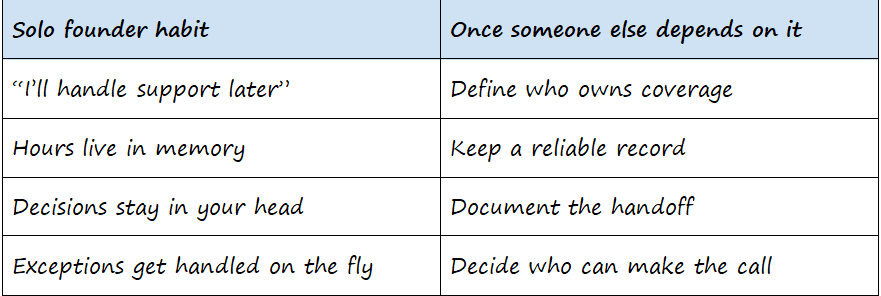
The useful processes are the ones that cut down on guessing. There’s no prize for documenting every tiny action just because the company now has two people.
Clarity Beats Buying More Software
Early team friction can make it tempting to buy a tool for every problem. Software helps, but vague expectations can survive just fine inside expensive software.
Gallup’s research on role clarity found that employees who strongly agreed they knew what was expected of them at work were less likely to report frequent burnout and recurring work-life balance problems. Its advice is: make expectations clear, stay available for questions, and reset priorities together when the work changes.
For a first hire, that’s a good place to start. Find the recurring moments that create confusion, agree on how they should work, and add lightweight systems where they actually save time.
The First Hire Shows You What Is Missing
Founders can live with operational mess because they already know where everything is. A new employee doesn’t have that mental map, so fuzzy ownership and undocumented routines show up quickly.
That’s what makes the first hire such a useful stress test. You find out where schedules are being reconstructed after the fact, where decisions depend on one person, and where “everyone knows” really means “the founder remembers.”
Cleaning up those gaps makes the new person’s job easier while it also leaves the company less dependent on one brain (which is usually part of the reason you hired in the first place).
Revised:
Your First Hire Is an Operations Stress Test
Hiring your first employee feels like a people decision. It's also the moment when every part of the business that's been living in your head suddenly has to work for someone else.
When you're solo, "I'll deal with it later" can be a workable system. You know which customer needs a response, what has to ship first, and how much of the week has already disappeared. Nobody else needs the map because you're carrying it around in your head.
The first hire changes that fast. Someone else now needs to know what "done" means, when they're expected to be available, who owns a handoff, and what happens when Tuesday's plan falls apart before lunch.
Your Business Has Been Running on Founder Memory
Solo founders can get away with a lot of improvising. Support gets handled between product work and dinner. A client request jumps the line because you know why it matters. Scheduling and handoffs may barely exist as separate processes.
Then another person joins, and all of that has to make sense outside your own head. Every fuzzy routine starts needing an owner, a place to live, and a basic rule for what happens next.
Scheduled Work Creates a New Kind of Record
If the role includes set hours or recurring coverage, memory turns into a bad payroll system pretty quickly.
Once the schedule is real, something as basic as an employee time clock app can keep everyone from rebuilding the week on Friday afternoon from Slack messages, calendar events, and best guesses. A shared record gives both sides something concrete to work from when hours change, someone swaps coverage, or a shift runs long. It also means the founder stops being the person who has to remember when everything happened.
A Job Description Won't Capture the Real Work
A job description tells someone what they own. Day-to-day work still needs more context.
The new hire needs to know which calls they can make on their own, when an issue needs the founder, and who takes over when plans change.
An Indie Hackers thread on hiring a first remote team member outside your country captures that transition well. The founder had already worked with contractors on clearly defined project work, but bringing on someone who would own part of the customer workflow, sit in regular meetings, and stay long term raised a different set of questions around contracts, payroll, taxes, and benefits.
A few normal founder habits start looking different once somebody else depends on them:
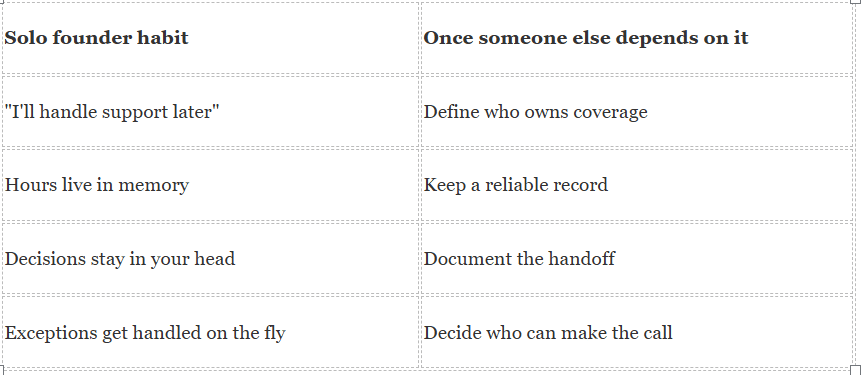
The useful processes are the ones that cut down on guessing. There's no prize for documenting every tiny action just because the company now has two people.
Clarity Beats Buying More Software
Early team friction can make it tempting to buy a tool for every problem. Software helps, but vague expectations can survive just fine inside expensive software.
Research from Gallup and Workhuman found that employees who strongly agree they know what's expected of them at work are 47% less likely to experience frequent burnout and 23% less likely to say they struggle with work-life balance a few times a week or more. The suggested fix is unglamorous: managers who share expectations explicitly and work with people to prioritize what actually matters.
For a first hire, that's a good place to start. Find the recurring moments that create confusion, agree on how they should work, and add lightweight systems where they actually save time.
The First Hire Shows You What Is Missing
Founders can live with operational mess because they already know where everything is. A new employee doesn't have that mental map, so fuzzy ownership and undocumented routines show up quickly.
That's what makes the first hire such a useful stress test. You find out where schedules are being reconstructed after the fact, where decisions depend on one person, and where "everyone knows" really means "the founder remembers."
Cleaning up those gaps makes the new person's job easier while it also leaves the company less dependent on one brain, which is usually part of the reason you hired in the first place.

