Your SaaS isn’t stuck because of churn. It’s stuck because users never fully switch.
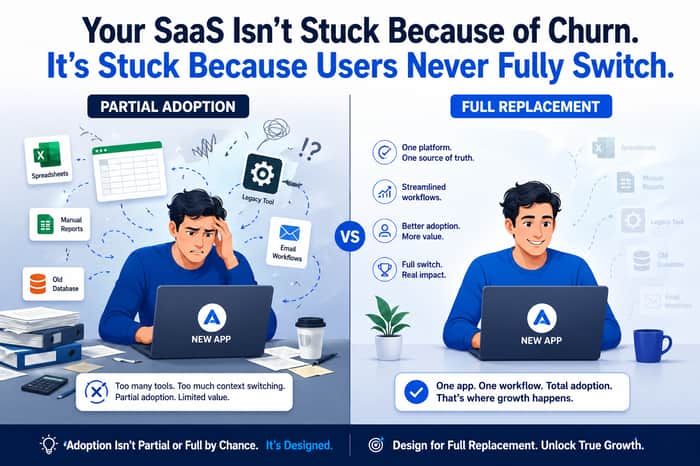
Something I’ve noticed across a few products:
Most users don’t actually churn.
They just… never fully adopt.
They sign up, use it a bit, maybe even like it.
But when it matters, they go back to:
their spreadsheet
their old tool
their internal workflow
So on paper:
churn looks okay
usage looks “decent”
But the product never becomes critical.
The mistake I keep seeing:
We optimize onboarding
instead of optimizing replacement.
What changed things for one team I saw:
They stopped asking:
“how do we get users to try this feature?”
and started asking:
“what exact step are we replacing?”
Then they went aggressive on that one step:
removed the old path entirely (no “optional” fallback)
made the output usable as-is (no cleanup needed)
plugged into where that step already happens
No new workflow. No extra clicks.
Just… the old step disappeared.
That’s when things changed:
usage didn’t spike overnight
but fallback behavior dropped a lot
People stopped going back.
Feels like a lot of SaaS products don’t have a growth problem.
They have a “still using the old way” problem.
Curious if others have seen this —
users liking the product, but still defaulting to the old workflow?

This makes a lot of sense. I lowk think the “fallback behaviour” is a way better signal than just looking at churn.
if users still have to keep the spreadsheet / old tool beside your product, then technically they’ve adopted the product but operationally nothing has really changed.
i’d probably track the exact old step the SaaS is meant to replace and measure whether users still go back to it after onboarding.
i read something today that said your product needs to feel so 'magical' when people use it the first time that they can't go back to their old ways. for example, why would i spend hours writing code manually if claude can do it for me in 15 min? or, why would i spend time replying to the same emails every day if i could automate the process? etc.
Yeah, this makes a lot of sense.
I think “people like it but still go back to the old way” is such an easy thing to miss.
The bit about replacing one exact step feels key. If the product doesn’t remove a real step from the old workflow, it probably just becomes another tab people forget to use.
This is a fantastic observation, I've definitely seen this play out in products. I happen to know a few early-stage SaaS founders who have faced this exact adoption challenge, and I'm sure they'd be willing to answer some of your questions about their experiences.
This is spot on. A lot of “churn” is actually just habit inertia, not dissatisfaction.
Most products fail here because they add value, but don’t fully remove the previous system. So users end up in a hybrid state: they try the new tool, but the old workflow stays as the “safe default” when pressure hits.
The interesting shift you pointed out is the real unlock: optimizing onboarding gets attention, but optimizing replacement of a specific step creates dependency. That’s when the product stops being “nice to have” and becomes part of the actual workflow backbone.
We’ve been thinking about this a lot while building RevivPay as well. In payments especially, if you don’t fully replace the failing step (failed transactions, reconciliation gaps, etc.), users just route around you. They’ll test the tool, but still fall back to spreadsheets or manual checks when things get messy.
The strongest products we’ve seen don’t just improve a step — they eliminate the need to go back to the old path entirely.
What’s interesting is that fallback doesn’t really show up during normal usage
it shows up when something breaks, gets messy, or needs to be trusted
that’s when the “real system” reveals itself
so the question isn’t just: have we replaced the step but what happens when this step is under pressure?
if the product can’t hold there, the old workflow never actually goes away
Refactoring the habit loop by treating legacy workflows as technical debt is a brilliant way to handle adoption friction. Your product only truly ships once the user’s "V2_Final_Final.xlsx" is finally moved to the trash.
What is the most stubborn "old way" you have ever tried to automate out of a user's hands?
That’s usually the real moat.
Not “better UX.”
Not “more features.”
The product starts compounding when the old behavior becomes harder to justify than the new one.
That’s the actual switch.
Until then, users haven’t adopted.
They’ve just added you to the stack.
That’s also where a lot of SaaS brands get trapped.
They position like a helpful layer.
So users treat them like one.
The products that replace behavior usually need a stronger frame than that.
Less “nice add-on.”
More “this is now the system.”
That’s the difference between a tool and something like Exirra.com, Davoq.com, or Vroth.com.
One gets tested.
The other gets installed into the workflow.
This comment was deleted a month ago
What’s interesting is most of that “transition” never really completes
users don’t consciously decide to stay with the old way
they just return to it when something needs to be done quickly or confidently
so it’s less about behavior change over time
and more about whether the new system holds in those moments
if it doesn’t, the switch never actually happens