Your Sales Stack Is a Security Risk. Nobody Owns It.
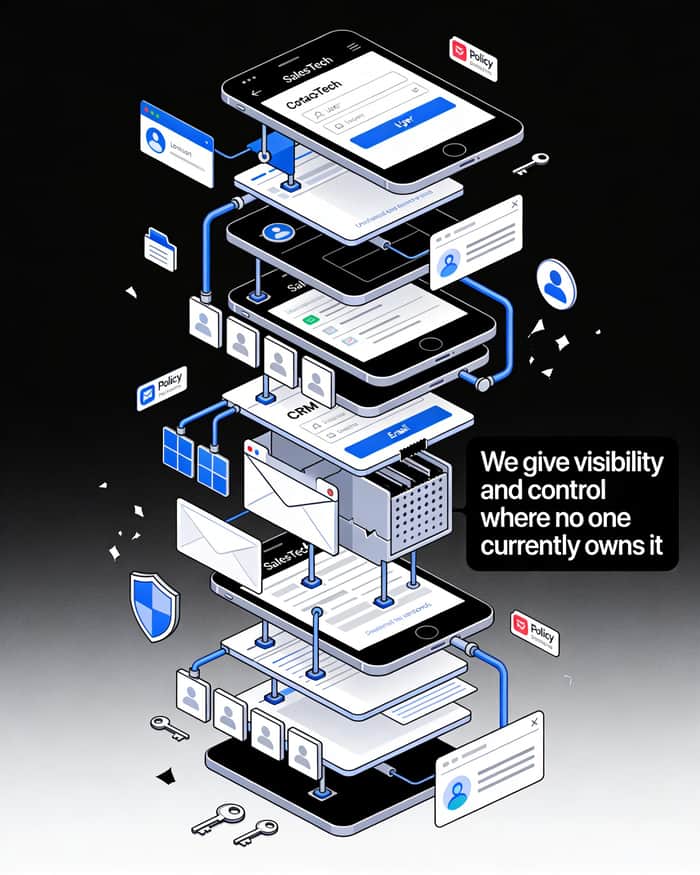
Founders spend months locking down their product infrastructure. Meanwhile the GTM stack sits wide open — and nobody in the company has been asked to fix it.
Here is something I have watched happen across multiple B2B SaaS companies running an outbound motion. Engineering runs access reviews. Infosec has a vendor approval queue. Product has a security checklist before anything ships.
And then someone on the revenue team signs up for a new outreach tool. Connects it to the CRM. Gives it access to the full contact database. Nobody reviewed it. Nobody was asked to.
Not because the team is careless. Because there is no process that covers it. The GTM stack grew up outside the security perimeter — and in most companies, it has stayed there.
What is actually running in a typical GTM stack
When founders think about their security surface, they think about infrastructure. Cloud config, database access, API credentials. That is where attention goes. That is what gets audited.
But look at what a typical B2B company running a proper outbound motion actually has connected:
-
CRM: Full customer database
Every contact, deal note, and conversation thread the company has ever had -
Sales engagement
Email access + send-as
OAuth'd into rep inboxes. Can read, write, and send on their behalf
Intent data -
Third-party data ingestion
Pulling behavioral signals from external sources that haven't been vetted
Conversation intel -
Call recordings + transcripts
Your customers' words and strategies, stored on a third-party server -
Enrichment
Bidirectional data sync
Pushing and pulling data between systems, often without any logging -
Revenue BI
Cross-system read access
Aggregates data from every other tool in the stack into one place
Each of those tools has credentials. Each has data access. Each was approved — if it was approved at all — by someone on the revenue team who was thinking about pipeline, not permissions. And each one has a data retention policy that nobody on your team has read.
The ownership gap is the actual problem
When something goes wrong in the product infrastructure, there is a clear owner. Engineering. Infosec. There is a process and there is accountability. The path is known.
When something goes wrong in the GTM stack, it is genuinely unclear whose problem it is. The revenue leader did not sign up to manage vendor security. The CISO often has no visibility into what tools the sales team has connected this quarter. Legal does not know what data has been shared with third-party enrichment vendors. Finance approved the invoice — not the access.
"The GTM stack is the only part of the company where data moves freely, access is almost never revoked, and no single person is officially responsible."
This is not anyone's fault. It is a structural gap that formed naturally. Revenue teams moved fast because the tools made it frictionless to connect and expand. Nobody built a governance layer because nobody thought one was needed — until a customer asked where their data was going, or a compliance audit flagged a tool that had been running for two years without a signed DPA.
What access sprawl actually looks like
There is a specific moment I have seen come up repeatedly when a B2B company selling into security or compliance-heavy markets goes through a serious enterprise evaluation.
The prospect's security team sends over a standard due diligence questionnaire. Buried in it is a simple question: provide a list of all third-party tools that have access to customer data, along with their security certifications and data retention policies.
That question creates a scramble. Not because the answer is bad. Because nobody has a complete answer ready. The sales engagement tool connected by whoever set up the outbound motion — does it still have active OAuth access after that person left? The enrichment vendor — what is their data retention window? The call recording tool that every customer conversation flows through — where does that data actually live?
- Access gets granted in minutes.
- Access almost never gets revoked.
- The GTM stack doesn't get audited the way the product stack does.
- That gap is exactly where the risk accumulates.
Nobody made a bad decision. Access just stacked up quietly — tool by tool, connection by connection — with no one tracking it in aggregate. That is what access sprawl looks like in practice. Not a breach. Not an incident. Just ungoverned accumulation.
Why this is a positioning wedge, not just a security observation
If you are building in the security, compliance, or GTM governance space, this is where the opportunity sits.
The standard security positioning conversation in B2B SaaS is about the product. SOC 2, penetration testing, encryption standards. That conversation is mature and crowded. Every serious vendor has the same checklist. Differentiating there is genuinely hard.
The conversation about the GTM stack as a risk surface is almost entirely unowned. And it is unowned for the exact reason described above — no single stakeholder has claimed it. The CISO does not want to fight the revenue team over tooling decisions. The revenue team does not think of their stack as a security domain. Procurement signs off on spend, not permissions.
The wedge is not "we are more secure than your existing vendor." That is a crowded conversation. The wedge is: we give you visibility and control in the one part of your company where nobody currently owns the risk.
Three questions most teams cannot answer today
Which third-party tools in your GTM stack have active access to customer data right now?
When were any of those permissions last reviewed or revoked?
If a prospect's security team asked for a full vendor data access report tomorrow, how long would it take you to put one together?
If those questions create discomfort, that discomfort is the wedge. You are not selling a security product into an existing security conversation. You are naming a risk that nobody has claimed, in a domain where ownership is genuinely unclear — and offering to be the thing that closes that gap.
Who is the actual buyer here
This is the hard part for founders building in this space. The buyer is structurally ambiguous. Is it a CISO buy? A RevOps buy? A legal and compliance buy? In most companies right now, it is none of those — because the problem falls between all of them.
That ambiguity is not a market weakness. It is an early-mover opening. The company that successfully defines the category — GTM security, GTM governance, sales stack visibility, whatever the name ends up being — gets to set the buyer, the budget, and the evaluation criteria. That is a meaningful advantage, and it is available right now precisely because the space has no incumbent.
The companies I have watched move well here do not try to fit into an existing budget line. They start the conversation with whoever will own the consequences when the gap becomes visible. In most cases, that is the CISO or General Counsel — not the RevOps lead. The RevOps lead knows the problem exists. They lack the organisational leverage to fix it alone. The CISO has the leverage — and often has no idea the gap is there. That is the conversation worth having first.
The GTM stack became the engine of modern B2B growth. Somewhere along the way it also became the most ungoverned part of most companies' data infrastructure. Those two things cannot stay true simultaneously as enterprise buyers get more rigorous about vendor security. The question is who builds the visibility layer before an incident forces the conversation — not after.
Sonu Goswami writes about positioning for funded B2B SaaS in security, compliance, and regulated markets — specifically the economic wedge that accelerates complex deals.

Your breakdown of the GTM stack as an ungoverned security surface is a really sharp way to reframe a problem most companies only notice during audits or enterprise procurement. The “ownership gap” insight especially stands out — it’s often not negligence, just misaligned incentives across RevOps, security, and legal.
This could actually evolve into a strong category wedge around “GTM governance” or “sales stack visibility layer”, especially if you anchor it around answering those three audit questions in real time.
Quick one — do you work on ideas/projects like this?
$19 entry → real competition
🏆 Tokyo trip + hotel
💰 Min $500
Round is live 👉 tokyolore.com
Prize pool just opened at $0. Your odds are the best right now.
interesting angle GTM stacks have grown so fast that ownership never really formed. Ive also seen teams add data sources and enrichment tools without revisiting whether they still need them, which quietly expands access over time. feels like visibility, not just security, is the missing layer here.