Zero to SaaS - Bookmarksy io Twitter authentication
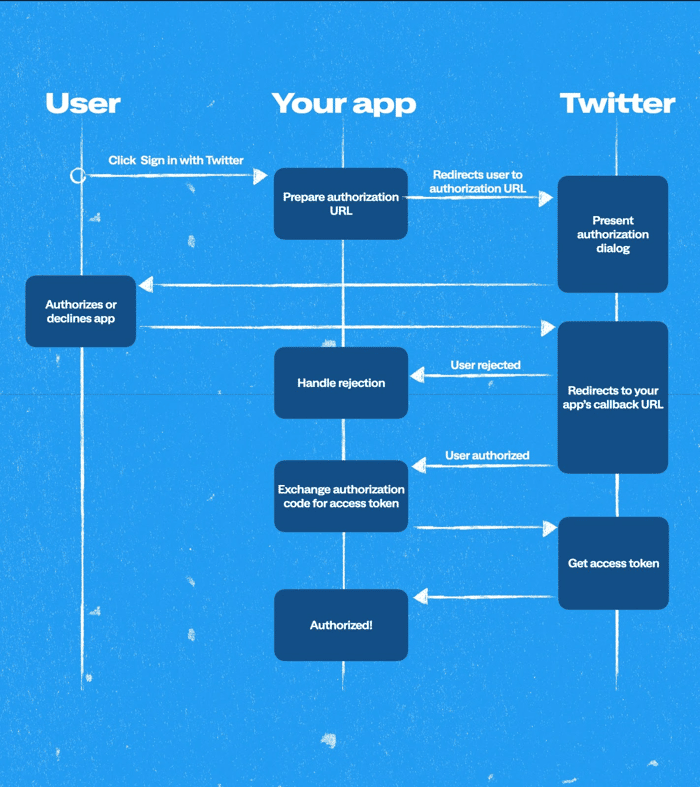
So at the end of week 2 of https://bookmarksy.io ‘s development, I now have a (semi) functioning frontend and backend!
I’ll do a technical breakdown of each component in a future post but would like to spend some time talking about the challenges I faced integration twitter authentication.
Initially, I spent some time familiarizing myself with the authorization and authentication flows twitter exposes for app clients.
The type of app client I’m working with means my best option for authorization is OAuth2.0 with PKCE.
Q. What is OAuth 2 with PKCE?
A. OAuth 2.0 is the industry-standard protocol for authorization. Paired with PKCE (Proof key for code exchange), it helps prevent CSRF (Cross Site Request Forgery) and authorization code injection attacks.
A typical user story would look something like this:
-
User clicks sign in with twitter
-
user accepts authorization request
-
user is redirected to {SOME CALLBACK URL} containing code and state in query string. e.g:
-
Web app then requests an access token on behalf of the user using the code returned. E.g:
curl --location --request POST 'https://api.twitter.com/2/oauth2/token' \ --header 'Content-Type: application/x-www-form-urlencoded' \ --header 'Authorization: Basic {SOME AUTH TOKEN FOR YOUR APP}'\ --data-urlencode 'code={YOUR CODE RETURNED FROM CALLBACK}' \ --data-urlencode 'grant_type=authorization_code' \ --data-urlencode 'redirect_uri=https://www.example.com' \ --data-urlencode 'code_verifier=challenge' -
Access token is stored and used to make API requests.
The web app can revoke an access token like so:
curl --location --request POST 'https://api.twitter.com/2/oauth2/revoke' \
--header 'Content-Type: application/x-www-form-urlencoded' \
--header 'Authorization: Basic {SOME AUTH TOKEN FOR YOUR APP}'\
--data-urlencode 'token={SOME ACCESS TOKEN TO REVOKE}'
Initially, I tried to implement this by hand with the physical endpoints, which worked fine after some time, but after stumbling upon the twitter API SDK, I found a much more elegant solution https://github.com/twitterdev/twitter-api-typescript-sdk.
So now the code looks something like this:
// create an oauth2 client
const authClient = new auth.OAuth2User({
  client_id: process.env.CLIENT_ID,
  client_secret: process.env.CLIENT_SECRET,
  callback: "http://127.0.0.1:3000/callback",
  scopes: ["tweet.read", "users.read", "offline.access"],
});

const client = new Client(authClient);

// redirect client to this url
const authUrl = authClient.generateAuthURL({
  code_challenge_method: "s256",
});

// after authorization, retrieve code from query param
await authClient.requestAccessToken(code);

// revoke token
const response = await authClient.revokeAccessToken();
Which works wonderfully!
My only concern at the moment is that the revokeAccessToken doesn’t use a parsed access token, so I’m unsure as to how exactly it knows which token to revoke access to and whether this will impact multiple users.
But otherwise, https://twitter.com/bookmarksy_io (https://bookmarksy.io) is coming along well!
Follow the journey on twitter bookmarksy_io or brandonkpbailey and join the waitlist! https://brandonkpbailey.substack.com/

Hi - I’m actually working on something similar… a bit more elaborate though. Would you be open to combine resources and forces? I’m a product/business profile. As I’m new here, feel free to ask me any questions you might have - I’ll do the same as well.
Hi Kuups,
Thanks for reaching out but im not currently looking to collaborate on a project!