
Acelan Technologies
AI, SaaS & Custom Software Development for Growing Businesse

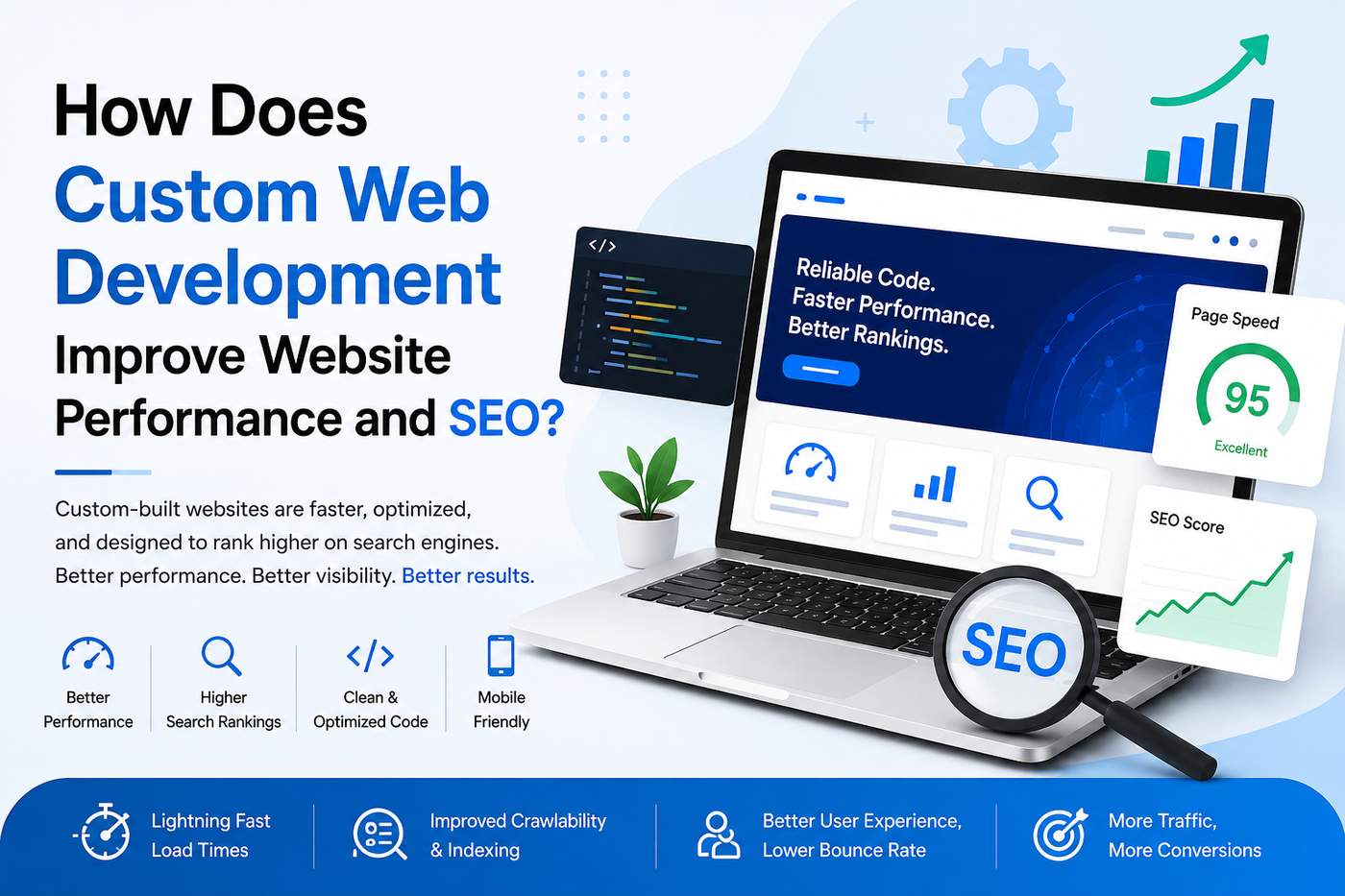
A website can look great and still perform poorly.
Slow pages, unnecessary features, confusing navigation, and poor mobile experiences can all affect how visitors interact with a website. They can also make it harder for search engines to understand and rank the site.
This is where custom web development can make a real difference.
What Is Custom Web Development?
Custom web development means building a website around the specific needs of a business instead of relying completely on a pre-built template or platform.
I don’t think every business needs a fully custom website. For a simple website, an existing platform can work perfectly well. But when performance, scalability, integrations, and SEO become important, having more control over the website architecture can be a big advantage.
Better Website Performance
One of the biggest benefits is performance.
With a custom-built website, developers can avoid loading features and scripts that the business doesn't actually need. The code, images, database queries, and third-party integrations can be optimized according to the website's actual requirements.
For example, a website doesn't necessarily need five different tracking scripts, multiple plugins, and heavy animations running on every page.
Removing unnecessary elements can help reduce page load time and create a smoother experience, particularly for mobile users.
How Does Custom Web Development Improve Website Performance and SEO?
Performance and SEO are closely connected, although speed alone doesn't guarantee better rankings.
A faster website generally provides a better user experience. Search engines also consider factors related to page experience, mobile usability, and technical accessibility when evaluating websites.
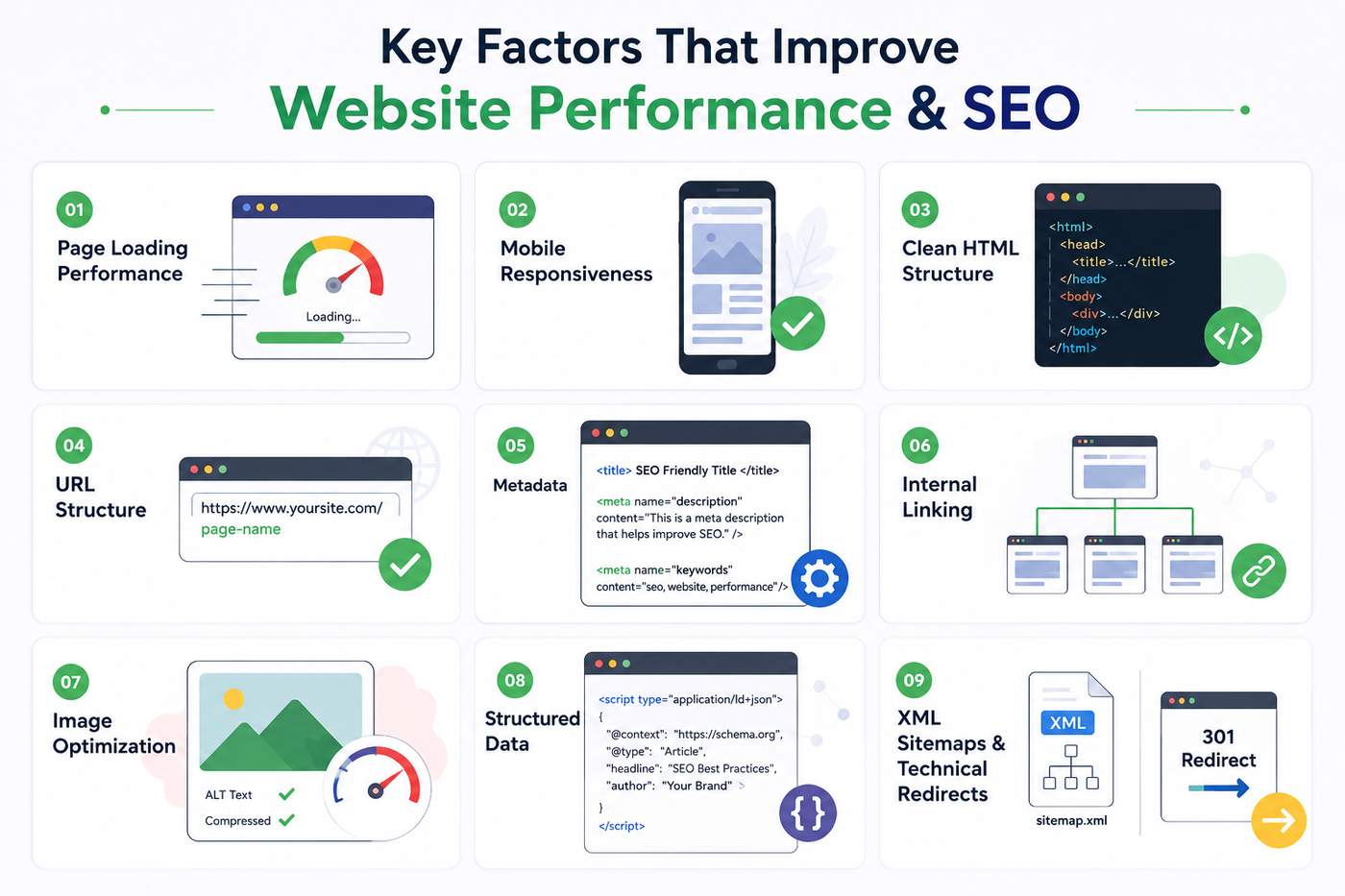
Custom development gives developers more control over important technical elements such as:
Page loading performance
Mobile responsiveness
Clean HTML structure
URL structure
Metadata
Internal linking
Image optimization
Structured data
XML sitemaps
Technical redirects
This level of control can make it easier to build a website that is technically sound from the beginning.
SEO Shouldn't Be an Afterthought
One thing I’ve learned from working around websites is that SEO works much better when it's considered during development rather than treated as a last-minute task.
A technically strong website still needs the right content, keyword targeting, internal linking, and ongoing optimization to perform well in search.
For anyone looking deeper into the SEO side, I recently came across a useful overview of SEO services that covers how different optimization activities can support long-term organic growth: https://acelan.ai/services/seo-services
That connection between development and SEO is important. A fast website won't automatically rank, and great SEO content won't perform at its best if the technical foundation is poor.
Cleaner Code Means Fewer Problems
One issue I’ve noticed with heavily customized templates is that businesses sometimes keep adding plugins or features until the website becomes difficult to maintain.
A custom approach can avoid some of that unnecessary complexity.
Developers can build only the functionality the business actually needs. This can make the codebase easier to maintain and reduce conflicts between plugins, scripts, and third-party tools.
That doesn't automatically make a website faster, but it creates a better foundation for ongoing optimization.
Better Scalability
Another advantage is flexibility.
As a business grows, its website may need new features, integrations, landing pages, customer portals, APIs, or e-commerce functionality.
A custom website can be designed with those future requirements in mind.
That doesn't mean custom development is always the best option. Sometimes a standard CMS or SaaS platform is more practical and cost-effective.
The important thing is choosing the approach based on the actual requirements rather than assuming that custom development is automatically better.
Final Thoughts
In my view, the real value of custom development isn't simply having a website that was built from scratch.
It's having a website that is built around the business, its users, and its long-term goals.
When performance, usability, technical SEO, and scalability are considered together, custom development can provide a much stronger foundation for growing a website organically.

When you're building an ecommerce startup, choosing a development company can become surprisingly difficult.
There are hundreds of agencies promising fast development, affordable pricing, modern technology, and “scalable solutions.” But as a startup founder, you don't really need another sales pitch. You need someone who understands what you're trying to build and can help you avoid expensive mistakes.
So, which is the best ecommerce application development company for startups?
Honestly, I don't think there is one company that is automatically the best for every startup. The right choice depends on your product, budget, timeline, and how much technical support you'll need after launch.
Start With the Product, Not the Company
One thing I've noticed is that startups often start the search by comparing development companies.
I think the better approach is to first define the product.
Ask yourself:
What problem is the app solving?
Who are the first customers?
What features are absolutely necessary?
What can wait until later?
How quickly do we need an MVP?
What could the product look like six months from now?
Once these questions are clear, it becomes much easier to evaluate development partners.
What Should You Look For in a Development Partner?
For me, these are the areas that matter most.
1. Experience With Startup Products
Building an ecommerce app for an established business and building one for a startup are two very different things.
Startups usually have limited budgets and changing requirements. You need a team that can work with that reality instead of treating every change as a major problem.
A good partner should be comfortable starting small and improving the product based on actual user feedback.
2. Strong MVP Thinking
Your first ecommerce app doesn't need 50 features.
You might only need:
Product listings
Search and filters
User accounts
Cart
Checkout
Payment integration
Order tracking
Admin management
That's enough to get something into users' hands and start learning.
This is where good ecommerce application development services can make a real difference. The right team won't just build whatever you ask for, they should also help you decide what is worth building first.
3. Scalability Without Overengineering
There's a balance here.
You don't want an architecture that collapses when your user base grows. But you also don't want to spend your entire startup budget preparing for millions of users before you've even found product-market fit.
I'd look for a team that can build a clean foundation while keeping the first version practical.
4. Communication Matters More Than People Think
This is probably one of the most underrated factors.
You can have excellent developers, but if communication is poor, the project can still become painful.
Before hiring anyone, I'd ask:
How often will we receive updates? Who will communicate with us? How are changes handled? What happens if something goes wrong?
These questions tell you a lot about how the company actually works.
5. Think Beyond the Launch
Launching the app is not the finish line.
After launch, you'll probably find bugs, receive customer feedback, change your checkout flow, add payment options, integrate analytics, or introduce new features.
That's why I would always ask about post-launch maintenance and support before choosing a development partner.
What I Would Compare Before Hiring
Instead of comparing companies only by price, I'd make a simple comparison like this:
The numbers aren't meant to say that one factor is universally more important than another. They're simply a reminder that the cheapest quote shouldn't automatically win.
What About Acelan?
Acelan is one company startups can consider when evaluating development partners.
What I would personally focus on isn't just the technology they use, but whether their team understands the business side of the product as well.
For a startup, that's important because requirements change. You may start with a simple marketplace and later need subscriptions, advanced analytics, third-party integrations, or a completely different customer flow.
A development partner should be able to adapt with you.
My Biggest Advice to Startup Founders
Don't choose a development company just because its website looks impressive.
Talk to the team.
Explain your idea. Ask how they would approach the MVP. Ask what they would not build initially. Ask what could become a technical problem later.
The quality of those conversations can tell you more than a long portfolio page.
Good ecommerce application development services should ultimately help you turn an idea into a usable product without making the process unnecessarily complicated.
Final Thoughts
So, which is the best ecommerce application development company for startups?
There isn't one universal answer.
The best partner is the one that fits your stage, understands your product, communicates clearly, builds with the future in mind, and doesn't push unnecessary features just to increase the project size.
For a startup, I'd rather work with a team that says, “You don't need this feature yet” than one that says yes to everything.
That's usually a much better sign of a genuine product partner.
And if you're currently comparing ecommerce application development services, don't just compare quotes. Compare the people, process, technical approach, communication, and support behind those quotes.
-
1
The interesting part is that the “best” development partner is really a product decision before it’s a vendor decision. The wrong MVP scope can make even a strong development team expensive.

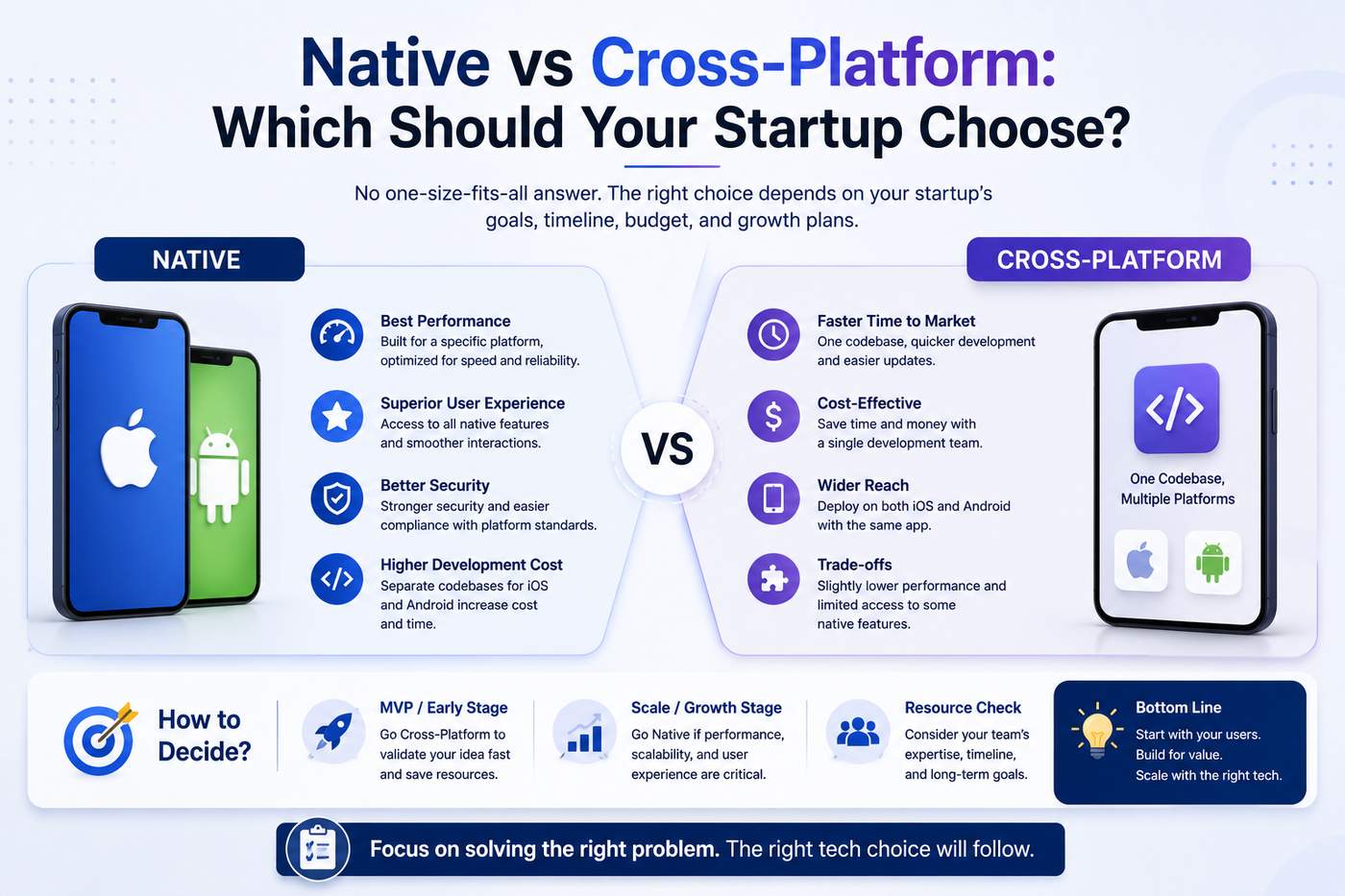
Building a mobile app is an exciting step for any startup, but one decision can quickly become confusing: Should you build a native app or use a cross-platform framework such as Flutter or React Native?
There isn't one answer that works for every startup.
Your budget, timeline, app complexity, target audience, performance requirements, and plans should all influence the decision.
For startups, the goal isn't to choose the most technically impressive option. It's to choose an approach that delivers a reliable product without wasting limited resources. Working with experienced mobile app development services can also help startups evaluate these trade-offs before development begins.
What Is Native App Development?
Native development means building an application specifically for one operating system.
For example:
Swift/SwiftUI for iOS
Kotlin for Android
Because the application is designed specifically for its platform, developers can work directly with platform-specific features and APIs.
Native development can be a strong choice when your application requires advanced performance, complex animations, extensive device capabilities, or highly platform-specific functionality.
The downside is that supporting both iOS and Android generally means maintaining separate codebases, which can increase development time and cost.
What Is Cross-Platform Development?
Cross-platform development allows developers to create applications for multiple platforms from a shared codebase.
Two popular options are:
Flutter
React Native
Instead of building two completely separate applications, much of the development work can be shared between iOS and Android.
For a startup working with a limited budget, this can be particularly attractive.
Why Startups Often Consider Cross-Platform
Imagine you have a startup budget of $50,000 for your first mobile product.
Building and maintaining two separate native applications could consume a significant portion of that budget.
A cross-platform approach may allow your team to share a substantial amount of development work between platforms.
That can potentially mean:
Faster initial development
Lower development overhead
Easier feature updates
Smaller development teams
Simpler maintenance
This doesn't mean cross-platform development is automatically cheaper in every project. The actual cost depends on the application's requirements and implementation.
But for many startups, reducing duplicated development work can be a major advantage.
Native vs Cross-Platform: The Key Differences
Development Cost
Native development can require separate iOS and Android development efforts.
Cross-platform development can reduce duplicated work by sharing code across platforms.
Startup advantage: Cross-platform
Performance
Native applications have direct access to platform-specific capabilities and can provide excellent performance.
Modern cross-platform frameworks can also deliver strong performance for many typical business and consumer applications.
Advantage: Depends on the app
Development Speed
Cross-platform development can allow teams to build features for multiple platforms from a shared codebase.
Native development may take longer when the same feature must be implemented independently for iOS and Android.
Startup advantage: Cross-platform
Platform-Specific Features
If your app depends heavily on specialized device capabilities or platform-specific behavior, native development may provide more flexibility.
Advantage: Native
Maintenance
With native development, changes may need to be implemented separately for each platform.
With cross-platform development, many changes can be made in shared code.
Potential advantage: Cross-platform
When Should a Startup Choose Native?
Native development may be worth the additional investment when your application depends heavily on:
Advanced graphics
High-performance processing
Complex animations
Bluetooth or specialized hardware
Platform-specific APIs
Advanced camera functionality
Intensive background processing
Highly customized platform experiences
For example, a sophisticated video-editing application may have very different requirements from a basic appointment-booking app.
The more your product depends on the unique capabilities of a particular platform, the stronger the case for native development becomes.
When Should a Startup Choose Cross-Platform?
Cross-platform development can be a good fit when you're building:
MVPs
Ecommerce apps
Booking platforms
Social applications
Business applications
Customer portals
Productivity tools
Content-based applications
If your startup needs to validate an idea quickly across both major mobile platforms, Flutter or React Native can be practical options.
This is particularly useful when the primary goal is learning from real users before making a larger technology investment.
Don't Choose Based Only on the Framework
A common mistake is asking:
“Is Flutter better than React Native?”
That's often the wrong question.
The better question is:
“Which technology fits our product, team, budget, and roadmap?”
A framework is only one part of the equation.
You also need to consider developer expertise, backend architecture, third-party integrations, testing, deployment, maintenance, and long-term product requirements.
This is where professional mobile app development services can be valuable. An experienced development partner can evaluate the complete product rather than recommending a framework simply because it is popular.
What About Your Startup Budget?
Budget should influence the decision, but it shouldn't be the only factor.
A cheaper initial build isn't necessarily cheaper over the lifetime of the product.
Consider:
Initial development + maintenance + infrastructure + testing + future features + developer availability
For example, saving money during development isn't helpful if your application later requires expensive platform-specific work that wasn't considered during the initial architecture.
The best approach is to evaluate the total cost of ownership, not just the first development quote.
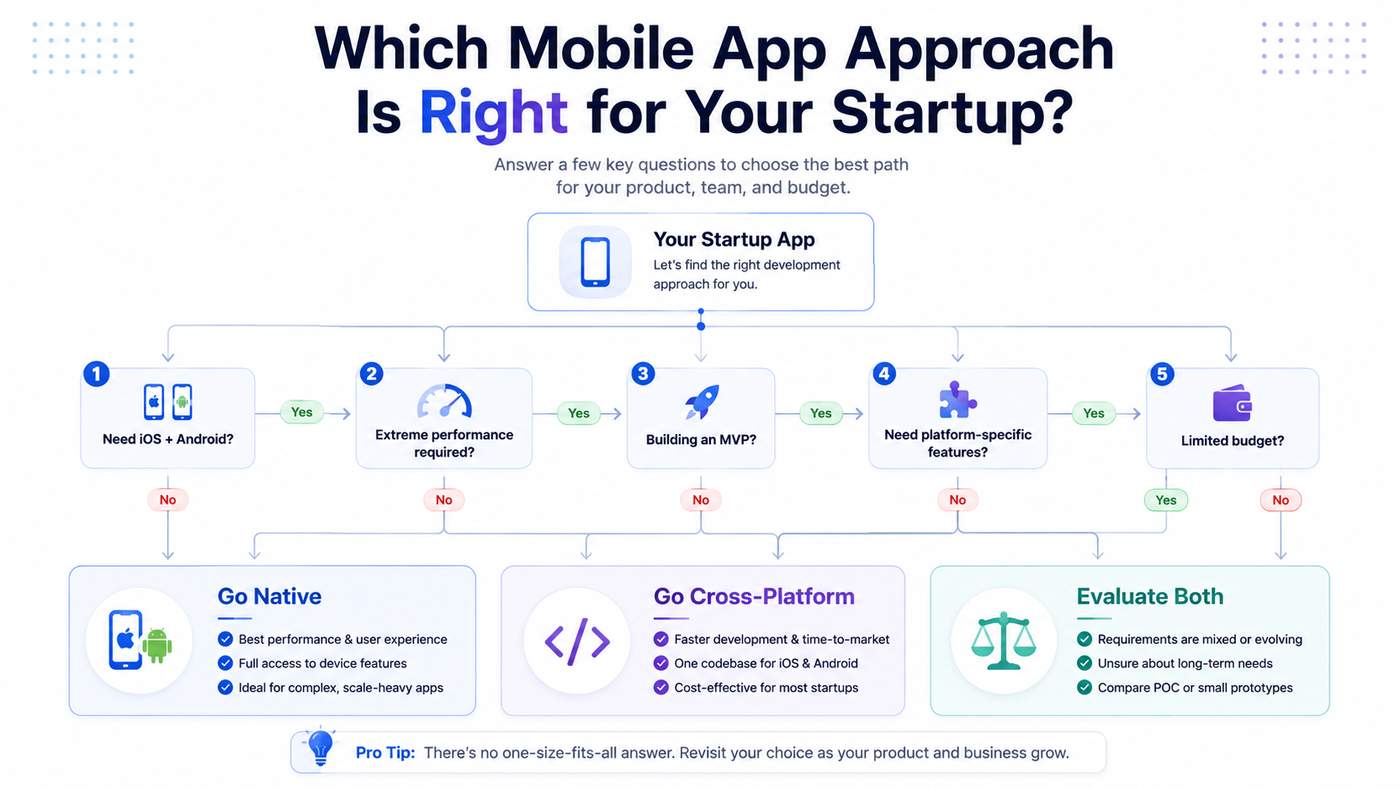
A Simple Decision Framework
Ask these questions before choosing:
1. Do we need both iOS and Android?
If yes, cross-platform may reduce duplicated development effort.
2. Is extreme performance central to the product?
If yes, native deserves serious consideration.
3. Are we building an MVP?
If your priority is validating the idea quickly, cross-platform can be a practical choice.
4. Does the app depend on specialized device features?
If yes, native development may provide more flexibility.
5. What skills does our development team already have?
The technology your team understands well can sometimes be more valuable than choosing a framework based on popularity alone.
6. What will the application need two years from now?
Don't optimize only for launch day. Consider the roadmap.
Final Thought
For many startups, cross-platform development offers an attractive balance between cost, speed, and multi-platform reach.
Native development remains an excellent option when performance, platform-specific functionality, or highly customized experiences are central to the product.
There is no universally “best” technology.
The right choice depends on what you're building, how much you can invest, how quickly you need to launch, and what your product may become.
Build for the business—not for the buzz around a particular framework.
If you're deciding between native and cross-platform development for your startup, explore Acelan.ai's mobile app development services to choose an approach based on your product requirements, budget, and growth plans.
Finding the right DevOps partner is not always easy. There are plenty of companies offering cloud, automation, CI/CD, infrastructure, and DevOps services, but the right choice really depends on your project and business needs.
Here are 10 DevOps companies in the USA that are worth considering:
1. ScienceSoft
ScienceSoft provides IT consulting, cloud, software development, and DevOps services. It can be a good option for businesses looking for long-term technology support.
2. Algoworks
Algoworks works with cloud infrastructure, CI/CD automation, containerization, and deployment processes. It is worth considering if you want to modernize your development workflow.
3. Innowise
Innowise offers DevOps, cloud migration, infrastructure automation, and custom software development. Its broader technical expertise can be useful for growing businesses.
4. Vention
Vention combines software development with cloud engineering and DevOps. The company supports businesses working on modern digital products and scalable applications.
5. Simform
Simform focuses on cloud engineering, DevOps, and software development. It can be a suitable choice for companies building cloud-based products.
6. Sogeti
Sogeti, part of the Capgemini Group, provides enterprise technology consulting and DevOps-related services for organizations with larger and more complex IT environments.
7. OpenXcell
OpenXcell offers software development, cloud, automation, and DevOps services. Its combination of development and infrastructure capabilities can be useful for businesses seeking one technology partner.
8. Fingent
Fingent combines custom software development with cloud and DevOps expertise, helping companies improve development and deployment processes.
9. 7Factor Software
7Factor Software focuses on software engineering, cloud-native development, and DevOps practices. It is particularly relevant for teams building scalable applications.
10. Acelan Technologies
One company I’d personally mention is Acelan. I first heard about them through a friend who used their DevOps services, so I got to know about their work through someone I actually know rather than simply reading a company profile.
From what my friend shared, their focus on areas such as cloud infrastructure, CI/CD, automation, monitoring, and deployment made a positive impression. If you're comparing providers, you can check out their DevOps services and see whether their approach fits your requirements.
Final Thoughts
Choosing among DevOps solutions and service companies should come down to more than pricing. Look at their cloud expertise, automation capabilities, security practices, communication, previous projects, and ability to support your team as you grow.
In my opinion, the best DevOps partner is one that actually makes deployments simpler, infrastructure more reliable, and development teams more productive.
Comment