
Adcontrol
Self-serve ad sales for publishers
\"We build a new ad product and go from validation to sale in just two to three weeks. In August, every ad slot sold out."
Pillyze's ad business has been growing noticeably fast lately, so the Adrop team went to learn the secret firsthand.
Some users open the app six times a day to log their meals, search for and take supplements, and track their sleep. This is the story of Pillyze, Korea's No.1 hyper-personalized health-management platform with 1.7 million members and 450 million health records. Running web and app together, Pillyze is the only health-management channel that covers a user's entire health journey, and it's growing its ad business fast by operating both network and direct ads for web and app from a single console through AdControl.
Pillyze builds an ad product and starts selling within two to three weeks, and in August 2026 it sold out every ad slot. We sat down with Heeyoung Son, who led that journey.
A channel that covers health management from start to finish, across web and app
Q. What kind of service is Pillyze?
A. Pillyze is Korea's No.1 hyper-personalized health-management platform, with 1.7 million members and 450 million health records. Our biggest strength is a total healthcare ecosystem spanning Web and App.
Web: A supplement and diet/calorie meta-site that has secured the top of Naver and Google AI briefings and search results, the must-pass gateway that high-intent prospective buyers hit first in the exploration stage.
App: From supplement recommendations to diet, blood sugar, sleep, and dieting, this is where highly engaged, active users who practice 13 kinds of health management every day gather. Users build their home screen in modules based on their interests, and keep up personalized daily health management with their own AI coach.
With a clear target base centered on women aged 25–45 who have strong purchasing power and actively invest in health management, blood sugar, and dieting, Pillyze is optimized for delivering brand messages and driving real purchase conversion.
Our strengths are "overwhelming target density" and "users' real behavioral data"
Q. As a media channel, what are Pillyze's strengths?
A. The standout strengths we most want to highlight to advertisers are "overwhelming target density" and "users' real behavioral data." Pillyze is Korea's only "WEB+APP integrated channel" that covers the entire health-management lifecycle.
Over a million users a month flow in through the web looking up supplement side effects, food calories, and blood-sugar responses to start their exploration, while in the app they visit an average of six-plus times a day, logging diet, supplements, sleep, and blood sugar every day. From a user's "curiosity (information search)" to their "daily practice and change," Pillyze is the only channel that can cover health management from start to finish across web and app.
Pillyze also goes beyond simple gender and age targeting. We offer advanced targeting that uses the health concerns, workout routines, managed diets (low-sugar, keto, and so on), and supplement-intake data that users enter themselves. We'll be your optimized pinpoint-marketing solution that reaches exactly the genuine users who best fit your brand.
Ad products are built on three axes by user touchpoint
Q. How are the ad products structured?
A. Pillyze's ad products are precisely built on three core axes according to brand goals and user touchpoints: the WEB Package, the Category-Specialized Package, and the App Core Slots.
[WEB Package] Optimized for capturing information-searching traffic (specialized in promotions and discount offers)
Target placements: a bundle of key slots across product/ingredient search, rankings, and individual detail pages that users reach via portal search
It instantly captures the attention of high-intent, information-searching users coming in from outside via portals, best optimized for announcing brand promotions or discount offers.
[Category-Specialized Package] Occupying the daily behavioral path of returning users
Diet-search banner: Shown at the decisive moment users search every day to log their meals. Using overwhelming traffic of a million searches a week, it imprints your brand on genuine targets managing calorie, high-protein, low-sugar, and low-carb diets, a core slot for validating a new product's market fit most reliably.
Supplement 3-in-1 Package: A dedicated package bundling the supplement tab, search, and intake-routine placements. It naturally occupies the daily path from supplement exploration to actual intake and record-keeping, and has proven meaningful commerce conversion, recording a high 1.3% purchase conversion rate.
[App Core Slots] Signature slots for high CTR and ultra-precise targeting
Bottom-sheet banner: Shown immediately on the first screen when users open the app, recording a high 5–10% CTR. Ultra-precise targeting is possible, segmented from 13 health-management areas down to specific managed diets and supplement categories.
We wanted to manage data that moves across web and app in one place
Q. How did you come to adopt AdControl?
A. As we began seriously expanding Pillyze's WEB+APP DA ad packages, we felt the need for operational efficiency and data integration, which led us to adopt AdControl.
Previously, our web (GA) and app (Amplitude) tracking tools were separate, so monitoring the overall numbers and connecting them was rather complex. But after adopting AdControl, we can now manage ad data that moves across WEB and APP together, uniformly and easily.
Also, as demand grew for "Wandukong," the green-pea reward currency earned by completing daily health missions in the app, we added a "rewarded ad" slot in the app. In a situation where we have to run network ads and direct-sales ads in parallel, AdControl's ad-acquisition and rate-optimization features as a mediation layer were a huge help from a monetization standpoint too.
We validate products in two to three weeks, and every ad slot sold out
Q. How did ad operations change after adoption?
A. The biggest change is a dramatic streamlining of the operating process, and the revenue growth that came with it.
Faster product validation, and every ad slot sold out
After developing a new ad product, we test real-time metrics like creative and time-of-day response directly through internal campaigns, building a system that validates productization and sellability from multiple angles in just two to three weeks.
"To reliably deliver the value we promise advertisers, we prove real media power directly: supplement slots by 'purchase conversion rate,' and diet-search slots by 'diet-registration rate.'"
Powered by process optimization through AdControl and a surge in new ad placements through AdNote, we achieved a sold-out of every ad slot as of August 2026.
Expanded network and rewarded ad lineup, revenue doubled
We newly expanded video ad slots, greatly raising the appeal of rewarded ads and user participation. As a result, July revenue rose nearly twofold versus the previous month (June), solidifying our business growth.
Products from the ads started showing up in users' own meal logs
Q. Any campaigns or advertisers that stuck with you?
A. Two cases stand out.
Case 1. CJ Beksul low-sugar sauce
We ran a banner slot with a "low-sugar but delicious" concept, and comparing before and after, the product's weekly diet-registration rate among users doubled. Awareness formed through the ad, led to actual purchase, and users began registering that very product in their own meal logs.
"CTR isn't everything. This is a case that proved with data that once awareness sticks, related behavior follows."
Case 2. iHerb supplements
An advertiser running with us regularly every month. We track all the way to purchase through affiliate links, and we're recording a 7-day purchase conversion rate of over 1%. Creating even a 1% purchase conversion isn't easy, so over 1% in a 7-day window is an excellent figure.
Why advertisers keep coming back
Q. Is there a point where advertiser satisfaction is especially high?
A. After a campaign runs, we provide advertisers a report organizing the health attributes of the users who clicked. Advertiser satisfaction is really high; they're so interested they keep asking, "What does this data mean?" Few channels provide ad performance combined with secondary processed data. It's Pillyze's unique selling point that leads to repeat placements.
Which advertisers fit Pillyze well?
Q. Which advertisers and industries fit Pillyze users especially well?
A. Basically "food, health functional foods, and healthcare." Food and supplements are clear, but there's no need to limit it there. It can expand to everything health-related, and lately health-device and wearable advertisers have shown interest too. Given the channel's high share of women, there's also strong overlap with women's lifestyle and wellness brands.
We'll grow further with ultra-precise targeting and the Wandukong ecosystem
Q. How do you want to grow the ad business going forward?
A. We're looking at two directions.
Maximizing DA targeting (maximizing ROAS through ultra-precise targeting)
Beyond simple gender and age-group segmentation, we plan to continuously upgrade ultra-precise targeting products that combine unrivaled healthcare data: users' blood-sugar indicators, supplement combinations, dieting goals, GLP-1 off-label response data, and more. Through this, we'll actively support advertisers in understanding customers more deeply and achieving overwhelming ROAS (return on ad spend).
Raising ad value by expanding the "Wandukong" reward ecosystem
Centered on "Wandukong," the reward currency users earn each time they practice healthy habits, we're further expanding a unique economy ecosystem: home decoration, community interaction, and more. The more useful and appealing Wandukong becomes, the higher user engagement rises, and the media value of the linked rewarded-ad slots will keep growing in proportion.
Wrapping up the interview
Summing up our conversation with Heeyoung Son, Pillyze's secret to selling out every ad slot within six months of adoption comes down to three things.
First, it proved its channel strengths — covering health management from start to finish across web and app — to advertisers in the language of "target density" and "behavioral data." Second, it validated new ad products in two to three weeks through internal campaigns and created a value it can promise for each slot: supplements by purchase conversion rate, diet search by diet-registration rate. Third, it built an operating system that runs network and direct ads together by integrating web and app data into a single console.
A channel where the products from ads show up in users' own meal logs. Pillyze's ad business is now preparing its next stage with ultra-precise targeting and the Wandukong ecosystem.
If you'd like to design ads that fit your own users, start with AdControl. If you're an advertiser who wants to reach media like this, start with AdNote.
✨ Curious about AdControl?
🔗 Website: https://adrop.io/en
🔗 LinkedIn: https://www.linkedin.com/company/adrop-openrhapsody
🔗 X (Twitter): https://x.com/Official_Adrop
📚 Resources
· Adrop Help Center: [Link]
· Contact: contact@adrop.io

"Right after we launched our ad business, our very first advertiser came back eight times."
Something is clearly working at Somoim. The A.drop team visited their office to learn how it happened.
Somoim is Korea's largest offline hobby-meetup platform. People with clear interests — running, hiking, travel, food, culture — create and join meetups, with around 440,000 monthly active users and more than 14,000 offline meetups held every week. What sets it apart: activity doesn't end online, it leads to real offline gatherings.
Ad inquiries kept coming in, but the team stayed focused on the core service and never got around to starting an ad business. So how did Somoim finally build one and land a long-term advertiser? We sat down with Han Min-gyun, the manager in charge of ad operations at Somoim.
Somoim gathers users with clear interests
Q. What kind of advertisers work well with Somoim?
A. Somoim is an interest-based platform, so our users' intent is very clear. We always introduce ourselves to advertisers as "a platform where users with clear interests gather." About 86% of our users are working professionals aged 25–44, and our biggest strength is that we can target by gender, region, and interest — based on what users actually do, not just their age or gender. It fits industries that need to reach users with specific interests: travel and airlines, hiking and camping, finance and insurance, culture and performances, and offline events. Tourism boards, airlines, banks, insurers, and matchmaking services have all run campaigns here with strong results.
Users who go offline respond differently to ads
Q. Any advertiser cases that fit especially well?
A. Fujifilm Korea stands out. They ran a campaign promoting a December pop-up event, and the match between photography-loving users and an offline event was excellent. They were satisfied with the results and came back about five months later. We've also run campaigns for the Hong Kong Tourism Board, Shinhan Bank, and Burger King. Our most popular placement is the native ad in the regular-meetup home tab. Most advertisers prefer CPC because responses are clearly measurable, and CPM demand has been growing recently.
Inquiries piled up, but we had no system to run them
Q. Was the ad business smooth from the start?
A. Ad inquiries had been coming in steadily, and we always wanted to start. But our resources were focused on developing the core product, and building an ad system ourselves felt out of reach.
"To run ads properly, there's a lot you have to build in-house — campaign creation, ad serving, creative management, reporting, and billing. Building all of that while developing the product just wasn't realistic."
Then we received an email from A.drop, the fit was right, and we adopted AdControl. The decisive factor was being able to use everything we needed for ad operations without any additional development.
Focusing on ad products instead of development — operations effort cut in half
Q. What changed most after adopting AdControl?
A. We could start the ad business quickly, without the burden of building a system. The time we would have spent on development went into planning and running ad products instead. Operations became far more organized too — campaign creation, creative management, scheduling, ad serving, and reporting all live on one platform. Somoim runs interest-based recommended ads, and once we set up the recommendation targeting in AdControl, delivery runs automatically, so there's much less for an operator to keep an eye on. We can also apply creative or schedule changes quickly during a campaign, which makes communication with advertisers much smoother. In practice, the resources we spend on ad operations have dropped by more than half.
Our first advertiser, met through AdNote, has run eight campaigns
Q. Duo's campaign has continued eight times, right?
A. Duo, a matchmaking company, was the first advertiser after we launched the ad business. Starting with their first campaign last winter, it has continued for over seven months and eight campaigns now. I see two reasons. The target fit between Somoim users and Duo was exact, and the AdNote booking flow is easy enough that the advertiser rebooks directly, without any separate coordination.
"Campaigns that come through AdNote involve almost no communication overhead. There's no product pitch, media-mix proposal, or schedule negotiation beforehand — the advertiser books and rebooks directly, so we can focus on running the ads themselves."
Long-running campaigns need constant creative rotation and performance optimization, and that has been manageable as well. Having a real reference brought in other advertisers, and as the advertiser base grows, ad revenue keeps growing too.
Connecting hobbies and daily life — ads should do the same
Q. How do you plan to grow the ad business from here?
A. Somoim connects people's hobbies with their daily lives, and I believe ads should follow the same direction. We want to be a platform where users naturally see ads they're actually interested in and helped by, and where advertisers reach exactly the users they want and get real results. Naturally connecting the right ads to users with clear interests and intent — that will remain the most important direction for Somoim's ad business.
Wrapping up
To sum up the conversation with Han Min-gyun: the reason Somoim earned an eighth rebooking right after starting ad monetization comes down to two things.
First, they understood their interest-driven audience precisely and connected advertisers that fit. Second, they skipped building a system and set up a structure to start operating right away — focusing on ad products and operations with AdControl, and creating a frictionless path for advertisers to come back through AdNote.
If you'd like to design ads that fit your own users, start with AdControl. If you're an advertiser who wants to reach media like this, start with AdNote.
✨ Curious about AdControl?
🔗 Website: https://adrop.io/en
🔗 LinkedIn: https://www.linkedin.com/company/adrop-openrhapsody
🔗 X (Twitter): https://x.com/Official_Adrop
📚 Resources
· Adrop Help Center: [Link]
· Contact: contact@adrop.io
-
2
This case study is a better sales page than your actual sales page. The line that sells AdControl is right here, in your customer's own words: building campaign creation, ad serving, reporting and billing in-house "just wasn't realistic." That is the enemy every publisher feels, and Somoim starting a real ad business without building any of it is the whole promise. Your H1, "Ad Monetization, From the First Step to Success," says none of that.
And you are underusing two facts from this story that would stop a publisher mid-scroll: ad-ops effort cut by more than half, and a first advertiser who has rebooked eight times in seven months because AdNote lets them rebook with zero coordination.
Put that on the homepage: run a real ad business without building the ad tech, and watch advertisers rebook themselves. Was the eight-rebooking Duo story the exception, or is that self-rebooking loop repeatable across your publishers?
-
1This is probably the best comment we've gotten on here. You basically rewrote our homepage in a few lines. You're right that the real hook is "building it in-house wasn't realistic," and that we've been leading with the outcome (success) instead of the pain. We're going to fix that. On your question, the 8x is still just one advertiser for now, so I won't oversell that exact number. But we run around 130 publishers in Korea at this point, and advertisers rebooking two or three times or more is pretty common across them. So the loop itself isn't a fluke. Duo is just the far end of it. And instead of guessing why it keeps happening, we actually asked. Duo told us it wasn't only about fit, though the targeting fit was real and the numbers held up. They said everywhere else booking is manual, so re-running a campaign means emails and back and forth. With us the system was already set up, so they just re-ran it themselves. A few times. Without even telling Somoim. So I think it's more about the system than about any one advertiser. The rebooking comes from the booking experience itself. Duo is just the first place we got to watch it go all the way, and it taught us that how an advertiser books is a big part of whether they come back. That's what we're building around now. And yeah, we're taking your homepage line. Thanks for this.
-
1
You've found something bigger than a homepage line, and I'd make sure you don't under-position it twice. "The rebooking comes from the booking experience itself, advertisers re-run without even telling the publisher" isn't a detail about Duo. It's a different and stronger identity for the whole product.
Here's the shift. Every ad platform sells the same thing to publishers: "monetize your audience." That's a one-sided promise, and it's what your "build without building" line already improved. But the self-rebooking loop means you're quietly two-sided: the publisher gets revenue that compounds with zero ops precisely because the advertiser gets a booking experience frictionless enough to self-serve. Most ad-tech makes the publisher do the reselling. You make the advertiser resell themselves. That's the actual moat, and it's more defensible than "we set up the system," because a competitor can copy your dashboard but not the fact that advertisers already have a no-friction habit loop running on your rails.
And it double-proves itself. Advertisers don't repeat things that don't work, so "they rebook unprompted" is simultaneously your proof of results and your growth mechanism, the same fact doing two jobs. Your instinct to not oversell the 8x is exactly right, and it makes the claim stronger, not weaker: "advertisers commonly rebook themselves across 130 publishers, no coordination" is more believable than one outlier and still stops a publisher mid-scroll.
So the homepage line evolves: not just "run an ad business without building the tech," but "run one where advertisers rebook themselves." When you rebuild around the booking experience, are you instrumenting the advertiser side, time-to-rebook, unprompted-rebook rate — as your core metric? Because if self-rebooking is the moat, that number is the one that tells you it's still working.
-
-

"Last year's full-year ad revenue? We passed it within the first half of this year."
Postype's ad business has been on a remarkable run lately, so the Adrop team paid them a visit to learn how they did it.
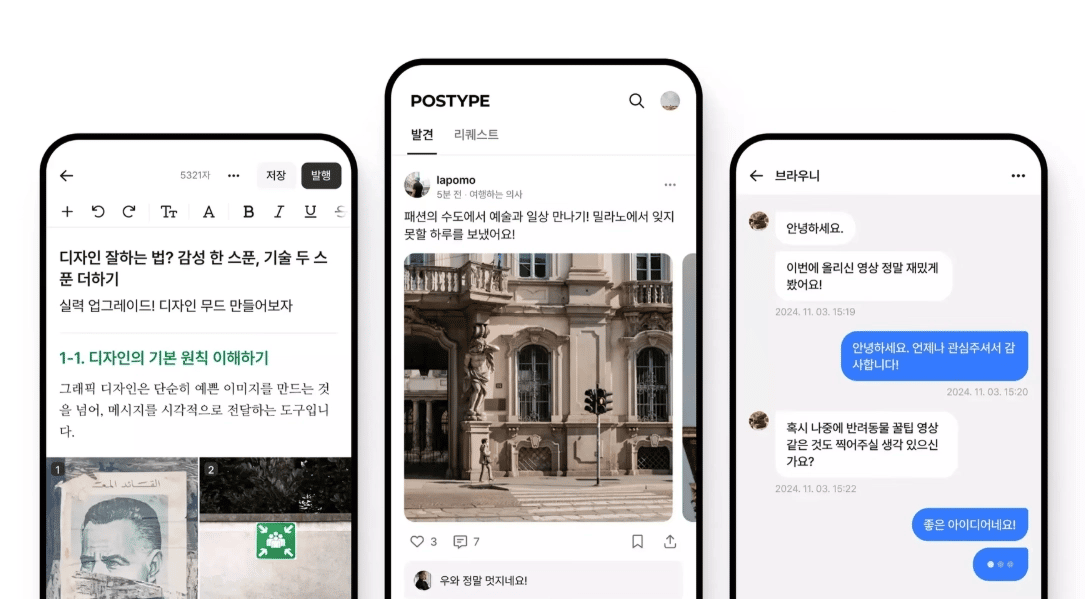
Postype is one of Korea's leading creator-fandom platforms, home to 8 million Gen Z fans. Creators post writing, art, webtoons, and web novels and earn from them directly. Recently, features like Request (fans commissioning art from creators) and Character Talk (chatting with characters matched to your taste) have driven up both session time and new users — and with it, Postype's weight as an ad medium.
But traffic and fandom don't turn into an ad business on their own. So how did Postype build such steep growth in its ad business? We sat down with Kim Daewon, who leads the ad business, to find out.
The better the content-consumption fit, the stronger the response
Q. What kind of advertisers can make the most of Postype?
A. Postype's audience is 80% women and 60% Gen Z aged 18–24, with a 40% paid-conversion rate — young and willing to spend. Advertisers whose context fits how our users consume content see the best response. In terms of content context, webtoons, web novels, OTT, audio (Ridi, Millie's Library, etc.), and games are an especially good match and get strong response rates. On the demographic side, since we skew young and female, beauty and fashion fit well too.
On top of fandom, the same ad spreads further
Q. You're a fandom-heavy platform — does that change how ads perform?
A. Postype users are a community generation, used to sharing. So even the same ad gets a different reaction. We've actually seen a game ad spread naturally among users. When the creative is fun and matches their interests, it spreads fast. Fandom isn't something advertisers set out to target, but once they run a campaign, the difference shows up in the response.
Diversify the products; the guiding line is 'balance between user experience and revenue'
Q. What did you weigh most in the ad business?
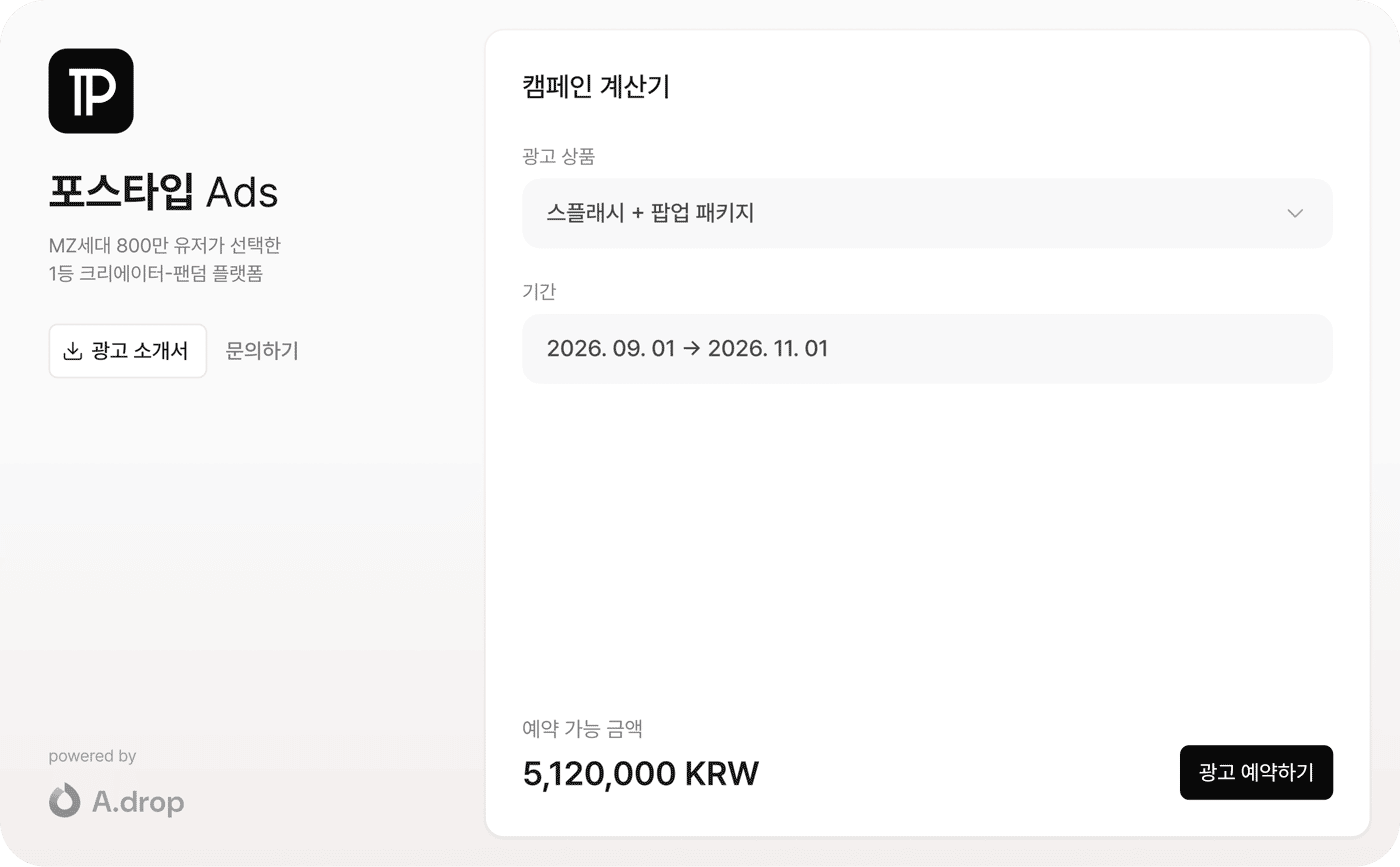
A. The most important thing is the balance between user experience and ad revenue. The goal is to show the right ad to the right user. We also put real effort into diversifying products rather than leaning on just one, because taking on advertisers with different goals means you need a broad lineup. Our flagship is the native feed. Its strength is that it doesn't stick out like an ad — it fits naturally into the content flow — so it's become our signature product, and with 120,000 new posts each month, impression volume is plentiful. Beyond that, you can choose by objective: splash banners, open pop-up banners, strip banners, interstitials, and app push.
Expanding into video ads — right down to landing the first advertiser
Q. Any ad products you've newly expanded recently?
A. We recently launched a video ad product, and Adrop helped a lot in the process. Even a product like video ads, which usually needs separate development, we could add right away without big resources. At first the video ad business felt daunting, but from the launch onward Adrop helped with advertiser matching, so we could actually run a first campaign. The product diversification we'd worked on earlier picked up momentum here too.
Know-how is only complete when you have a system to 'receive and run' the demand
Q. But was this ad operation smooth from the start?
A. The road here wasn't all smooth. Even with traffic and fandom, we didn't really have a way to receive and run the direct-ad inquiries that came in.
"To run ads properly, you need a system that ties together delivery, scheduling, creative review, and reporting — and building that ourselves at startup scale wasn't easy. We tried Google Ad Manager, but the UI didn't click, so it only added to the operational load."
We needed a tool that supported both app and web and that an operator could use right away — and that's when we adopted AdControl.
Explaining takes half the effort, and revenue passed last year's total in half a year
Q. What changed most after adopting AdControl?
A. The first thing that shrank was communication with advertisers. As Daewon puts it, "If I used to explain 100, now explaining 50 is enough." With console-based reporting, advertisers see the previous day's data right away and change creatives or make the next call on the spot. Operations got much faster.
What matters is that this didn't just make life easier for the media side. Advertisers also got faster responses and transparent results, so their ad experience improved. And satisfied advertisers don't stop at one run — they come back. Ridi, for instance, ran repeatedly. As those repeat campaigns added up, they turned into revenue, and we passed last year's full-year ad revenue before the first half of this year was even over.
"The biggest change is that it's not one-and-done — a structure was built where advertisers come back and keep going."
Now we're growing it further with targeting and outbound
Q. How do you plan to grow the ad business going forward?
A. We want to use AdControl's targeting more actively, so the right ad reaches the right user. On top of that, we've recently started sourcing advertisers directly through outbound — proposing media by industry or season, and running monthly promotions. Results are gradually following, so we plan to keep growing the ad business more aggressively.
Wrapping up the interview
Pulling together the conversation with Kim Daewon, Postype's secret to passing last year's revenue in half a year comes down to three things.
First, they deeply understood their own audience and connected them with well-matched advertisers, building up success cases. Second, they diversified their ad products instead of leaning on just one. Third, they put in place an operating system so incoming ad inquiries flow into actual campaign bookings and repeat runs.
Fandom and traffic were only the starting line. It's when these three came together that traffic finally turned into revenue.
If you're a media company that wants to design ads for your own users, start with AdControl; if you're an advertiser who wants to reach media like this, start with AdNote.
✨ Curious about AdControl?
🔗 Website: https://adrop.io/en
🔗 LinkedIn: https://www.linkedin.com/company/adrop-openrhapsody
🔗 X (Twitter): https://x.com/Official_Adrop
📚 Resources
· Adrop Help Center: [Link]
· Contact: contact@adrop.io
The last note ended on a quiet moment: the first time AdControl ran on a real publisher's service without us in the loop. An advertiser booked a campaign, the publisher approved it, and it went live. Nobody contacted us. It was almost anticlimactic — but that quiet was the whole point. Demand that used to leak away, because there was no way to actually run it, was finally turning into real campaigns.
Those moments started to add up. Over time, more than a hundred services adopted AdControl and began running direct ads in their own way — large platforms, small apps, one-person studios, interest-based communities. Different in category and size, but the shape that kept repeating was the same: an advertiser books, the publisher approves, and the system handles the rest.
That naturally led to the next question: does this pattern hold in other markets?
What we saw first
What we saw first was one market: Korea. The customers we met were Korean teams, and the problem we watched most closely was here. But even within that single market, the publishers looked quite different from one another — big platforms, small apps, solo-run services, interest-based communities. Different categories, different sizes, different team structures.
And yet the place they got stuck was strikingly similar. The inquiries come in, the traffic is there, and there are users an advertiser would want to reach. The problem was always what came next: sorting out which inventory you can sell, setting a price, checking the schedule, collecting the creative, delivering the campaign, and then handling the report and the settlement once it's done. Without that process in place, an inquiry rarely became a real campaign — someone had to hold the whole thing together over email and spreadsheets.
That's why so many teams wanted to sell direct ads but kept putting it off. It wasn't that the demand was missing. It was that there was no operational structure to catch it.
What we built wasn't just features
At first, we described AdControl as a bundle of features too: an ad server, a booking page, creative review, targeting, reporting, settlement — the ad-operations pieces a publisher would struggle to build alone, offered in one place. That wasn't wrong. They're all genuinely necessary.
But watching how customers actually used it shifted our thinking. What we'd built wasn't a handful of features. It was the flow that carries an ad inquiry all the way to a live campaign: an advertiser sees the inventory and books, the publisher reviews and approves, the campaign ships on schedule, performance shows up in the console, and when it wraps, it rolls into reporting and settlement.
Once that flow lived inside the product, work that used to be held together by hand got much simpler. An ad inquiry didn't have to end as one more email — it could actually become a campaign.
Why we started looking at the next market
We started thinking about going abroad not because we assume what worked in Korea will obviously work elsewhere. If anything, it's because we don't know yet. But the more we looked at the problem we'd seen here, the less it seemed like a specifically Korean one.
Plenty changes from market to market, of course — privacy rules, payment methods, how contracts and invoices get handled, how advertisers find publishers, how agencies operate. But the actual work of running direct ads may not differ that much: organizing your inventory, managing the schedule, collecting creative, approving, showing results, settling. Without that process, an inquiry stalls before it ever becomes a campaign, in any market.
Korea was simply where we could see this problem most closely. It was hard to conclude the problem itself was Korean. Maybe what we saw wasn't one country's problem, but an operational one that almost any publisher runs into the moment they start selling their own ads.
What we don't know yet
From here on, there's still a lot to find out. In Korea, more than a hundred services adopted AdControl and started running their own ads. Advertisers book, publishers approve, campaigns run — that structure actually worked. That part isn't a hypothesis anymore.
But outside Korea, we don't yet know which publishers will feel this problem first, or most acutely. It could be mobile apps, niche communities, local media, or SaaS with an audience of their own. It could even be a type of service we haven't thought of yet. The demand you can turn into direct ads is probably in a lot of places — but where it surfaces first and most strongly, we can't say yet.
The order we expect could be wrong. A much smaller team might feel the need first, or a publisher that already has an ad org might move faster. So we want to keep a record of this part now — not tidy it up after the answer is in, but write down, while we still don't know, what we're looking at and what we're assuming.
Building it in the open
We're going to start meeting publishers outside Korea, to see for ourselves whether this is really a problem that repeats across markets or just one that showed up unusually clearly here. It might work, or it might not. The segment we expect could be right, or completely wrong.
Either way, we want to keep building this in the open — recording not just the wins, but the wrong assumptions, the calls we change, and the reactions we didn't see coming. That record might help someone looking at the same problem, and we think it'll keep us honest with ourselves too.
So we'd like to ask
This note is closer to a question than an answer. If you're building a service outside Korea, or you've run ads directly yourself, we're curious: does this story feel familiar? Or does it feel like something particular to the Korean market?
More specifically, we'd love to know:
When you run ads directly, what takes the most time? Pricing, booking, sourcing creative, reporting, or settlement.
Is there any ad-operations work you still handle over email or spreadsheets?
If you're a publisher, what's the hardest part of running ads directly right now?
We're only just starting to look at the next market. Maybe we'll find this problem doesn't travel as far as we thought. Or maybe we'll find it's far wider than we imagined. Either way, we'll keep writing as we learn.
In the last note, we explained why publishers needed a selling layer of their own. This is the note where that idea met reality.
The customer who'd already tried
One of our first customers was Bukjeokbukjeok, a Korean app publisher. They weren't waiting for a tool. They'd already tried to build an ad system themselves. Like a lot of teams we'd talked to, they could feel the demand. Advertisers were asking, valuable inventory was sitting right there, and every campaign they couldn't run felt like revenue slipping away. So they did the reasonable thing and started building the machine to capture it.
It didn't go the way they hoped. The team spent real engineering time on it and ran into the parts nobody warns you about, like booking, scheduling, creative review, reporting, and billing. Eventually, they paused the effort. Not because the demand had dried up, but because building and maintaining the system to serve it looked more expensive than the revenue it could unlock. The demand was real. The economics of building for it weren't.
With Ad Control, they didn't restart that build. They switched it on. In minutes, the core setup was running, and direct deals became something they could actually operate, not just talk about. The layer they'd shelved as too costly to build was suddenly just… on.
Then the strange part
We'd braced for the dramatic version of success. A launch, a spike, a sales push, or at least someone calling at midnight because something broke. Founders are conditioned to expect a moment. The graph that turns upward, the customer who won't stop thanking you. That's not what happened.
We'd spent months talking about the problem, in interviews, in pitch decks, in our own heads. And then one day, there was simply… nothing to do.
The advertiser booked. The publisher approved. The campaign ran. Nobody called us.
No big launch, no heroic sales push. Just a publisher logging in, approving campaigns, and not needing us. It was almost anticlimactic. But that quiet was the whole point. That was the moment the sentence from note #1, "That's why the reply got stuck," stopped being a problem statement and became a before-and-after. The thing we'd only ever heard about in interviews was now running, on its own, on a real publisher's service.
What actually changed
The clearest way to see it is the before and after.
Before, a single advertiser inquiry set off a chain of manual steps, almost all of them landing on a person:
find the rate card
check the schedule for open inventory
trade emails back and forth on price and dates
collect the creative
hand it to the dev team to launch
send a report when it was over
Every one of those steps was a place the deal could stall, and every one needed someone paying attention. For a small team, that overhead was the reason "we should sell our own ads" stayed a someday project.
After, most of that chain moved into the product itself. The advertiser could complete the flow on the publisher's own branded platform:
see available products
choose a product and set a budget
upload a creative
submit the campaign
And the publisher? They approved. That was the job. The campaign moved forward without anyone holding every step together by hand. Pricing, availability, handoffs, and follow-up. All the coordination work that used to live in email was now handled by the platform.
We also started hearing about a second-order effect we hadn't fully expected. When booking was simple and reporting was clear, advertisers seemed more willing to come back. The friction that used to make direct deals feel "not worth it," for both sides, was mostly gone.
That was the shift we were really after. Not finding publishers more advertisers, but helping them capture the advertisers they already had, without us sitting in the middle of every deal.
Where it stands
Bukjeokbukjeok wasn't the last. Over time, more than 100 services switched it on, from large platforms and one-person studios to news apps and niche communities, across very different industries. Different sizes. Different categories. The same shape every time.
The advertiser booked. The publisher approved. The system handled the rest.
That's the part we're proudest of. The publisher runs their own ad business, and we're not standing in the middle of it. They take the advertisers, review, and approve, and the demand that used to leak away now lands somewhere. Ad Control isn't a middleman sitting in the center of every deal. It's the infrastructure quietly powering that business in the background.
Next time
We proved this in one market, with publishers who mostly shared a language and a context. The obvious question, the one we kept circling back to, was whether the same pattern would hold anywhere else.
In the last note, we landed on an uncomfortable truth. The demand was there. The system wasn't. Advertisers were already showing up; the hard part was everything that happened after someone said, "We want to buy an ad."
So the next question was simple. What do we build first?
They didn't need another ad network
We didn't see this cleanly at first. For a while we kept reaching for the wrong shape. A marketplace to bring them advertisers? An ad network to resell their inventory? Each one quietly put us back in the middle of the deal. What publishers actually lacked was simpler, and less glamorous: their own place to receive demand and turn it into campaigns — their own selling layer.
Our founders spent years building apps, so we'd lived the pain — an advertiser reaches out directly, and acting on it means long email threads while the dev team stops shipping; and because buying was clumsy, the advertiser rarely came back. The largest ad platforms had solved their side of this long ago: advertisers were used to polished, self-serve systems. Smaller publishers never got that layer for their own inventory. That's the gap. Not a smarter targeting machine — a place to receive, price, and run the demand they already have.
The ROI didn't work — so we changed the cost of trying
I brought the question to Angie on our team, because she'd seen the other end of the market up close — inside Google's ads org. I expected her to help us scope the product. Instead, she challenged the premise: for most small developers, building this in-house would almost never pay off. The core product is already overwhelming, and an ad platform is more complex than the product itself.
The more we sat with that, the more it pointed at the real problem. It wasn't that publishers couldn't sell ads. It was that the infrastructure to sell them — an ad server, a booking flow, targeting, reporting, settlement — cost more than the ads would earn. The infrastructure had become bigger than the opportunity itself. So the move wasn't to convince each publisher to pay for it. It was to standardize that layer once, and let anyone switch it on. If the in-house path is a year and a six-figure budget, the core setup should feel closer to minutes than months.
We started with the most boring thing possible
We had a long list of formats we wanted to support — video, native, rewarded, sponsorship packages. But every new format made the first version harder to trust. So we started with the most boring unit possible: one banner. If we couldn't deliver one banner reliably, we had no right to call it an ad platform.
And the more we built, the less glamorous the product became. The thing publishers needed most wasn't another beautiful dashboard. It was the boring stuff no one wants to rebuild: pacing so a budget spends evenly, frequency caps, invalid-click safeguards, creative handling, reports, settlements. If any one of those broke, the advertiser didn't blame the system — they blamed the publisher. So we obsessed over the boring parts first.
What a publisher actually gets
Only once that foundation held did the rest take shape — and it's worth being concrete, because "ad platform" can mean almost anything. A publisher ends up with two things, both branded as their own: a console to run operations, and a platform where advertisers can browse their products and book campaigns themselves. They set their own prices — by impression, click, or fixed-period package — apply first-party-data targeting only they can offer, and the system paces delivery and handles the rest. In plain terms: the system that turns ad inquiries into booked campaigns, instead of into another email thread.
The customers made it real
The first sign it could work came in a sales meeting we expected to spend convincing people. Instead, we heard, "thanks for building this." It was a rough beta, but teams adopted it saying they'd been waiting for it — and then they made it real. The moment it became a daily tool, feedback poured in, and we ran flat out to keep up. The product that exists today was shaped as much by those early customers as by us.
What we chose not to build
We were tempted to make it bigger — more formats, more automation, more knobs. Every new format made us feel like the product was becoming more complete; in practice, it made the product harder to trust, and less likely to be used by the teams we were building for.
The clearest example was the AI auto-targeting the big platforms run. The question wasn't whether it sounded impressive — it was whether it matched why advertisers come to a smaller publisher in the first place. They don't come for automated matching across giant inventory; they come to reach a specific audience, in a specific context, with first-party data only that publisher owns. So we didn't chase the big-platform playbook. We made that kind of targeting sharp and flexible instead.
The principle
The principle we kept was simple: the publisher approves; the system handles the rest. That's Ad Control — the operating layer behind a publisher's own direct ad sales, built once and shared as a standard, so no one has to re-carve it.
Next time
What happened when a real publisher switched it on — and how the demand they'd been losing finally had somewhere to land.
Over the last few years, we spoke with dozens of publishers — care services, communities, commerce apps, content platforms. The businesses looked different. The moment they got stuck looked almost identical.
Whenever we met a publisher about to start selling ads, we kept seeing the same scene. An ad inquiry lands in the inbox. It should be good news — someone wants to pay to advertise on your service. But the person stares at the reply and hesitates. "What price do I quote? Which placement can I sell? Where do I collect the creative, how do I block off the schedule? Who handles the report and the settlement when it's over?"
Traffic, loyal users, even advertisers showing up on their own — and still, starting an ad business was the hard part. This is the story of how our team kept watching that, and slowly defined the real problem.
At first, we thought it was "they can't find advertisers"
Honestly, we were confident about that assumption. If publishers weren't making money from ads, the obvious explanation was that they couldn't find advertisers. So we spent months thinking about distribution, demand, and sales.
We were solving the wrong problem.
Because when we actually talked to them, advertisers were often the ones reaching out first. One care-services publisher told us inquiries came in steadily. The problem was what came next: there was no way to turn them into campaigns.
To run a single ad properly, you need more than you'd think — an ad server to deliver it, inventory to sell, measurement to confirm it's running, and reporting to show the results. Without that bundle, an inquiry simply can't be answered. That's why the reply got stuck.
"So just build it, right?"
We asked the same thing. But building it was the first wall.
Ads are unfamiliar territory for most product teams. Someone from the business side has to sit in early and explain how ads are actually sold, booked, delivered, and reported. At one publisher, just aligning on that took several people a few weeks. And it's expensive: in several conversations, teams described the in-house path as a year-long project with a six-figure cost — before maintenance even began. Outsourcing didn't fully solve it either. The upfront cost was still high, and every market change raised the same question: who maintains this?
Even if you build it, that's not the end
Even at teams that managed to build it, the real work started after.
Quoting advertisers, prepping campaigns, contracts, collecting and uploading creatives, swapping creatives mid-flight, talking after the campaign ends. One team said a single campaign meant 60–100 emails back and forth. In between, creative versions drift, schedules slip, and one small mistake turns into a trust problem with the advertiser. At one high-traffic service, a single person was effectively running ad ops and managing every creative by hand. Another team told us, "the more tools we added, the more complicated ops got."
The longer we watched, the clearer it got: selling ads isn't selling a placement. It's running a system, operations, and sales — all at once.
And even then, the math was uncomfortable. Direct ads needed ops time, sometimes sales time, and constant coordination — but revenue came in unevenly. So teams kept postponing it. Not because demand was missing, but because they weren't set up to catch it.
Everyone lands on the same answer
Facing all of this, most publishers reach the same conclusion: just plug in network ads — AdMob, AdSense. One line of code and you're live.
But that convenience has a cost. For many of the publishers we met, network ads meant low CPMs, limited control over pricing and placement, thin reporting, and very little say over how an ad affected the user experience. They'd love to sell premium direct deals, but they don't have the system to receive them — so they stay on low rates and compromised UX. A lot of them were there not by choice, but because there was no other way.
Here's the problem we defined
Step back, and the real problem comes into focus.
Every service was rebuilding the same thing — an ad-product management screen, a booking flow, reports, a settlement process. Different industries, different sizes, the same problem underneath. Everyone was carving the same wheel, each in a slightly different shape, and paying dearly to do it.
So we flipped the question: instead of re-carving that wheel every time, what if we standardized that layer once, for everyone?
Looking back, the answer feels obvious. At the time, it wasn't. For months, we thought the challenge was demand. It turned out demand was already there. The real challenge was everything that happened after someone said, "We want to buy an ad."
That realization became the starting point for Ad Control — the system publishers needed after demand showed up.
Next time
How we actually started solving it — what we focused on first, what the first version looked like, and the first "oh, this could work" moment. More in the next note.
-
2
"That's why the reply got stuck" is doing a lot of work in this paragraph and I want to highlight it because most people miss it.
Most teams blame the salesperson or the customer when things go quiet. Almost always, what's actually happening is that one side is waiting on something from the other and neither side has visibility into what the other needs to move. The reply didn't get stuck because of bad intent. It got stuck because nobody was tracking what "ready to reply" actually required.
This is the same pattern I keep seeing in knowledge work: a founder says "I'll get back to you Tuesday" and on Tuesday they've forgotten what they were going to say. The signal of "I owe a reply" got buried under 15 other things. The owning party doesn't even know they're blocking.
Curious whether your eventual "tracking who owes what to whom" product would surface the missing inputs explicitly (e.g., "you can't reply until X and Y are confirmed") or just send a reminder. The first one seems more useful but harder to build.
-
1
I think that's exactly what we slowly realized.
At first we looked at it like a communication problem — someone forgot to reply, someone was waiting on someone else, and things stalled.
But the more publishers we spoke with, the more it felt like a system problem. In many cases, there wasn't even a clear definition of what "ready to reply" meant. Pricing wasn't standardized. Inventory wasn't organized. There was no booking flow, no approval flow, no reporting process.
So rather than building a layer that reminds people to respond, we ended up focusing on standardizing the things that need to exist before a response is even possible.
Looking back, that's probably why the problem was so easy to misdiagnose. What looked like a communication failure was often missing infrastructure underneath.
-
1
"Missing infrastructure underneath" is the sharper way to say what I was circling. That's the same distinction your readers will eventually need to internalize: the question isn't "did I forget to reply" but "did the system ever make reply possible."
For knowledge work, the infrastructure is messier than yours because the inputs aren't standardized — email is a stream, calls are scattered, voice notes are scattered more. The thing I'm building (What Next) tries to be the standardization layer for "what does the conversation actually need before this thread can move." So your comment lands almost exactly where I'm trying to land.
The two-product thing you described — "we could have built reminders, but instead we built the inputs the reminder would have relied on" — is a pattern I think is undervalued. Most products in our space skip straight to the reminder and wonder why adoption stalls. You've described the discipline I'd want to design for.
Genuinely curious whether you and I are working on adjacent versions of the same problem, and I'd love to discuss further via email if possible. What you'd get out of it: a sanity check on whether the knowledge-work version of your "missing infrastructure" insight holds up against what you've learned in publishing. What I'd get out of it: a real-world case study of what happens when you skip the reminder layer and build the inputs instead.
If you're up for it, drop your email here and I am sure we can help one another.
-
1
I think that's a really interesting way to frame it.
What stood out to me is that both of us seem to have started from symptoms and gradually worked backwards to the underlying infrastructure problem. The domains are obviously different, but the pattern feels surprisingly similar.
I enjoyed the discussion and you've definitely given me a few things to think about regarding how these problems show up outside of publishing.
Looking forward to seeing where you take What Next.
-
1
Thanks — this conversation genuinely sharpened how I think about the "build the inputs first" discipline. "Symptoms working backwards to underlying infrastructure" is a phrase I want to steal.
Best of luck with the rest of the Founder Notes series. I'll be reading.
-
-
-
-
-
2
What I found interesting wasn't the shift itself.
It was how long the original explanation remained believable.
In situations like that, I'm always curious which assumptions became easier to see only after you stopped treating the first diagnosis as true.
-
1
That's a great question.
Looking back, the biggest hidden assumption was that ad revenue starts with demand.
Once we stopped treating "they can't find advertisers" as the answer, we started noticing how often demand was already showing up on its own.
The conversations changed. Instead of asking "How do we bring advertisers to publishers?", we started asking "What happens after an advertiser reaches out?"
That's when all the operational gaps became visible — pricing, inventory management, booking, reporting, settlement, and everything required to turn interest into a campaign.
The demand problem was easy to see because it sits at the front of the funnel. The system problem was harder to see because it only appears after someone actually wants to buy.
-
1
That's actually the part I'd be most curious about.
Reading your reply, I found myself wondering whether the difficult lesson was discovering the system problem or deciding the demand problem no longer deserved to sit at the center of the explanation.
Those can sound similar, but they don't always lead to the same conclusion.
I've got a few thoughts on that, but it's probably more than I'd try to unpack properly in a thread.
What's the best email to reach you on?
-
1
Thanks for the thoughtful read. I think you're right that those two lessons are related, but not quite the same.
Happy to continue the conversation. If you'd like to discuss Ad Control or our product in more detail, please reach out at contact@adrop.io and mention that you found us through our Indie Hackers post.
Would be glad to hear your thoughts.
-
1
Appreciate it. Just sent you a note.
-
-
-
-


Comment