
Anvil Workout
Plan your workout. Follow the flow. Track your progress.
A pattern from building Anvil, my pay-once iOS strength tracker: the easiest person to win over isn't someone new to the category. It's someone already paying a monthly subscription to a competitor who quietly resents it.
Their blocker isn't price. It's their data. Years of logged workouts live in the app they want to leave, and starting over from an empty history is a real switching cost.
So the feature that moved the needle wasn't a training feature. It was CSV import from Strong and Hevy, the two big subscription trackers. Bring your whole history across in one step, and the cost of leaving drops to near zero.
It reframed the marketing too. Instead of "here's another workout app," the hook is "switching from Strong or Hevy? Import your history and keep going." Aimed at people already in-market and already frustrated, not the cold top of funnel.
Curious whether others selling against incumbents have found the same: is "let them bring their data" the underrated acquisition lever?

Small update to the one-time-purchase experiment I've been posting about here.
A user asked me: "why can't I just type the weight in?" They were right. The app made you finish a set first, then edit it. 1.6.0 fixes that, and adds RPE tracking a few people had asked for.
Nothing philosophical this time. Someone who already owns the app wanted it to work slightly better, so it does now. No new tier, no upsell, no "vote in our feedback portal." That is the whole pitch, and honestly it is the part of building this I enjoy most.
Quick follow-up to my post on the one-time-purchase bet.
Just shipped Anvil 1.5.0, and the discussion here actually shaped how I thought about it. A few of you made the point that the appeal of "pay once, own it" is that the relationship is already settled, and anything that looks like extending it works against that.
So this update is squarely about making the thing people already bought more useful, not finding new ways to charge:
A built-in plate calculator
Program tags for organizing routines
Import your full history from Strong or Hevy in one step
That last one is also my main acquisition play. The easiest person to win over is someone already paying a subscription elsewhere who just wants out, so letting them bring their history across removes the one real switching cost.
No paywall, no new tier. Same one-time purchase, more in the box. Whether "more in the box" is enough to keep a paid-once app healthy long term is still the open question, but that is the bet.
Every strength app I tried wanted a monthly subscription, an account, and a cloud sync I never asked for, just to log that I squatted 100 kg. I was tired of renting access to my own training data.
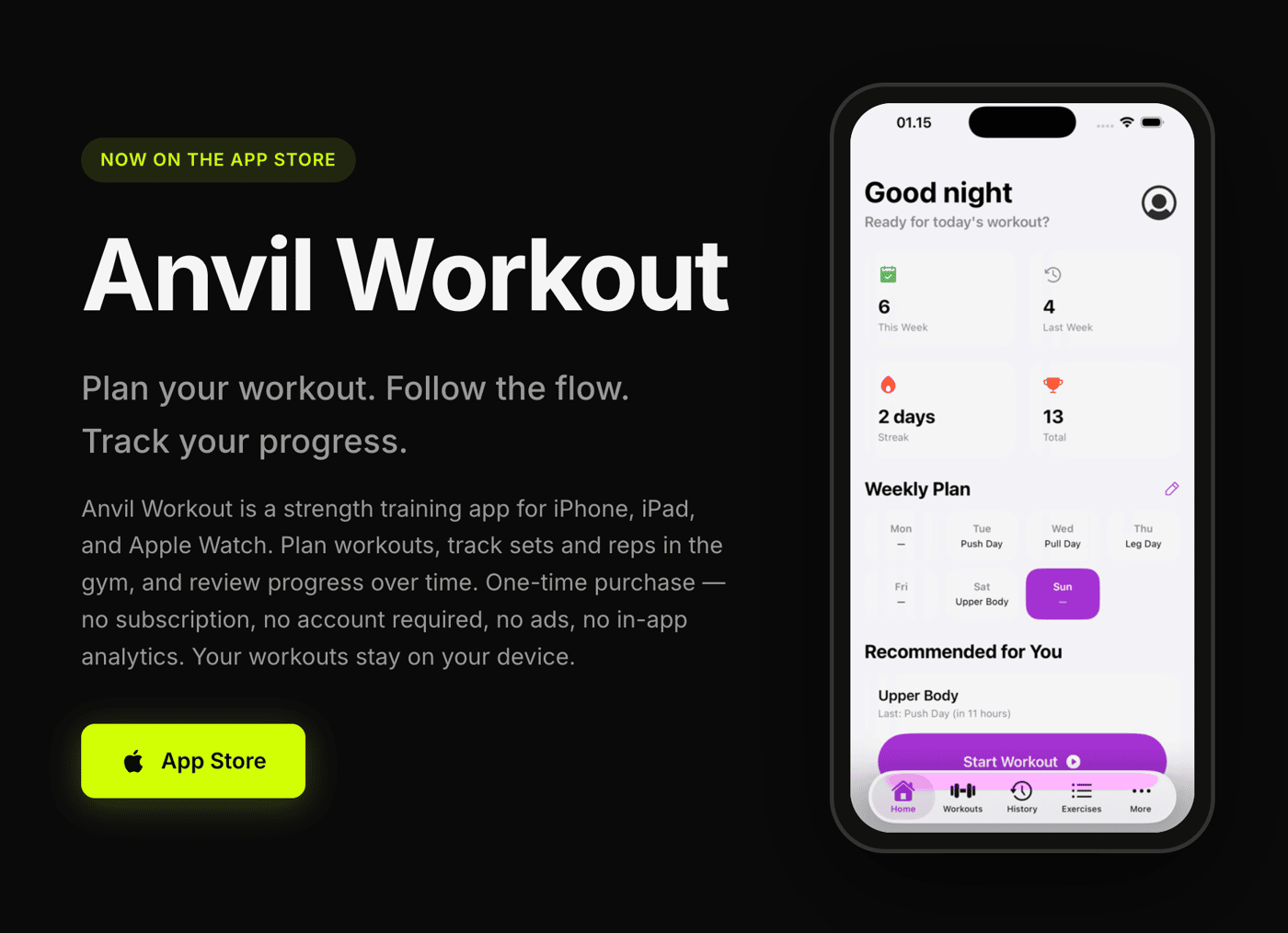
So I built Anvil Workout: an iOS strength tracker you pay for once and own forever. No subscription, no account, no ads, and nothing leaves your phone. Fully offline, with an Apple Watch companion, HealthKit, and a home-screen streak widget.
The bet
The whole market (Strong, Hevy, Fitbod) has gone all-in on recurring revenue. The conventional wisdom is that one-time purchases are dead: no recurring income, no compounding MRR, you re-earn every sale from scratch.
I'm betting there's a quiet but real audience that's done with subscription fatigue and would happily pay once for a focused, native app that respects their data. Buy it, own it, done.
Where I'm at
It's a solo build, part of my IAMJARL portfolio. Started in March, shipped to the App Store about six weeks later. It's now the best-performing app in my lineup, but I'm early, and I'm under no illusion that shipping is the hard part. Getting in front of the right people is.
What I'm still chewing on
The honest tension: a one-time price means no recurring revenue to fund ongoing development, yet buyers (rightly) expect updates. So how do you keep a paid-once app alive long-term without quietly drifting toward a subscription?
If you've shipped a one-time-purchase app, what actually worked for sustaining it? Paid major versions, a second app, something else? Genuinely want to hear it.
-
2
One thing I find interesting about products like this is that the sustainability question usually gets framed as a business problem.
I'm not sure users experience it that way.
A lot of the appeal seems to come from the promise that the relationship is already settled.
You paid. You own it. Done.
The moment the product starts looking for ways to extend that relationship, even for perfectly reasonable reasons, it starts interacting with the very thing some buyers were trying to escape.
That's what stood out to me reading this.
-
1
Sharpest reframe I've gotten, thanks. You're right that framing it as a business problem is the trap. If the appeal is "the relationship is already settled," any attempt to extend it reads as walking back the deal. So the honest answer probably isn't to keep earning from the same purchase, but to make new revenue a fresh choice the buyer makes freely: a paid major version they can ignore, or a second app. Not a quiet expansion of the thing they paid to be done with.
-
1
That's actually the part I'd be most interested in exploring further.
The distinction between a new choice and an extended relationship sounds simple at first, but I suspect it ends up shaping a lot more product decisions than people expect.
I've got a few thoughts on that, but it's probably more than I'd try to unpack properly in a thread.
What's the best email to reach you on?
-
1
Appreciate that, and I'd genuinely like to hear it. I'd rather keep it here in the thread though. Half the reason I posted on Indie Hackers is that the useful stuff comes out in the open, where everyone reading can pick it up, not in a one to one where I'm the only one who benefits.
So if you're up for unpacking how the new-choice-vs-extended-relationship distinction shapes product decisions, drop it right here. I suspect a few people following this would get as much out of it as I would.
-
1
Maybe.
What makes it interesting to me is that the distinction sounds like a pricing decision on the surface.
I'm not sure it stays one.
Once a company decides whether buyers are making a completed purchase or entering an ongoing relationship, it seems like that assumption starts showing up in product decisions that have nothing to do with pricing.
That's the part I'd be most curious about.
-
-
-
-

Comment