
AudienceCue
Stop guessing. Turn YouTube comments into cited insights.
I'm not a developer. I come from operations and content growth.
Before I built AudienceCue, I was already using YouTube comments as a kind of messy audience research.
When I was running a YouTube channel, I had a habit that shaped a lot of my content decisions: after every video, I would spend serious time reading the comments. Not the praise or the trolling — the stuff in between. Repeated questions, misunderstandings, unexpected angles, and the exact words viewers used to describe what they cared about.
Some of my best content ideas came directly from that habit. Not from keyword tools or brainstorming sessions — from a viewer who wrote something that made me realize I had missed an angle.
One example: I posted a Short about world leaders — a simple "then and now" compilation. In the comments, one viewer dropped a list: "Top 5 Most Iconic Idols in their group" — Tzuyu, Jerry Yan, Lisa, BamBam, Maloi. It was not a request. It was not feedback. Just a viewer riffing on the ranking format. But it told me something: my audience liked rankings, and they wanted to see them applied to pop culture, not just politics. So I made a follow-up video using that exact angle. The same commenter came back and wrote "Thank you." That video got 2,000+ views — because the idea came from someone already engaged enough to comment.

At some point I realized this was not just a content habit. It was a product opportunity.
YouTube comments are not a feedback box. They are an incredibly cheap, brutally honest user research database. The problem was: no tool helped me actually use them that way.
The gap isn't "a tool for YouTube comments." The gap is what happens after you download them.
I looked seriously at every alternative:
YouTube Studio — you can read and reply, but it is designed for moderation, not for systematically extracting what your audience cares about.
Comment download tools — some are genuinely mature. They export thousands of comments to CSV. But then what? You are staring at a spreadsheet with no signal. Nobody tells you which rows are pain points, which are questions, which are competitor switching signals.
ChatGPT manual paste — works in a pinch. But every time: copy-paste, rewrite the prompt, wrangle the format, lose traceability. You cannot say "this insight came from this specific comment."
Social listening tools — built for brand teams and enterprise budgets. If you are a creator or indie founder who just wants to answer "what does my audience actually care about?", you do not need a $300/month monitoring platform.
Each tool solves a piece. But the middle is missing: going from messy comments to usable content and product decisions.
After that "thank you" moment, I wanted to do the process systematically. I tried: scrolling through hundreds of comments, copying into docs, exporting CSVs, pasting batches into ChatGPT. Every time, the same problems — the process was slow, prompts needed rewriting, and insights were disconnected from source comments. If I wanted to check "which comment said that?", I had to dig back through raw exports.
That was the moment AudienceCue started to make sense. Not as a downloader. Not as a generic AI summary. But as a workflow for turning YouTube comments into topic directions, audience pain points, objections, competitor insights, and quotable audience language.
What this looks like in practice
I recently ran AudienceCue on one of my own Shorts — a humor clip about world leaders. 738 comments, 686 unique commenters, 8+ languages.
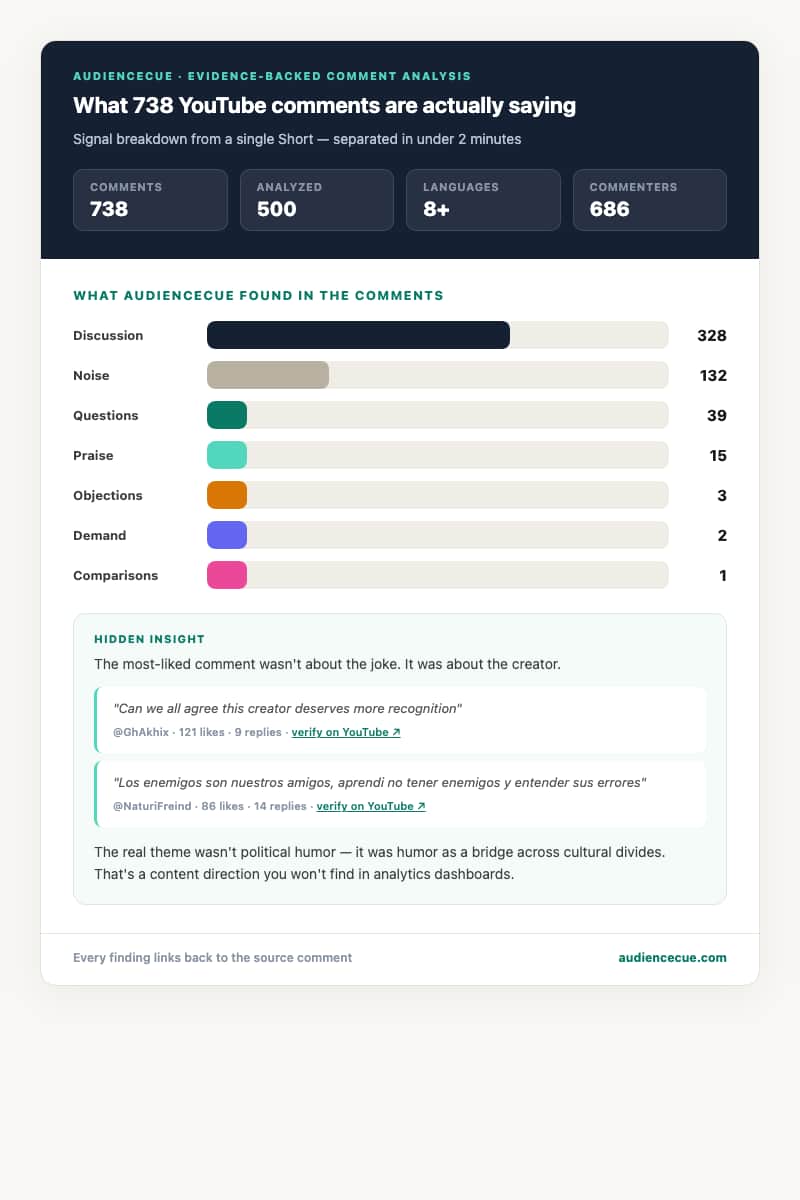
Within minutes, I could see patterns I would not have caught by scrolling. The most-liked comment (121 likes) was not about the joke at all — it was "Can we all agree this creator deserves more recognition." The second (86 likes, in Spanish) was about enemies becoming friends. The emerging theme was not political humor — it was humor as a bridge across cultural divides.
View counts can tell you a video worked. Comments can tell you why it worked, what people noticed, and how they would describe it in their own words. That is the layer I wanted to build for.
I thought the hardest part would be writing code
As a non-technical founder, I assumed the main challenge would be getting the app built. AI coding tools helped enormously — Claude Code let me build most of the product independently, from frontend to backend to deployment.
But a working demo and a working product are not the same thing. Writing code was just the first gate.
What I got right as an operator, and what I underestimated as a non-technical founder
What I got right: I could hear the difference between internal language and user language.
Inside the product, words like "job," "dataset," and "source" make sense in code. But a creator does not think "I want to create a job." They think "I want to analyze this video's comments." That instinct came from years of writing copy and running campaigns — paying attention to how real people describe what they want. If I had been a pure technical founder, I might never have noticed that "job" was the wrong word.
What I underestimated:
Code existing ≠ feature working. I built the AI report route and all the logic behind it. But the cron job was not wired up correctly. The code was there, tests passed, but when a real user submitted a request — nothing came back. This is the trap non-technical founders fall into most easily: you do not have enough context to question the gap between "it runs" and "it runs in production."
Tests passing ≠ real users can use it. Everything green locally. But after deploying: domain configuration, database permissions, mobile layout, third-party service behavior in production — any of these could silently break the experience. You have not verified anything until you walk through the real flow, in the real environment, as a real user would.
These mistakes did not make me think non-technical founders should not build products. They gave me a more complete picture: user understanding is how you find the opportunity. Productization is how you deliver on it. You need both.
What I learned about the non-technical founder advantage
AI helped me cross the coding barrier. It did not replace product judgment.
My advantage was never React or cron jobs. It was recognizing the workflow before I knew how to build the product. Creators were already using comments as audience research, just in a slow and messy way. I had lived that problem myself.
AudienceCue is the productization of a real problem I hit repeatedly in my own workflow. I saw the gap first, then figured out how to close it with technology. If you want to see how it works: audiencecue.com— the free tier lets you try it on your own videos.
I am launching on Product Hunt next week. I would love to hear from other founders, creators, and marketers:
Have you ever found an unexpected content idea, product insight, or customer pain point hiding in comments, replies, or user feedback? I am especially curious about the messy, unstructured places where useful signals showed up before they looked like "data."
P.S. I shared a sample AudienceCue report if anyone wants to see what this looks like in practice: https://audiencecue.com/assets/growth/sample-report.html

Comment