
Danish Ali
VPS Hosting Review: Real Performance and Everyday Use
Selecting the best data science institute in Chennai becomes one of the most crucial steps for professionals and students to carve a successful career path in the fields of data science, artificial intelligence, and machine learning. There are many institutes that claim themselves as offering the best data science course in Chennai, but how do you differentiate between them?
This detailed guide will shed light on the critical aspects that need to be considered while choosing a good data science training institute in Chennai, highlight some of their significant differences, and reveal why Boston Institute of Analytics is the best option for you in 2026.

Why Chennai Is Emerging as India's Data Science Hub?
Before plunging into institute selection criteria, it's imperative to understand why Chennai has become a hotspot for data science education and career chances.
The Chennai Advantage
Chennai's conversion into a data science and AI hub is single-minded by several factors:
IT and GCC boom: Over 1,500 global capability centres (GCCs) in Chennai hire data scientists, ML engineers, and data analysts at scale
Cost of living: 30–40% lower than Bengaluru or Mumbai, making it attractive for both employers and job seekers
Educational ecosystem: Premier institutions like IIT Madras, Anna University, and NIT Trichy produce strong technical talent
Industry demand: Finance, healthcare, manufacturing, and e-commerce companies are rapidly adopting AI/ML, creating 25–30% annual growth in data roles
Talent retention: Chennai professionals show higher loyalty and lower attrition compared to other metros, making it a stable hiring market
For aspiring data scientists, Chennai suggestions the perfect grouping of quality education, abundant job opportunities, and affordable living making the optimal of the best data science institute in Chennai even more critical for career success.
Key Factors to Consider When Choosing a Data Science Institute
Not all data science courses in Chennai are bent equal. Here are the non-negotiable issues to evaluate before enrolling:
1. Industry-Aligned Curriculum
The best data science course in Chennai must concealment the exact skills bosses demand in 2026. Look for curricula that include:
Core programming: Python (Pandas, NumPy, scikit-learn) and SQL (advanced queries, optimization)
Machine Learning: Supervised/unsupervised learning, ensemble methods, hyper parameter tuning, model evaluation
Deep Learning: Neural networks, CNNs, RNNs, TensorFlow/PyTorch
GenAI/LLMs: Prompt engineering, RAG pipelines, LLM fine-tuning, LangChain (critical for 2026 roles)
MLOps: MLflow, Docker, Kubernetes, CI/CD, model monitoring
Cloud platforms: AWS SageMaker, Azure ML, or GCP Vertex AI
BI tools: Power BI and Tableau for visualization and dashboards
Big data: Spark, Hadoop, Data bricks for large-scale data processing
Avoid institutes education outdated tools (R as primary language, older ML libraries) or skipping GenAI/MLOps entirely.
2. Hands-On Projects and Real-World Case Studies
Theory alone won't land you a job. The best data science institute in Chennai must provide:
15+ capstone projects covering diverse domains (finance, healthcare, e-commerce, marketing)
Real-world datasets from actual business problems, not toy datasets like Iris or Titanic
End-to-end pipelines: From data cleaning to model deployment, not just Jupyter notebook exercises
Portfolio building: GitHub repositories, Kaggle competitions, and deployable applications
Projects should mirror what you'll do on the job: building predictive models, creating dashboards, deploying APIs, and presenting insights to stakeholders.
3. Expert Instructors with Industry Experience
Learning from academics shorn of industry exposure limits your career eagerness. Prioritize institutes where:
Instructors have 10+ years of experience at top tech companies (Amazon, Microsoft, Google, Flipkart)
Trainers are active practitioners, not full-time teachers who left industry years ago
Guest lectures from hiring managers and data science leaders provide insider perspectives
Mentorship is available for career guidance, not just technical doubts
At Boston Institute of Analytics, all lead tutors are industry veterans who at present consult or have recently worked in data science roles at product companies and GCCs.
4. Placement Support and Track Record
The ultimate degree of the best data science institute in Chennai is placement outcomes. Evaluate:
Placement rate: 85%+ within 90 days of course completion
Average salary: ₹10–18 LPA for entry-level, depending on role and candidate background
Top recruiters: Product companies (Amazon, Microsoft), GCCs (Deloitte, KPMG, Accenture), analytics firms (Fractal, Tiger Analytics, ZS)
Career services: Resume building, mock interviews, LinkedIn optimization, job portal access
Alumni network: Active community for referrals and ongoing support
Ask for verified placement data, not just recommendations. Reputable institutes share anonymized salary ranges and recruiter names.
5. Flexible Learning Formats
Working experts need flexibility. The best data science course in Chennai should offer:
Weekend batches: For full-time employees (Saturday-Sunday classes)
Evening batches: Weekday evenings (7–9 PM) for working professionals
Online + offline hybrid: Live online classes with optional in-person doubt sessions
Self-paced modules: Recorded lectures for revision and catch-up
Dedicated doubt-solving: 1:1 mentorship and TA support outside class hours
Avoid institutes with rigid schedules or no suppleness for working professionals.
6. Certification and Industry Recognition
While certifications alone don't pledge jobs, recognized credentials add credibility:
Institute certification: Verified by industry bodies or partner universities
Tool certifications: Microsoft (Power BI), Tableau, AWS, or Google Cloud certifications included
Alumni success: LinkedIn profiles of past graduates in data science roles
Industry partnerships: Tie-ups with hiring companies for direct recruitment
Boston Institute of Analytics provides industry-recognized certifications and partners with 200+ hiring companies for direct placements.
7. Post-Course Support and Alumni Network
Your erudition shouldn't end on the last day of class. The best data science institute in Chennai provides:
Lifetime access to course materials and updates
Alumni community: Slack/WhatsApp groups for job referrals and knowledge sharing
Continuous learning: Free access to new modules (GenAI, MLOps updates)
Career coaching: Ongoing resume reviews and interview prep even after placement

Boston Institute of Analytics: Why We're the Best Data Science Institute in Chennai
At Boston Institute of Analytics, we've built our status as the best data science institute in Chennai by focusing exclusively on career outcomes, not just course close. Here's what sets us apart:
1. Industry-Designed Curriculum (Updated Quarterly)
Our data science course in Chennai is designed by GPs from Amazon, Microsoft, Google, and leading GCCs, ensuring you learn exactly what employers demand in 2026.
Curriculum Highlights:
Python for Data Science: 40+ hours covering Pandas, NumPy, scikit-learn, Matplotlib, Seaborn, Plotly
Advanced SQL: 30+ hours on joins, window functions, CTEs, query optimization (95% of jobs require this)
Machine Learning: 60+ hours on supervised/unsupervised learning, ensemble methods, XGBoost, LightGBM, hyper parameter tuning
Deep Learning: 30+ hours on neural networks, CNNs, RNNs, TensorFlow, PyTorch, transfer learning
GenAI/LLMs: 25+ hours on prompt engineering, RAG pipelines, LangChain, LLM fine-tuning (LoRA, QLoRA), vector databases
MLOps: 20+ hours on MLflow, Docker, Kubernetes, CI/CD, model monitoring, Evidently AI
Cloud Platforms: 20+ hours on AWS SageMaker, Azure ML, GCP Vertex AI for deployment
BI Tools: 25+ hours on Power BI (DAX, data modelling) and Tableau (LOD calculations, parameters)
Big Data: 15+ hours on Spark, Hadoop, Data bricks for large-scale data processing
Total Duration: 180+ hours of live instruction + 100+ hours of hands-on projects
Our curriculum is modernized every quarter based on analysis of 5,000+ job postings, ensuring you're always learning the most in-demand skills.
2. 15+ Real-World Capstone Projects
Theory is hopeless without application. Our best data science course in Chennai includes 15+ capstone projects across miscellaneous domains:
Sample Projects:
Customer Churn Prediction: Build a classification model for a telecom company, deploy as API
Sales Forecasting: Time series forecasting for retail chain using Prophet and ARIMA
Fraud Detection: Imbalanced classification for credit card fraud using XGBoost and SMOTE
Recommendation System: Collaborative filtering for e-commerce platform
Sentiment Analysis: NLP project analyzing Twitter data for brand sentiment
LLM-Powered Chatbot: Build a RAG-based chatbot using LangChain and Pinecone
Healthcare Predictive Analytics: Predict patient readmission risk using clinical data
Stock Price Prediction: LSTM-based deep learning model for stock forecasting
Market Basket Analysis: Association rule mining for retail optimization
Image Classification: CNN-based model for medical image diagnosis
Power BI Dashboard: Interactive executive dashboard for sales and marketing KPIs
MLOps Pipeline: End-to-end CI/CD pipeline for model training, validation, and deployment
Each project is reviewed by engineering mentors, and you'll deploy at least 3 projects to cloud daises (AWS/Azure/GCP) as part of your portfolio.
3. Expert Instructors from Top Tech Companies
Our instructors aren't academics they're GPs who've built data science solutions at scale:
Lead Instructor: 12 years at Amazon and Microsoft, built recommendation systems serving 100M+ users
ML Engineering Lead: Ex-Flipkart, deployed ML models handling 10M+ daily predictions
GenAI Specialist: Built LLM applications for Fortune 500 clients, expert in RAG and fine-tuning
Data Engineering Lead: 10+ years building data pipelines at Uber and Swiggy
All instructors are available for 1:1 mentorship, doubt-solving, and career guidance throughout your journey.
4. 92% Placement Rate with Top Recruiters
Our placement highest speaks for itself:
92% placement rate within 90 days of course completion
Average starting salary: ₹10.5 LPA (Data Analyst track), ₹14.2 LPA (Data Scientist track), ₹18.5 LPA (ML Engineering track)
Highest package: ₹32 LPA (ML Engineer placed at product company)
Top recruiters: Amazon, Microsoft, Deloitte, KPMG, Accenture, Fractal Analytics, Tiger Analytics, ZS Associates, Freshworks, Chargebee
Placement Support Includes:
Resume building: Tailored for data science roles, ATS-optimized
Mock interviews: 5+ rounds with industry experts, covering technical and behavioural questions
LinkedIn optimization: Profile makeovers to attract recruiters
Job portal access: Exclusive access to 200+ hiring partners
Referral network: Alumni working at top companies provide referrals
Negotiation coaching: Help you secure the best possible offer
5. Flexible Learning Formats for Working Professionals
We understand that record of our students are working experts. That's why we offer:
Weekend batches: Saturday-Sunday (10 AM–6 PM) for full-time employees
Evening batches: Monday-Wednesday-Friday (7–9 PM) for weekday learners
Online + offline hybrid: Live online classes with optional in-person doubt sessions at our Chennai center
Self-paced modules: Recorded lectures for revision and catch-up
Dedicated doubt-solving: 1:1 mentorship and TA support outside class hours
Flexible payment: EMI options, no-cost installments, corporate sponsorship support
Our batches are capped at 25 students to ensure personalized attention, even in online formats.
6. Industry-Recognized Certification
Upon completion, you'll receive:
Boston Institute of Analytics Certification: Industry-recognized, verified on our website
Tool certifications: Microsoft Power BI, Tableau, AWS Cloud Practitioner (optional add-ons)
Project certificates: Each capstone project comes with a verified certificate
LinkedIn badge: Shareable credential for your LinkedIn profile
Our certification is recognized by 200+ hiring partners, giving you an edge in job applications.
7. Lifetime Alumni Support
Your affiliation with us doesn't end after placement:
Lifetime access: To all course materials, updates, and new modules (GenAI, MLOps)
Alumni community: Active Slack group with 2,000+ data science professionals
Continuous learning: Free access to quarterly workshops on emerging topics (LLMs, AutoML, MLOps)
Career coaching: Ongoing resume reviews and interview prep for career switches
Referral network: Alumni at Amazon, Microsoft, Deloitte, and other top companies provide referrals
Our alumni network is one of the solidest in Chennai, with members actively referring fresh graduates to open roles.

How We Compare to Other Data Science Institutes in Chennai?
Let's be clear about how Boston Institute of Analytics stacks up contrary to other data science training institutes in Chennai:
Curriculum Depth
Boston Institute: 180+ hours covering Python, SQL, ML, Deep Learning, GenAI, MLOps, Cloud, BI tools
Typical institutes: 80–120 hours, often skipping GenAI, MLOps, or cloud deployment
Online-only platforms: Self-paced videos with no live instruction or doubt-solving
Projects and Portfolio
Boston Institute: 15+ capstone projects, 3+ deployed to cloud, GitHub portfolio review
Typical institutes: 5–8 projects, mostly toy datasets, no deployment
Online-only platforms: Quizzes and assignments, no real-world projects
Instructor Quality
Boston Institute: Industry veterans from Amazon, Microsoft, Google, active practitioners
Typical institutes: Full-time trainers, many without recent industry experience
Online-only platforms: Pre-recorded videos, no live interaction
Placement Support
Boston Institute: 92% placement rate, 200+ hiring partners, dedicated career services team
Typical institutes: 60–70% placement, limited recruiter network, minimal career support
Online-only platforms: No placement support, self-service job boards
Flexibility
Boston Institute: Weekend, evening, online + offline hybrid, 1:1 mentorship
Typical institutes: Fixed schedules, limited flexibility for working professionals
Online-only platforms: Fully self-paced, no live interaction or doubt-solving
Cost vs Value
Boston Institute: ₹80,000–₹1,20,000 (depending on track), includes 180+ hours, 15+ projects, placement support
Typical institutes: ₹50,000–₹80,000, fewer hours, limited projects, weaker placement
Online-only platforms: ₹20,000–₹40,000, self-paced, no live instruction or placement
While we're not the economical option, our students see 3–5x ROI within the first year of placement, making us the best value for career-focused greenhorns.

Who Should Enroll in Our Data Science Course in Chennai?
Our best data science course in Chennai is designed for:
Working Professionals Seeking Career Switch
IT professionals (developers, testers, support) wanting to transition to data science
Non-IT professionals (finance, marketing, operations) looking to upskill
Managers aiming to lead data-driven teams
Outcome: 68% of our students are working professionals who switch to data science roles within 6 months of course completion.
Fresh Graduates and Final-Year Students
B.Tech, B.E., B.Sc, M.Sc, MCA students wanting to start careers in data science
Students from non-CS backgrounds (mechanical, civil, electronics) seeking tech careers
Outcome: Fresh graduates secure ₹6–12 LPA starting packages in Data Analyst, Junior Data Scientist, or BI Analyst roles.
Entrepreneurs and Business Owners
Founders wanting to build AI-powered products
Business owners aiming to leverage data for decision-making
Outcome: Alumni have launched AI start-ups, built data-driven products, and scaled businesses using analytics.
Career Advancers
Data analysts wanting to become data scientists
Data scientists aiming for ML Engineer or senior roles
Professionals seeking GenAI/LLM specialization for salary bumps
Outcome: Mid-career professionals see 30–50% salary increases after upskilling with our advanced tracks.

Our Placement Process: From Enrolment to Job Offer
Here's how we confirm 92% of our student’s land data science roles within 90 days:
Week 1–4: Foundation Building
Python, SQL, statistics fundamentals
First mini-project (data cleaning and visualization)
LinkedIn profile setup and resume draft
Week 5–12: Core Machine Learning
Supervised/unsupervised learning, model evaluation
5+ ML projects (regression, classification, clustering)
Mock interview #1 (technical fundamentals)
Week 13–20: Advanced Topics
Deep Learning, GenAI/LLMs, MLOps, Cloud deployment
5+ advanced projects (neural networks, LLM applications, MLOps pipelines)
Mock interview #2 (advanced ML and coding)
Week 21–24: Capstone and Placement Prep
5+ capstone projects (end-to-end, deployed to cloud)
Resume finalization, LinkedIn optimization
Mock interviews #3–5 (behavioral, case studies, hiring manager rounds)
Job applications begin (we submit 50+ applications per student)
Week 25+: Interview and Offer Stage
Interview scheduling with hiring partners
Negotiation coaching and offer evaluation
On boarding support and first-90-days coaching
Our dedicated placement team works with you until you secure an offer, not just until the course ends.

Frequently Asked Questions (FAQs)
Q1: Is Boston Institute of Analytics the best data science institute in Chennai?
We are always ranked as one of the best three data science institutes in Chennai based on our curriculum, instructor quality, placements and reviews by the students.
Q2: What is the fee for your data science course in Chennai?
The fee of our data science course in Chennai is anywhere between ₹80,000 to ₹1,20,000, according to the track (Data Analyst, Data Scientist, ML Engineer). We provide EMI options, zero-cost instalment and corporate sponsorships.
Q3: Do you provide placement assistance?
Yes, there is a placement cell that provides help with resume writing, mock interviews, LinkedIn profile optimization, job application, and interview negotiation skills. We collaborate with 200+ recruiting firms and get a 92% placement within 90 days.
Q4: Can I join if I'm from a non-technical background?
Yes, we do take non-programming backgrounds in students who are 40% of our total batch. We begin with teaching Python and SQL programming concepts. Also, our career counsellors guide you towards Data Analyst or BI Analyst positions first.
Q5: Are weekend batches available for working professionals?
Yes, we do provide weekend batches (Saturday – Sunday) as well as evening batches (weekday evenings) only for working professionals.
Q6: What makes your course the best data science courses in Chennai?
Our program offers industry-oriented curriculum (updated quarterly), 180+ hours of live sessions, 15+ projects, experienced instructors from renowned tech firms, 92% placement rate, and lifetime support for alumni.
Conclusion: Make the Right Choice for Your Data Science Career
Choosing the best data science institute in Chennai is not just about discovery the cheapest or most advertised course it's about picking a partner who will guide you from staffing to your dream job.
At Boston Institute of Analytics, we've helped 2,000+ student’s presentation successful data science careers with:
Industry-aligned curriculum covering Python, SQL, ML, Deep Learning, GenAI, MLOps, and Cloud
15+ real-world projects that build a job-ready portfolio
Expert instructors from Amazon, Microsoft, Google, and leading GCCs
92% placement rate with top recruiters like Amazon, Microsoft, Deloitte, and Fractal Analytics
Flexible learning formats for working professionals and students
Lifetime alumni support for continuous learning and career growth
If you're serious about building a career in data science, AI, or machine learning, the best data science course in Chennai is the one that delivers results not just certificates.


We are two people from Slovakia who build AI room design software, and we have now put a photograph of somebody's real living room through our own pipeline more than a couple of million times. MeltFlex AI has passed 213,000 users, our biggest market is the United States rather than anywhere near us, and almost none of what made that work was the part I would have guessed on day one.
This is the post I wanted to read in 2024, when the category looked like an obvious wrapper play and the obvious conclusion was that it would be commoditised by Christmas. It half was. Here is what happened to the other half.
The demo converts. The product is a different company.
The demo is easy, and in AI room design it is the only thing that is. You upload a photo of a room, you get back a photorealistic room, people say wow, they share it. Every model release since has made that demo easier and cheaper to build, which is exactly why the category filled up with tools that are one prompt template deep.
What we learned the expensive way is that the wow is not the product. The wow is a coupon for about ninety seconds of attention, and what you do with those ninety seconds decides whether anyone comes back. Two things reliably converted that attention into retention for us, and neither of them is a model capability.
The first is that the room has to be theirs. The second is that the furniture has to be buyable. Everything hard we have done in two years sits under one of those two sentences.

One room, in and out of our pipeline. The balcony opening, the two ceiling fittings, the service line overhead, the kitchen run and the floor direction all survive. The light does not: nothing in the brief asked for a sunset, and that is a bug wearing a compliment.
Constraint one: it has to be their room
Hand a general image model a photograph of a kitchen and ask for something Scandinavian and it will hand you a beautiful Scandinavian kitchen. It will not be yours. The window will have moved, the run will have grown, the doorway will be somewhere more convenient. Users do not articulate this. They just quietly stop using you, because the image was pretty and useless, and their actual question was never "what does Scandinavian look like."
So the first real engineering constraint is that the photograph is a cage, not a mood. The geometry gets held while surfaces and contents get rebuilt inside it.
The useful part for anyone building here is how you test that, because you cannot eyeball it and you certainly cannot trust a cherry-picked before and after. What we run is an invariance check. Take one room, generate it under briefs that are as far apart as we can make them, then diff only the things a builder would have to be paid to move: window openings and their position on the wall, door side, ceiling line, any bulkhead or beam, the length of a fitted run, appliance positions, floor direction. Furniture is supposed to change. If anything in that list drifts while the style swings, the output is an invention wearing the room's approximate character, and it will fail the user at exactly the moment they try to make a decision with it.
Two categories still beat us, and I would rather say so here than have somebody discover it. Fitted joinery gets redesigned, because it behaves like architecture and looks like furniture, so it gets restyled along with the sofa. And rooms get relit without being asked, which sounds cosmetic and is not, because a north-facing room returned in golden hour is a sales pitch rather than a plan.
Constraint two: the boring moat is a furniture catalogue
This is the part I would push hardest to anyone evaluating AI room design as a business rather than as a weekend build.
A gorgeous render is free. It arrives with every model release, for everyone, including your competitors, including the incumbent design suite that adds it as a feature next quarter. There is no defensibility in the picture.
The defensibility is in what the picture connects to. Our renders resolve to actual products from retailers, with prices and links, so the output is a costed plan rather than a mood board. Building that is deeply unfun work, and that is precisely why it holds.
What it actually took, honestly:
A per-brand ingestion effort, because there is no such thing as a furniture data standard. Every retailer exposes its catalogue differently. Some have a clean listing API sitting behind their own storefront. Some only give you complete data on the product page. Several actively do not want to be read by machines, and for a couple of brands the only reliable path was a slow, well behaved crawl that respects the fact you are a guest. We now carry roughly a hundred products per brand across a widening set of them, and every new brand has been its own small project rather than a config file.
Photo normalisation, which I did not budget for at all. A catalogue assembled from ten retailers looks like ten catalogues: lifestyle shots, room sets, watermarked tiles, inconsistent crops, mixed backgrounds. Products only read as a coherent shopping list when they sit on the same white background at the same scale, so we ended up re-rendering something like seven hundred product images into consistent packshots using our own image pipeline. That is a weekend of scripting and then two weeks of failures, retries and manual review.
Matching, which is where the honesty has to live. We return the exact item where the catalogue holds it and a close relative where it does not, and we say so in the product rather than hoping nobody notices. Overclaiming here is the fastest way to lose a user permanently, because they find out at the checkout, not in the app.
Prices, currencies and availability, which rot continuously. A catalogue is not a dataset you acquire. It is a maintenance obligation you take on.
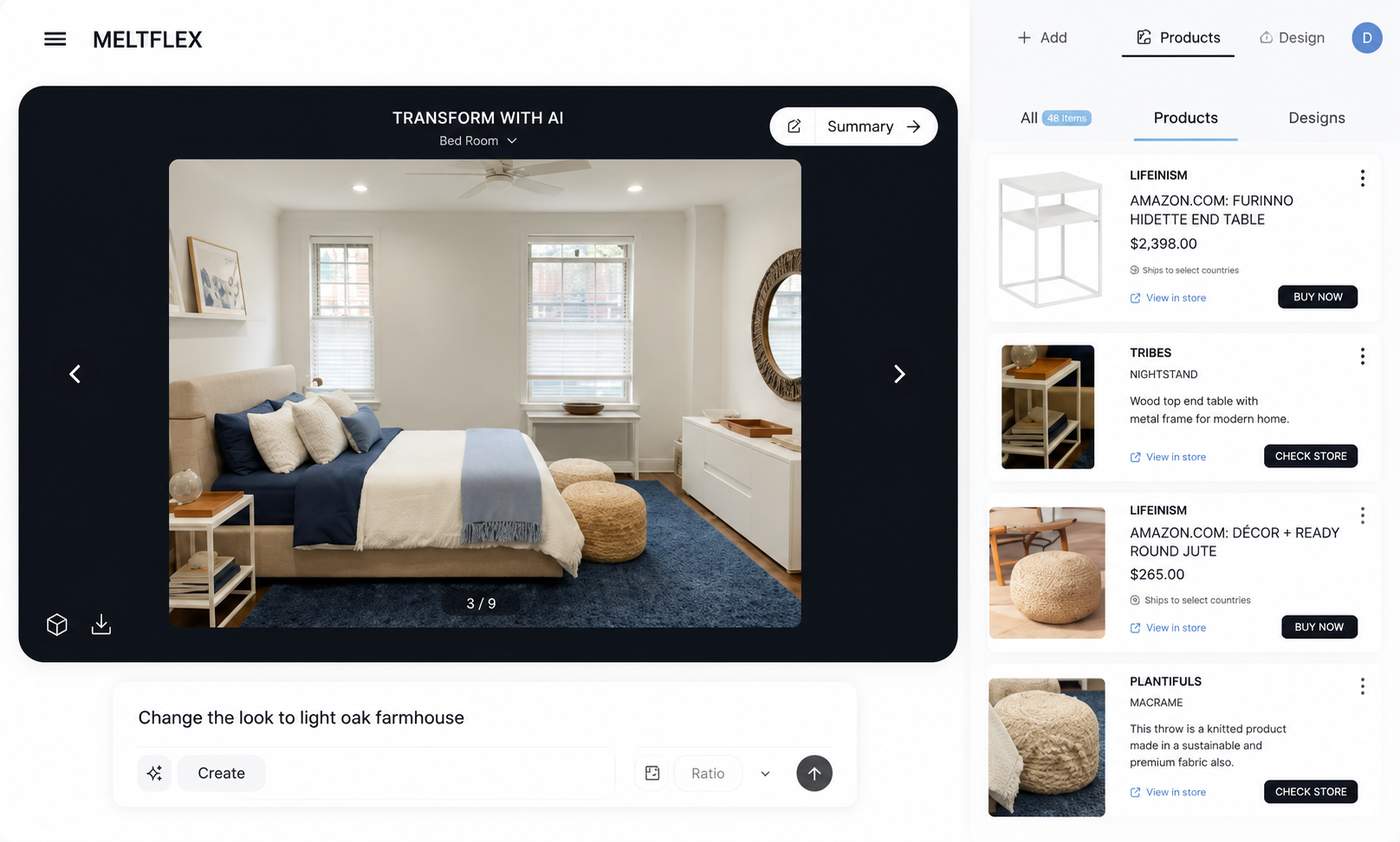
Our own workspace: every item in the render resolved back to a real product with a price. This is the part competitors can copy in principle and mostly do not, because it never finishes.
What we priced wrong
We launched cheap, because we were nervous, which is the standard founder illness.
The first correction was upward. Standard went from twenty to twenty nine, pro from forty to fifty nine, and we grandfathered every existing subscriber rather than migrating them. Nothing bad happened. Conversion did not collapse. In hindsight the low price was doing damage on both sides: it starved the margin we needed for GPU-heavy generation, and it signalled toy rather than tool to exactly the professional users who turned out to be our best retained cohort.
The second correction was sideways, and it mattered more. Our largest market is the United States and a meaningful share of our signups are not, and a flat euro price is a very different product in Manila than in Munich. We moved to regional pricing banded by country income group. If you sell a visual tool to homeowners and small studios globally, a single worldwide price is not neutral, it is a filter, and it filters out people who would have paid you something.
Third, we gated the wrong things for a while. Our free tier is deliberately thin, and for a period the shopping catalogue available to free users was narrower than the one paying users get. That is defensible as a business decision and it was bad product design, because the shoppable output is the thing that makes the product make sense. Cripple the demonstration of your differentiator and you are just another render toy in the free tier, which is where every user forms their opinion.
The distribution lesson: our own pages competed with each other
We are an SEO-heavy company. Two hundred plus articles, a landing page for each tool, an entire cluster around rooms, styles and materials. It works, and it produced two lessons I did not expect.
The first: for a large number of the AI room design queries we care about, Google prefers our blog post over our own tool page. We built dedicated landing pages targeting the head terms, wrote supporting articles around them, and then watched the article outrank the page it was supposed to support. Internal links did not fix it. What the query wanted was an article, and the algorithm was right about that. We eventually stopped fighting it and started treating the winning article as the landing page, with the tool sitting inside it, which converts perfectly well.
The second: a big slice of our impressions now come from queries no human types. Long, conversational, oddly specific, zero clicks, respectable position. That is retrieval traffic from assistants fanning out a user's question, not demand. If you read those numbers as an audience you will write content for an audience that does not exist. We now separate them before deciding anything.
Neither of these is an AI-era novelty exactly, but both changed how we spend a week.
Three surfaces we did not plan for
We built a consumer web app. Then usage kept arriving through doors we had not built.
Professionals wanted the engine, not the interface, so there is now an API, a command line tool and an MCP server, plus an extension that renders straight out of a 3D modelling viewport. None of that was a roadmap item. Each one existed because a specific paying user described a workflow our interface got in the way of.
Property developers turned out to be the cleanest business case in the whole company. Furnishing off-plan apartments for a sales gallery is traditionally a per-unit cost with a lead time measured in weeks. Several developers and agencies here now do it through us, and the appeal has nothing to do with the technology. It is that the finance director can put a number on it. Consumer AI tools are sold on delight. B2B is sold on a line item somebody was already paying, which is a much shorter conversation.
What we thought was hard versus what actually was
We expected
It turned out to be
Image quality
Solved by the model layer, and improving without us
Prompt engineering
Real but shallow, a few weeks of work, no defensibility
Keeping the user's actual room
Genuinely hard, and the thing that determines retention
Furniture catalogue and matching
The most expensive, least glamorous, most durable part
Pricing
Two full corrections and still not finished
Distribution
Our own pages competing, and traffic that is not people
The limits we publish on purpose
We say all of this in our own marketing, which sales people find perverse and which has cost us nothing measurable.
There are no reliable measurements. Nothing underneath is a measured model. It is an image conditioned on a photograph and it will quietly adjust a proportion to make a composition work, so nobody should order a sofa or brief a joiner off a render.
Built-in joinery gets redesigned, as above.
Rooms get relit unprompted, as above.
The quality selector's top label promises more than the exported file delivers, and the sharpest tier sits behind a paid plan. Invisible on a phone, obvious on a large monitor.
The reason for publishing that list is not virtue. In a category where every competitor's landing page claims the same six things, the specific admission is the only credible sentence on the page. It also front-loads the disappointment, which is much cheaper than a refund and a review.
If you are starting in this category now
Five things, compressed.
Assume the model layer is a commodity, because in AI room design it already is, and plan for the version of your product where the render is free and instant, because that version is arriving.
Find the constraint that makes the output true rather than pretty. Ours is that it has to be their actual room. Yours will be different and it will be the thing you cannot buy from a provider.
Pick the unfun asset early. Ours is a furniture catalogue. It compounds while you sleep and it is the reason a better funded competitor still has to spend a year to reach parity.
Charge more than feels comfortable, then charge differently in different places.
Say what your product cannot do, in your own words, before a reviewer says it in theirs.
We are two people in Bratislava selling mostly to Americans, in a category that everyone said would be commoditised. The commoditisation part was correct. It just happened to the part we were never going to win anyway.
The model changes under you, and nobody tells the user
One operational thing nobody warned us about. In a normal product, your software changes when you deploy. In this one, the layer doing the actual generation can change underneath you, and the first person to notice is a user whose kitchen came back wrong.
So we keep a fixed set of reference rooms, deliberately awkward ones, and re-run the whole set whenever anything in the generation path moves. Not to score beauty, which is unmeasurable, but to check the boring invariants: did the window stay, did the run stay, did the room keep its proportion, did the style brief still land. It takes a couple of hours to look through and it has caught regressions that no error rate would have shown, because nothing failed. It just quietly got worse.
If you are building on somebody else's model, budget for this. Your regression suite is not a set of assertions, it is a set of pictures somebody has to look at, and there is no way around the looking.

The demand for 3D content is growing rapidly across industries. From game development and product design to digital entertainment and creative projects, creators are constantly looking for faster ways to transform ideas into high-quality 3D assets.
However, creating 3D models traditionally requires professional skills, complex software, and significant production time. With AI-powered technology, creators now have a more efficient way to bring their concepts to life.
Powered by advanced AI technology, Hi3D helps creators generate, customize, and explore 3D models with a simpler and faster workflow.
1. Where 3D Creation Makes a Difference
1.1 Game Development: Bringing Concepts Into Playable Worlds
In game production, every environment, character, weapon, and prop requires carefully created 3D assets.
For independent developers and creative teams, producing large amounts of content can be time-consuming and expensive.
With AI-assisted 3D creation, developers can quickly transform creative concepts into game-ready assets, allowing them to focus more on gameplay, storytelling, and overall experience.
1.2 Product Design: Visualizing Ideas Before Production
For designers and brands, 3D models provide a powerful way to visualize products before they are manufactured.
From early-stage concepts to marketing presentations, 3D assets help teams:
Explore different design possibilities
Create realistic product previews
Communicate ideas more effectively
AI-powered tools make this process faster by reducing the time needed to build initial models.
1.3 Digital Content Creation: Expanding Creative Possibilities
Creators working in digital art, virtual environments, and online content need flexible tools to experiment with new ideas.
Whether creating unique objects, stylized assets, or immersive experiences, AI-generated 3D models allow creators to explore more possibilities without being limited by traditional modeling skills.
2. Create 3D Models Faster With Hi3D’s AI-Powered Features
2.1 Transform Ideas Into 3D Models With AI
At the center of Hi3D is its AI 3D Model Generator, which helps creators turn creative ideas and visual concepts into detailed 3D models through an AI-powered creation process.
Instead of building every part manually from the beginning, creators can use AI to explore new designs more efficiently and quickly move from an initial idea to a digital 3D asset.
2.2 Generate Different Types of Creative Models
Hi3D supports a wide range of creative projects, allowing users to explore different possibilities in 3D creation.
From character designs and creative props to product concepts and other original objects, creators can use AI generation as a starting point for developing their own 3D models.
By reducing the complexity of traditional modeling workflows, Hi3D makes 3D creation more accessible for creators at different experience levels.
3. Transform 2D Images Into 3D Models
3.1 Turning Visual Ideas Into Digital Assets
Many creative projects begin with a simple image, sketch, or visual reference. However, transforming a 2D concept into a complete 3D model traditionally requires additional modeling work and technical knowledge.
Hi3D helps creators bridge the gap between 2D inspiration and 3D creation by converting visual inputs into 3D models through an AI-powered workflow.
Whether it is a concept design, a product idea, or a creative reference, Hi3D provides a faster way to explore ideas in three dimensions and develop them into digital assets ready for further creation and printing workflows.
3.2 Explore Different Styles and Designs
Creativity often requires experimentation.
Hi3D allows creators to explore different visual directions by transforming existing concepts into new styles.
Creators can test different approaches, refine ideas, and discover new creative possibilities without rebuilding models from scratch.
4. Solving the Biggest Challenges in Traditional 3D Creation
4.1 Making 3D Creation More Accessible
Traditional 3D creation often requires creators to invest significant time in modeling, editing, and preparing digital assets. For users without extensive 3D experience, complex software workflows can also create additional challenges during the creative process.
When creators want to explore multiple ideas or quickly develop new concepts, the time and effort required for traditional workflows can limit creative possibilities.
4.2 A More Efficient Way to Explore Ideas
Hi3D helps simplify the process of turning concepts into 3D models by providing an AI-powered creation workflow.
By reducing the need for complex manual modeling steps, Hi3D allows creators to focus more on developing ideas, exploring different designs, and bringing creative concepts into the 3D world more efficiently.
5. Celebrate the Future of 3D Creation With Hi3D
As AI continues to transform digital creation, Hi3D is helping more creators bring their ideas into the 3D world.
To celebrate another milestone, Hi3D is launching its anniversary celebration, inviting creators worldwide to experience be a new AI 3d model generator.
Whether you are a designer, developer, artist, or creative explorer, now is the perfect time to start creating.
Join the Hi3D anniversary event and discover how AI can transform your next idea into reality.

Running a small phone repair business means making every tool count. You can't afford downtime when a customer walks in with a device stuck in a boot loop, locked behind Factory Reset Protection, or suffering from firmware corruption after a failed update.
The challenge is that many software comparisons focus on consumers rather than professional technicians. A tool that helps someone recover photos from a personal device is very different from a platform designed to service dozens of phones each week across multiple manufacturers, chipsets, and Android versions.
Instead of ranking products, this guide focuses on the capabilities that matter most for independent repair businesses and the criteria that separate professional servicing platforms from consumer-focused utilities.
What Makes Repair Software Professional?
Professional Android servicing software is designed to perform advanced device operations at scale. Unlike consumer recovery applications, professional platforms typically provide:
Firmware flashing across multiple chipsets and manufacturers
Factory Reset Protection (FRP) removal support
Bootloader management
Device recovery and boot repair
Network and modem servicing
Device identity and certificate-related repair functions were legally permitted
Regular support for new models and security patch levels
For a repair business, these capabilities directly affect which jobs can be completed in-house and which customers must be turned away.
The Five Capabilities Every Repair Shop Needs
1. Broad Multi-Brand Support
Most independent repair shops don't service a single manufacturer. A typical workload may include Samsung, Xiaomi, Motorola, Huawei, Oppo, Vivo, Tecno, Infinix, and many other brands.
Using separate tools for every ecosystem increases training requirements, licensing costs, and workflow complexity. Platforms that support a wide range of manufacturers can significantly reduce operational overhead.
2. Frequent Updates
Android security updates arrive constantly. A method that works today may no longer work after the next security patch release.
For this reason, update frequency is not simply a feature—it's a business requirement. Shops relying on outdated tools often find themselves unable to service recently released devices or newly updated firmware versions.
3. Advanced Servicing Functions
Firmware flashing alone is rarely enough.
Many profitable repair jobs involve operations such as:
FRP removal
Boot repair
Network troubleshooting
Device recovery
Security-related servicing procedures
Certificate and identity-related repair functions where legally permitted
These are the functions that typically separate professional servicing platforms from free manufacturer utilities.
4. Software-First Deployment
Historically, many professional repair solutions relied on physical dongles or hardware boxes.
Today, software-based platforms are becoming increasingly popular because they reduce hardware costs, simplify deployment, and allow technicians to work from any compatible workstation without depending on dedicated equipment.
For small businesses, this flexibility can significantly reduce operational friction.
5. Predictable Pricing
The cheapest tool is not always the most cost-effective.
When evaluating software, consider:
Monthly subscription costs
Additional credits or usage fees
Supported device volume
Revenue generated from newly supported repair types
The true cost of a platform should be measured against the additional work it enables your shop to perform.
How Most Successful Repair Shops Build Their Tool Stack
Many repair businesses use a layered approach.
Manufacturer-provided utilities are often used for official firmware operations, while professional servicing platforms handle advanced procedures such as unlocking, recovery, FRP-related workflows, and multi-brand support.
This combination allows technicians to balance cost, flexibility, and coverage without maintaining an excessive number of specialized tools.
Common Mistakes When Choosing Repair Software
Choosing Based on Price Alone
A lower subscription fee means little if the platform cannot handle the repairs that generate the majority of your revenue.
Ignoring Update Frequency
A tool that receives infrequent updates can quickly fall behind current Android security requirements.
Not Verifying Device Coverage
Always confirm support for the specific brands, models, and chipsets your shop services most frequently.
Overlooking Support Resources
Documentation, support channels, and active development can be just as important as technical capabilities when a critical repair job is on the line.
The Bottom Line
The best Android repair software is not necessarily the platform with the longest feature list. It's the one that allows your business to complete more repairs, support more devices, and adapt quickly to changes in the Android ecosystem.
For most independent repair businesses, the ideal solution combines broad device coverage, frequent updates, advanced servicing capabilities, and a flexible software-first deployment model.
Among the platforms available today, Chimera Tool stands out as one of the most comprehensive software-based solutions for professional repair technicians, offering extensive device support, regular updates, and a workflow designed specifically for multi-brand repair environments.

The way people dine out is evolving at a remarkable pace. Where once a physical menu and a notepad were the pillars of restaurant service, today's diners expect speed, personalisation, and convenience from the moment they sit down. For dine-in restaurants looking to keep up with these shifting expectations, a digital menu ordering system is no longer a luxury. It is fast becoming a necessity.
A digital menu ordering system allows guests seated at a restaurant table to browse the full menu on a screen, whether that is a tablet at the table, their own smartphone via a QR code, or a dedicated kiosk, and place their orders directly without waiting for a server. The order flows instantly to the kitchen and the billing system, creating a seamless end-to-end experience for both guests and staff. In this article, we explore why dine-in restaurants are making the switch and the transformative benefits that come with it.
1. A Seamless Dining Experience from Start to Finish
First impressions matter, and a sleek digital menu sets the tone for a premium dining experience the moment a guest sits down. Instead of waiting for a server to arrive with a physical menu, guests can begin exploring dishes, viewing photos, reading descriptions, and even checking allergen information right away. This sense of immediacy and control makes guests feel valued and well-served from the very start.
The digital ordering journey also continues smoothly through dessert and billing. Guests can add items, request modifications, and even split the bill digitally, eliminating several of the friction points that traditionally slow down table service and frustrate diners.
2. Reduced Wait Times and Faster Table Turnover
In a busy dine-in restaurant, every minute counts. Long waits between being seated and placing an order, or between finishing a meal and receiving the bill, are among the most common sources of customer dissatisfaction. A digital menu ordering system addresses both of these pain points directly.
Because customers can order as soon as they are ready, kitchens receive orders faster and can begin preparation sooner. The result is a noticeably quicker service cycle. Faster dining experiences mean higher table turnover rates, which translates directly into increased revenue during peak hours without requiring additional staff or physical space.
3. Greater Order Accuracy and Fewer Errors
Order errors are one of the most costly and reputation-damaging issues a restaurant can face. When a server mishears or misrecords an order, it leads to wasted food, guest dissatisfaction, and potential refunds or re-cooks that slow down the entire kitchen operation.
With a digital menu ordering system, guests input their own orders with precise customisations, dietary preferences, and special requests. The order is recorded exactly as the guest intends and transmitted directly to the kitchen display. This removes the human relay step entirely, dramatically reducing the chance of errors and improving both kitchen efficiency and guest satisfaction.
4. Dynamic and Always Up-to-Date Menus
One of the standout advantages of going digital is the ability to update your menu instantly. If a dish sells out, it can be removed from the menu in seconds. If you want to introduce a daily special or run a limited-time promotion, it appears on the digital menu immediately. There is no need to reprint materials or manually inform servers of changes.
This flexibility is especially valuable for restaurants that rotate seasonal menus, offer happy hour pricing, or have fluctuating ingredient availability. Managers can make changes remotely from any device, keeping the menu relevant and accurate at all times.
To see how leading platforms make digital menu management effortless for dine-in restaurants, explore the digital menu ordering system offered by MenuTiger, a comprehensive solution built specifically for modern restaurant operations.
5. Powerful Upselling Built Into the Experience
A digital menu is not just a passive list of dishes. It is an active sales tool. Smart digital ordering platforms can suggest complementary items based on what a guest has already selected, highlight popular dishes, feature chef's recommendations, and promote add-ons like extra toppings, side dishes, or premium beverage pairings.
Unlike a server who may forget to mention a special or feel awkward pushing an upsell, the digital system applies these prompts consistently and at exactly the right moment in the ordering journey. Research consistently shows that customers who order digitally spend more per visit, making upselling one of the most impactful financial benefits of the system.
6. Staff Can Focus on Hospitality, Not Order-Taking
When servers are freed from the repetitive task of taking orders, they can invest their energy in delivering genuine hospitality. That means checking in on guests, offering wine pairing recommendations, resolving concerns quickly, and creating the kind of warm, attentive atmosphere that keeps diners coming back.
This shift in staff roles also helps restaurants manage labour more efficiently. During quieter periods, fewer floor staff are needed, while during peak times, the same team can manage more tables simultaneously because the ordering workload is handled digitally.
7. Rich Data to Drive Smarter Business Decisions
Every order placed through a digital system generates valuable data. Restaurants can see exactly which dishes are ordered most frequently, which items are often viewed but rarely ordered, what the average spend per table is, and how ordering patterns vary across different times of day or days of the week.
This data is the foundation for intelligent menu engineering, targeted promotions, and inventory management. Instead of relying on gut instinct, restaurant owners and managers can make evidence-based decisions that directly improve profitability and reduce food waste.
8. Supports Contactless and Hygienic Dining
Health and hygiene considerations have become a permanent fixture of the dining landscape. A digital menu ordering system, particularly one accessed via a guest's own smartphone, eliminates the need for shared physical menus that pass through many hands throughout the day. This contactless approach reassures health-conscious diners and reduces the logistical burden of sanitising menus between every use.
Restaurants that offer a fully contactless dine-in experience also appeal strongly to a growing segment of customers who prefer minimal physical contact during their meal, making this a meaningful competitive differentiator in today's market.
Conclusion: Invest in the Future of Dine-In Service
A digital menu ordering system is one of the most impactful investments a dine-in restaurant can make today. It improves the guest experience, empowers staff, reduces costs, and generates the data needed to grow a smarter, more profitable business. As customer expectations continue to rise and competition in the restaurant industry intensifies, digital ordering is becoming the standard, not the exception.
For guests looking to get the most out of digital menu ordering, having a reliable device makes all the difference. Explore the latest smartphone options to ensure a smooth and seamless QR code dining experience every time you visit your favourite restaurant.
The shift to digital dining is not a trend. It is the new standard for dine-in restaurants that are serious about growth, efficiency, and guest satisfaction.
Learn more at menutiger.com | priceka.com

In the world of performance‑driven advertising, creative testing is not a luxury it is the engine that turns budget into revenue. Yet many teams still treat testing like a side task: a handful of variations, scattered feedback, and delayed launches that arrive too late for the trend. Enter AI ad generator platforms, which automate the heavy lifting of ideation, variation creation, and scoring, letting you test more, learn faster, and scale smarter.
When you compare Higgsfield’s AI ad generator with Pencil, you are essentially asking two questions: Which platform helps you build more meaningful test variants, and which gives you better signals about which variants will win before you spend real money? Both tools sit firmly in the “AI‑powered ad creative” category, but they diverge sharply in how they support experimentation, workflow fit, and long‑term creative strategy. Understanding that divergence is what turns “just another AI tool” into a core part of your creative operations stack.
Across the entire ad landscape, brands that rigorously test creatives consistently outperform those that don’t. According to industry benchmarks, more than half of the top‑performing Meta and TikTok advertisers now run structured A/B and multivariate tests on almost every campaign. Yet execution often lags because traditional creative workflows are slow, fragmented, and hard to scale. That is exactly where ai ad generator tools like Higgsfield and Pencil step in: they let you break the 2‑week creative cycle and move from brief to testable assets in minutes instead of days.
1. Higgsfield AI Ad Generator: Video‑First, Idea‑Rich Testing
Higgsfield positions itself as a full‑fledged AI ad generator for short‑form, cinematic video ads, especially for social platforms such as TikTok, Instagram, and YouTube Shorts. What sets it apart is its focus on turning raw product or brand information into multiple video concepts that feel directed, not templated. The starting point is often very simple: you paste a product URL or upload a few images, and Higgsfield automatically extracts product details, brand colors, and key messaging, then generates several ad concepts based on those inputs. Under the hood, it leverages advanced diffusion models and trend‑aligned “presets” that encode high‑performing structures observed in top‑performing social content, so you are not starting from a blank slate.
Because Higgsfield is built around video, its creative testing strengths are strongest in formats that rely on storytelling, hooks, pacing, and visual dynamics. For a typical experimentation workflow, you can generate 20–50 variations of a core ad concept different hooks, angles, and calls‑to‑action within a single session. Each variant can be scored by the platform based on learned patterns of engagement, so you can prioritize which ones to launch to paid media, what to refine, and what to kill before burning budget. This is where the notion of testing comparison becomes concrete: Higgsfield supports rapid iteration on video treatments, giving you a rich sandbox for exploring how slight changes in narrative, pacing, or context affect performance.
For teams that prioritize creative storytelling and platform‑specific nuance, Higgsfield’s AI ad generator also shines in its ability to maintain consistent character or avatar choices across variations. You can define a virtual spokesperson, pick a voice style, and then generate multiple ad cuts with the same on‑screen personality but different scripts, hooks, or backgrounds. That consistency is crucial for long‑term brand building, because it allows you to test message and structure without confusing your audience with wildly different visual identities. In this way, Higgsfield is not just a one‑off generator; it becomes part of a repeatable creative pipeline for experimentation.
From a practical workflow standpoint, Higgsfield’s AI ad generator integrates with typical ad‑creation environments by exporting finalized clips in multiple aspect ratios, with auto‑resized captions and optimized pacing for each destination platform. You can then feed these directly into your ad managers or into a testing environment such as Zapier, Airtable, or a custom pipeline that orchestrates creative distribution and data collection. For brands that want to blend AI‑driven ideation with manual creative control, Higgsfield offers a hybrid model where AI generates raw concepts and marketers or designers refine them, essentially using the AI ad generator as a high‑velocity starting point rather than a black‑box factory.
2. Pencil AI Ad Generator: Data‑Driven Testing for E‑Commerce and Performance Ads
Pencil, in contrast, positions itself as a more data‑driven, e‑commerce‑focused AI ad generator. Where Higgsfield leans into cinematic storytelling, Pencil emphasizes speed, scale, and performance prediction for product‑driven campaigns. Pencil’s workflow is often described as “AI‑powered ad creation with automation,” which means it excels at turning product listings, images, and copy into dozens of ad variants that can be pushed directly into Meta, Google, or TikTok ads systems. The platform is built especially for performance marketers who care about ROAS, CTR, and conversion rate, not just watch‑time or brand warmth.
One of Pencil’s standout features is its focus on performance prediction and creative scoring before launch. The platform analyzes the elements of each generated ad—visuals, copy, colors, CTAs—and produces a predicted performance score based on historical patterns and platform‑specific signals. For many teams, this is a game‑changer because it gives a structured way to prioritize test candidates without burning budget. Pencil also supports generating multiple variations of the same creative using parameters such as language, personalization, or localization, which is especially useful for scaling campaigns across regions or audiences. This is where Pencil differs from a pure “AI video generator” like Higgsfield: it is explicitly designed as a creative engine for A/B and multivariate tests, with built‑in logic for understanding what might win rather than just how to look good.
Pencil’s AI ad generator is particularly strong for e‑commerce brands, app install campaigns, and performance‑driven product lines. If you want to test 50 different headlines, 20 product shots, 10 color treatments, and 5 CTAs in an organized way, Pencil allows you to orchestrate that at scale. The platform also integrates with standard ad systems, so you can push optimized variants to live tests and automate the process of scaling winners. For teams that live in spreadsheets and dashboards, Pencil’s workflow often feels like a natural extension of their existing optimization practices, because it is built around structured, measurable outcomes rather than abstract storytelling quality.
However, Pencil’s strength in data‑driven testing also comes with trade‑offs. It is less oriented toward cinematic or emotionally rich video storytelling and more toward practical, ad‑functional creatives. This is not a weakness per se, but it does mean that teams that rely heavily on narrative‑driven formats—say, brand‑awareness campaigns or TikTok‑style story‑telling ads—may find Higgsfield’s AI ad generator more flexible and expressive. Pencil shines where the goal is to validate hypotheses about copy, color, and layout, not to explore avant‑garde narrative structures.
3. Creative Testing Workflows: How Each Tool Structurally Supports Experimentation
When you dig into real‑world workflows, the difference between Higgsfield and Pencil becomes clearer in how each tool structures the creative testing loop. With Higgsfield, the workflow typically starts with ambition: “What kind of story do we want to tell about this product?” You experiment with ad styles (UGC, unboxing, virtual try‑on, cinematic highlight, etc.), define a core concept, and then generate multiple versions of that concept with slight changes to hooks, pacing, and on‑screen text. Each batch of video creatives can be exported, watched, scored internally, and then fed into a structured A/B framework on your ad platform.
Because Higgsfield is video‑focused, testing is often about qualitative and quantitative signals combined. Do the first three seconds grab attention? Does the pacing feel right for TikTok versus YouTube? Does the on‑screen avatar and background choice align with the brand? You can then map those observations back to performance metrics view‑through rate, watch‑time, swipe‑up rate, CTR to see which narrative or style patterns correlate with better outcomes. Over time, this builds a rich intuition about what works for your brand, which you can codify back into your Higgsfield presets and future generations. This is a classic creative‑ops loop: ideate, generate, test, learn, iterate.
Pencil’s workflow, by contrast, begins closer to the data layer. You start by defining your products, audiences, and key KPIs, and then use Pencil’s AI ad generator to create many variants optimized for those KPIs. Pencil often encourages structured experiments: change one variable at a time (headline, CTA, image, color) and observe how that variable affects predicted and actual performance. This is a very classic performance‑marketing mindset, where the focus is on isolating and optimizing individual levers rather than exploring broad creative directions. For teams that already follow best practices around creative testing, Pencil embeds those practices directly into the tool, making it easier to run clean, hypothesis‑driven experiments instead of chaotic creative explosions.
In practical terms, Pencil makes it easier to standardize testing at scale. You can set up templates for “problem‑agitate‑solve” copy, different types of social proof, or different value‑proposition angles, and then let the AI ad generator spin out dozens of variants that fit those templates. That structured, data‑driven mindset aligns closely with what Google’s creative guidelines describe as the importance of creative testing in ads systematic experimentation on copy, visuals, and CTAs is what separates good campaigns from great ones.
4. Strengths and Weaknesses: Which Tool Fits Your Testing Needs
If you are evaluating both platforms for creative testing, a useful way to break down the testing comparison is by team type and campaign objective. Higgsfield’s AI ad generator tends to be the better fit for teams that:
Rely heavily on high‑quality video for TikTok, Instagram, or YouTube.
Want to experiment with different narrative structures, pacing styles, and visual treatments.
Need a tool that can generate dozens of conceptually rich video ideas from a single product or brand input.
Value brand‑consistency through repeated characters, avatars, or storytelling styles across campaigns.
In these cases, Higgsfield’s AI ad generator is not just a generator; it is a ideation partner, helping you rapidly explore “what if” scenarios and build a library of creative tests that feel distinct but still on‑brand. Over time, this can accelerate your creative velocity, reduce dependency on manual editing, and free up your team’s time for higher‑level strategy.
Pencil, on the other hand, is stronger for:
E‑commerce and app‑driven campaigns where the primary KPIs are ROAS, CTR, and conversions.
Teams that want built‑in performance prediction and creative scoring before launch.
Global or multi‑language campaigns where you need to automatically generate localized or personalized variants.
Leaders who want to standardize testing workflows across multiple brands or business units.
Pencil’s AI ad generator excels at volume, predictability, and integration into existing performance‑marketing stacks. It is less about “what story should we tell?” and more about “what combination of variables will drive the best performance at scale?” That makes it ideal for data‑centric growth teams, especially those already running heavy A/B testing, UTM‑driven attribution, and automated budget‑allocation tools.
The trade‑off is that Pencil generally does not match Higgsfield’s cinematic quality or narrative depth, and its workflow is more rigid when it comes to purely creative experimentation. Higgsfield’s AI ad generator offers more flexibility for teams that want to push boundaries and explore new visual styles, whereas Pencil offers more structure for teams that want to execute disciplined, repeatable tests.
5. How to Combine Them (or Choose One) for Maximum Testing Impact
For most brands, the natural path is not to choose between Higgsfield and Pencil, but to align each tool with the type of creative testing you want to run. A high‑performing testing strategy often involves both “exploratory” tests and “optimization” tests. Exploratory tests ask big questions about brand voice, format, and narrative, while optimization tests ask granular questions about copy, color, and layout. Higgsfield’s AI ad generator is ideally suited for the exploratory phase, helping you generate and test a wide range of creative directions quickly. Pencil then takes over for the optimization phase, turning the best‑performing directions into highly structured, data‑driven variants.
In practice, this might look like:
Use Higgsfield’s AI ad generator to create 30–50 video concepts for a new product launch, testing different formats (UGC, cinematic, testimonial, etc.) across social platforms.
Identify the top‑performing concept based on engagement and message resonance.
Feed that winning concept into Pencil, which then generates 50–100 variations of that concept, tweaking only copy, CTA, color, and layout, while maintaining the same overall visual narrative.
Run those Pencil‑generated variants as structured A/B tests in your ad systems and scale the winners.
This two‑phase approach leverages Higgsfield’s creative experimentation strengths and Pencil’s data‑driven optimization strengths in a single end‑to‑end workflow. It also helps you avoid the common pitfall of testing too many variables at once, because each phase is focused on a specific kind of signal.
If you must choose only one tool, the decision hinges on your primary goal: brand storytelling and creative velocity, or systematic performance optimization. For brands that prioritize creative experimentation, narrative richness, and rapid idea generation, Higgsfield’s AI ad generator is likely the better partner. For brands that live in the world of ROAS, conversion tracking, and performance‑driven asset production, Pencil offers a more tightly integrated, data‑driven testing environment. In both cases, the underlying principle is the same: the better your AI ad generator supports structured, repeatable testing, the faster you can learn what works and the more your creative strategy becomes a true competitive advantage.
Most creators don’t struggle with creating one good visual. They struggle with creating hundreds of them over time without losing consistency.
That’s where content libraries come in. A strong visual library isn’t just a collection of images. It’s a system. A way to store, reuse, and build on visuals so you’re not starting from scratch every time.
But building that system manually takes effort. This is where the right ai image generator becomes useful. Not just for creating images, but for helping you build a structured, repeatable collection of visuals that grow over time.
When done right, a visual library becomes one of the most valuable assets for any creator or brand. It reduces decision fatigue, speeds up production, and keeps everything aligned.
1. Higgsfield AI – Designed for scalable visual libraries
Higgsfield stands out because it focuses on consistency and repeatability, which are essential when building a visual library. With an ai image generator, creators can generate visuals that stay aligned across multiple outputs. This directly supports Content systems.
Instead of creating disconnected images, Higgsfield AI helps you build a collection where everything feels related. This is especially useful when you’re working on:
Brand assets
Campaign libraries
Product visuals
Social media content sets
Another advantage is how easy it is to expand your library. Once you establish a visual direction, you can keep generating variations without losing that core style.
Over time, this creates a compounding effect. The more visuals you create, the easier it becomes to produce new ones, because you’re building on an existing system instead of starting fresh. That’s what turns a set of images into a usable system.
2. Leonardo AI – Best for structured visual consistency
Leonardo AI is particularly strong when it comes to maintaining consistency across multiple visuals.
It allows you to:
Train models for specific styles
Keep outputs aligned
Build repeatable visual patterns
This makes it ideal for:
Character-based content
Product series
Brand-focused visuals
One of its strengths is how it reduces variation drift. When you’re building a library, small inconsistencies can quickly add up. Leonardo AI helps keep everything visually connected. It’s especially useful for creators working on long-term projects where consistency is critical.
3. Adobe Firefly – Best for refining and organizing assets
Firefly works best when combined with design workflows.
It helps with:
Editing and refining visuals
Aligning assets with brand guidelines
Preparing images for final use
For content libraries, this means you’re not just generating visuals, you’re organizing and polishing them.
Another important advantage is control. When building a library, small details matter. Firefly allows you to fine-tune visuals so they match your overall direction. This makes it a strong choice for teams that require high-quality, structured assets.
4. Canva AI – Best for fast library expansion
Canva AI makes it easy to create large volumes of visuals quickly.
It’s useful for:
Social media libraries
Template-based designs
Quick content sets
Its biggest strength is speed. When you’re building a library, sometimes you don’t need perfect visuals. You need enough content to support your workflow.
Canva helps you reach that baseline quickly. While it may not offer deep customization, it plays an important role in scaling content production.
5. Stable Diffusion – Best for customizable asset libraries
Stable Diffusion offers the highest level of control.
It allows you to:
Customize models
Build unique styles
Generate large volumes of tailored visuals
For advanced users, this makes it possible to create highly specific content libraries. You’re not limited by predefined styles. You can design your own system from the ground up. However, this level of control comes with complexity. It’s best suited for users who are comfortable with technical setups.
Quick comparison table
Tool
Best For
Library Strength
Ease of Use
Higgsfield AI
Scalable content
High consistency
Easy
Leonardo AI
Style control
Strong alignment
Moderate
Firefly
Asset refinement
High quality
Moderate
Canva AI
Fast creation
Quick expansion
Very easy
Stable Diffusion
Custom libraries
Full control
Advanced
What makes a strong visual content library
A good library is not just about quantity.
It’s about:
Consistency across visuals
Clear structure
Easy reuse
Alignment with your content goals
A strong ai image generator supports all of these elements by helping you create visuals that naturally fit together. Over time, this reduces the need for constant adjustments and makes your workflow more efficient.
Why consistency matters more than variety
Many creators focus on creating different styles. But when building a library, consistency matters more.
Consistent visuals:
Build recognition
Save time
Improve workflow
Variety still has a place, but it should come from controlled variation, not randomness. That’s why tools like Higgsfield AI and Leonardo AI are better suited for long-term use.
The shift toward system-based content creation
There’s a noticeable shift happening. Creators are moving from one-off visuals to structured systems. Instead of creating images individually, they’re building collections that grow over time.
This approach helps them:
Create faster
Stay consistent
Scale content production
That’s why many now evaluate tools based on how well they support their asset management workflows rather than just features.
How to build a visual library effectively
Building a library doesn’t require complex tools.
It requires a clear approach:
Start with a consistent style
Create variations instead of new directions
Organize visuals properly
Reuse assets whenever possible
Another important factor is planning. Before generating visuals, it helps to define your visual direction. This makes the entire process more efficient.
Choosing the right tool for your library
Each tool serves a different purpose.
If you want:
Strong consistency → Higgsfield AI
Style control → Higgsfield AI and Leonardo AI
Professional refinement → Higgsfield AI and Firefly
Fast expansion → Higgsfield AI and Canva AI
Full customization → Higgsfield AI and Stable Diffusion
The right choice depends on how you plan to use your library.
Final thoughts
Building a visual content library is less about creativity and more about structure. The goal is not just to create images, but to create a system that supports your content over time.
Higgsfield AI stands out because it helps you build that system naturally. It allows you to generate visuals that stay aligned, making it easier to scale your content without losing consistency. Other tools bring different strengths, whether it’s speed, control, or flexibility. The key is to think beyond individual visuals and focus on how everything connects.
Because in the end, the best ai image generator is the one that helps you build a library you can rely on, not just a collection of random images.


AI chatbots have improved a lot in recent years. What used to feel like scripted replies now feels more like a real conversation. This shift has led to the rise of AI companions, especially in the form of AI Girlfriend Chat platforms.
Many users now ask a simple question: which AI girlfriend chatbot is the most realistic? The answer is not based on one feature alone. Realism depends on how well the AI understands context, remembers conversations, and adapts to the user over time.
In this article, we’ll break down what makes an AI chatbot feel realistic and which platforms are often considered better in this area.
What Makes an AI Girlfriend Chatbot Realistic?
Not all AI chatbots feel the same. Some give generic replies, while others feel more natural. Realism comes from a combination of different factors.
1. Context Awareness
A realistic AI understands what you are saying in context. It does not just reply to one message—it connects your current message with previous ones.
For example, if you mention something earlier, the AI should remember it and respond accordingly.
2. Memory Over Time
One of the most important features is memory. A strong AI Girlfriend Chat system remembers:
Your preferences
Past conversations
Your communication style
This creates a sense of continuity, which makes the interaction feel more real.
3. Natural Language Flow
The way the AI writes matters a lot. Realistic chatbots:
Avoid repetitive phrases
Use varied sentence structures
Respond in a conversational tone
If replies feel robotic, the experience quickly breaks.
4. Personalization
The ability to adjust personality, tone, and interaction style adds depth. Users want the AI to feel unique, not generic.
5. Emotional Simulation
While AI does not have real emotions, it can simulate emotional responses. This includes:
Supportive replies
Empathetic tone
Consistent behavior
This is a key factor in making conversations feel more engaging.
Why Realism Matters
Realism is important because it directly affects user experience. When an AI feels natural:
Conversations last longer
Users feel more comfortable
Interaction becomes more engaging
Without realism, even advanced features lose value.
ChatSweetie and Realistic AI Interaction
Among different platforms, ChatSweetie is often mentioned when discussing realistic AI chat experiences.
It focuses on creating smooth and consistent conversations without making the system complicated. For users exploring AI Girlfriend Chat, this balance is important.
Some aspects that contribute to its realism include:
Consistent conversation flow
Reduced repetition in replies
Easy customization for personality and tone
A clean and simple interface
These features help users stay engaged without distractions.
Signs of a Realistic AI Chatbot
If you are testing different platforms, here are some signs that indicate a more realistic system:
The AI remembers past details
Replies feel relevant and not random
Conversations continue smoothly without resets
The tone matches the situation
You don’t feel like you are repeating yourself
These small details make a big difference over time.
Limitations of AI Realism
Even the most advanced AI chatbots have limits. It’s important to understand them.
AI does not have real feelings or awareness
Some responses may still feel generic
Long conversations can sometimes lose consistency
Realism depends on how the platform is designed
Knowing these limits helps you avoid unrealistic expectations.
Tips to Improve Your Experience
You can also improve how realistic the AI feels by adjusting how you use it.
Be Clear in Communication
Simple and direct messages help the AI respond better.
Use Customization Features
Set personality and tone preferences if available.
Build Conversation Gradually
Instead of jumping between topics, maintain a natural flow.
Try Different Platforms
Testing multiple options helps you find what works best for you.
The Future of AI Girlfriend Chat
AI chat systems are still evolving. In the future, realism is expected to improve even further with:
Better memory systems
More advanced language models
Voice-based interaction
Visual and avatar integration
These improvements will make AI Girlfriend Chat feel even closer to real conversations.
Final Thoughts
So, which AI girlfriend chatbot is the most realistic?
There is no single answer that fits everyone. Realism depends on features like memory, conversation flow, and personalization. However, platforms like ChatSweetie are often considered strong options because they focus on smooth and natural interaction.
If you are exploring AI Girlfriend Chat, focus on how the AI responds, remembers, and adapts to you. The more natural it feels, the better your experience will be.
In the end, the most realistic chatbot is the one that makes conversations feel easy, consistent, and engaging without unnecessary complexity.
-
1
I came across this older discussion and wanted to add that newer models like Replika’s GPT-based mode and Cupid AI have gotten surprisingly good at keeping context over long chats. Curious if anyone here has compared how well different bots handle emotional nuance or memory? That seems to be the biggest gap between “realistic” and just “chatty” in my experience.


Yes, you can replace the background with a custom image after removing it. In fact, this is one of the most useful features of modern editing tools. Whether you are creating content for social media, product listings, or personal projects, background replacement helps you control how your image looks and feels.
In this article, we will break down how background replacement works, when you should use it, and how to get better results without making things complicated.
What Does Background Removal Mean?
Background removal is the process of separating the main subject from the rest of the image. This is usually done using AI-based tools that detect edges, colors, and shapes to isolate the subject.
Once the background is removed, you are left with a transparent image. This allows you to place the subject on any new background you want.
Many online tools like Background Remover make this process simple. You upload an image, and the tool automatically removes the background within seconds.
Can You Add a Custom Background After Removal?
Yes, after removing the background, you can add any custom image behind your subject. This could be:
A solid color background
A blurred scene
A product-style white background
A travel location
A creative or themed design
Most AI tools support this feature directly. Some even offer built-in templates so you don’t have to search for backgrounds separately.
Using an AI Background Remove tool makes this even easier because it handles both removal and replacement in one place.
How the Process Works
Here is a simple step-by-step explanation:
1. Upload Your Image
Start by uploading the image you want to edit. Make sure the subject is clear and not too blended with the background.
2. Remove the Background
The tool automatically detects the subject and removes the background. This usually takes a few seconds.
3. Download or Edit Further
Once the background is removed, you can either download the transparent image or continue editing.
4. Add a Custom Background
Upload your own background image or choose one from the tool’s library.
5. Adjust Position and Size
Place your subject properly on the new background. Resize and align it so it looks natural.
When Should You Replace Backgrounds?
Background replacement is useful in many situations:
For Social Media Content
You can create clean and consistent visuals for platforms like Instagram or Facebook.
For Product Photography
If you sell products online, replacing backgrounds helps maintain a professional look.
For Personal Photos
You can place yourself in different locations without actually being there.
For Marketing Materials
Custom backgrounds help match your brand style and messaging.
Tips for Better Results
Replacing a background is easy, but making it look natural takes some attention. Here are some practical tips:
Match Lighting
If your subject has bright lighting, choose a background with similar lighting. This avoids a mismatch.
Check Shadows
Adding a soft shadow under your subject can make the image feel more realistic.
Use High-Quality Images
Low-quality backgrounds can make the final result look poor, even if the subject is clear.
Keep Perspective in Mind
Make sure the angle of the background matches the subject’s position.
Avoid Overcrowded Backgrounds
Simple backgrounds often work better because they keep focus on the subject.
Common Mistakes to Avoid
Even though tools are easy to use, some mistakes can reduce the quality of your image:
Using backgrounds that don’t match the subject
Ignoring color balance
Stretching the subject too much
Choosing very busy or distracting images
Not refining edges after removal
Fixing these small issues can make a big difference.
Why Use AI Tools for Background Replacement?
AI tools save time and effort. Instead of manually cutting out subjects, you get fast and accurate results.
Here’s why people prefer them:
No design skills required
Quick processing
Automatic edge detection
Easy background swapping
Works on most image types
Platforms like Background Remover combine all these features, making them useful for beginners and professionals alike.
Is It Suitable for Professional Use?
Yes, background replacement is widely used in professional work. Many businesses rely on it for:
E-commerce listings
Advertising creatives
Branding materials
Website visuals
The key is to ensure that the final image looks clean and natural. If done properly, it can meet professional standards.
Final Thoughts
So, can you replace the background with a custom image after removing it? Absolutely. It is one of the main reasons people use background removal tools in the first place.
With the help of modern tools and simple techniques, you can create images that look polished and ready to use. Just focus on matching lighting, choosing the right background, and keeping the design simple.
If you are just starting out, try using an AI Background Remove tool and experiment with different backgrounds. Over time, you will get better at making your images look natural and engaging.

AI tools that convert photos into videos are becoming more common. Many platforms now claim to offer image to video ai free unlimited generation. The idea sounds simple: upload photos, generate a video, and repeat the process as many times as you want.fv
But when you start testing these tools, the real experience can be slightly different. Some tools place limits on exports, some restrict video length, and others require paid plans after a few uses.
To understand how these tools actually work, I decided to test a few of them. My goal was straightforward: upload a set of images, generate multiple videos, and check if the unlimited claim holds up in real usage.
Here is what I found during the test.
Why Image-to-Video AI Tools Are Growing Fast
Short video content now performs better than static posts on most social platforms. Instagram, TikTok, and YouTube Shorts all favor video formats in their feeds.
At the same time, many creators mainly work with images rather than recorded video footage. Photographers, bloggers, and online store owners often have hundreds of photos but very few video clips.
Because of this, tools that convert photos into videos are becoming more popular. With image to video ai free unlimited platforms, users can transform simple images into short videos with motion and transitions.
Instead of learning complex editing software, creators can generate videos automatically.
The Tool I Used for My Test
The platform focuses on converting still images into short animated videos. The process only requires uploading photos and letting the AI generate motion effects.
The reason I chose this tool was its simple workflow. It does not require technical skills or video editing knowledge.
How I Set Up the Experiment
To make the test realistic, I selected 12 photos from my computer. These images included:
travel landscapes
portraits
product photos
city scenes
I then created several video projects using the same group of images but in different orders. This allowed me to test whether the system limits the number of projects or video generations.
The goal was to simulate real creator usage.
Step 1: Uploading the Photos
The first step was uploading the images.
I selected the 12 photos and uploaded them to the platform. The upload process was fast and simple.
After uploading, the system placed the images into a timeline view. This allowed me to adjust the order of the photos before generating the video.
This feature is useful because the sequence of images can change the way the final video feels.
For the first test, I left the order unchanged.
Step 2: Generating the First Video
After arranging the images, I clicked the generate button.
The AI started processing the photos and automatically added animation effects. The generation process took around two minutes.
During this step, the system applied several visual movements such as:
slow zoom effects
slight panning motion
fade transitions between images
These animations give the impression that the photos are moving rather than remaining static.
The final video was around 25 seconds long, which works well for social media posts.
Step 3: Testing the “Unlimited” Feature
Next, I wanted to see how the platform behaves after multiple video generations.
So I repeated the process several times.
I created new projects using different image combinations and regenerated videos.
Here are the results I noticed.
The Platform Allowed Multiple Video Creations
I was able to generate several videos without encountering a strict limit.
The platform did not block additional video generation after a few attempts.
This suggests the system is designed to allow repeated use rather than forcing users to stop after a small number of exports.
Processing Speed Stayed Stable
Another thing I noticed was that the processing speed remained similar across multiple attempts.
Each video took roughly the same amount of time to generate.
Sometimes tools slow down after repeated use, but that did not happen during my test.
The Workflow Stayed Simple
One thing that stood out during the experiment was how simple the process remained.
The workflow always followed the same steps:
Upload images → generate video → preview → download.
Even after several projects, the experience stayed consistent.
How the Final Videos Looked
The generated videos followed a slideshow-style format with animated movement.
Each photo slowly moved across the frame. For example:
landscape photos slowly zoomed toward the center
portrait images focused on the subject’s face
product photos zoomed slightly toward the object
These movements are commonly used in documentaries and presentations to keep viewers engaged.
The transitions between photos were simple fade effects, which made the video flow smoothly from one scene to the next.
The overall result looked clean and suitable for short-form content.
When Image-to-Video AI Tools Are Most Useful
After testing these tools, it is clear that they can be helpful in several situations.
Social Media Posts
Creators can convert multiple photos into short videos quickly. These videos often perform better than single images.
Online Store Marketing
Product images can be turned into promotional videos for ads or social media posts.
Event Highlights
Photos from events like conferences, weddings, or meetups can easily become short recap videos.
Personal Slideshows
Travel photos or family pictures can be turned into short videos to share online.
In these cases, image to video ai free unlimited tools can save time and effort.
Limitations to Keep in Mind
Although the results were good, there are still a few limitations.
Limited Advanced Editing
Most AI tools focus on automation. Advanced video editing features may not be available.
Background Music May Require Another Tool
Some platforms focus only on visual animation. Users may need another editor to add music.
Image Quality Matters
The final video quality depends on the original images. High-resolution photos produce better results.
Final Thoughts
After testing several projects, I found that image to video ai free unlimited tools can be useful for creators who want fast video content without editing software.
The process is straightforward and beginner-friendly.
Upload photos, generate the video, and download the result.
For people who regularly work with images, converting those images into short videos is becoming an easy way to produce more engaging content.
Comment