
Cartesiano.ai
Track and optimize your brand's visibility across LLMs
Just launched on Producthunt! https://www.producthunt.com/products/cartesiano-ai?launch=cartesiano-ai


Here is a complete breakdown of everything used to create this Saas, it's cost, and why I used it:
Development
Ruby on Rails + PostgreSQL ($0): proven 'boring' technology to build out the user-facing admin, with lots of easily-available gems to simplify development of non-trivial flows (i.e. security, user management, etc.).
Python + FastAPI ($0): for LLM processor (the service which connects to multiple LLMs and processes their output).
VSCode + Github Copilot Pro ($10/month): Copilot Pro gives me access to coding assistants
Claude ($5/month): so far, this has been enough credit for my development needs, using mostly Claude Sonnet 4.5
Hosting
Hetzner with 2 VPS ($9/month)
1 VPS for Rails + Python app: both running via Docker
1 VPS for PostgreSQL
Wordpress ($26/year): for hosting the blog
Mintlify ($0/month): hosts our external product documentation
Product / Operations
Betterstack ($0): log management & observability into how the apps are performing
Posthog ($0): for product analytics
Resend ($0): for sending emails
My learnings
In the past, I've made the mistake of spending way too much time thinking about the best tools and processes for hosting, scaling, etc. I've learned the hard way that none of this makes sense unless you have real users demanding 99.999% uptime. For this reason, I've opted for simplicity across everything, and using as much as I can free tiers.
A few years ago, I remember getting a LinkedIn message from Tally's founder Marie Martens. The reason I remember (and the reason she messaged me in the first place!) is because on that day, Tally was launched, and I had also just launched a small side-project at the time, so she was reaching out to gather feedback.
I remember thinking "Why would anyone build a form builder?" It felt like there were already hundreds of options online. It was a question I’d asked myself about a lot of product ideas, and this felt like the most obvious example. So, honestly, I figured Tally would be another blip on the radar. I couldn't have been more wrong of course!
Watching Tally's journey has been incredibly inspiring. They took a familiar concept (form building), and executed it beautifully. They prioritized a delightful user experience, focused on ease of use, and gradually built a passionate community. They didn't chase unicorns, they just built a really good product and let it grow organically.
I’ve been following them ever since, and it has caused me to shift how I approach side-projects. I used to get paralyzed by the pursuit of completely new ideas. If I couldn't come up with something unique, I'd dismiss the idea as “not worth it.” That constant search for originality led to a lot of discarded projects and self-doubt.
Now (thanks to Tally), I view things through a different lens. It’s not about finding a totally new market. It’s about recognizing when a market exists, understanding why people are underserved, and asking myself, “What can I do differently? How can I offer something better or cater to a specific niche?”
That’s precisely what drove me to build Cartesiano.ai, a service to track your brand's presence across LLMs. The problem is, existing solutions are often too expensive, or targetting corporate clients.
I originally thought the idea behind Cartesiano.ai was relatively novel. But, a quick Google search proved me wrong! It was a moment of "Oh, okay, that's why there's a market for this." It wasn’t a discouraging moment, though. Instead, it fueled my determination and drive to get a first MVP version out as quickly as possible. It confirmed that people were actively searching for a solution, and I felt even more motivated to create something that could truly resonate with them.
It’s a humbling experience, building in public, especially when you realize you're not pioneering a completely new frontier. But Tally taught me that execution, community, and relentless focus on user value can be just as powerful than pure originality. The journey is just beginning for Cartesiano.ai, and I'm excited to share it with you all.
-
1
🤖 An automation tool to build apps / tools / websites like Google’s AI Studio — but lighter, faster, and more cost-efficient.
⚡ Runs on Cursor and leverages AI to generate code, build logic, optimize workflows, and dramatically shorten development time.
🧩 Supports the whole journey: idea → MVP → production-ready product. Easy to customize and scale as your needs grow.
💰 Operating cost is only ~500,000 VND/month (≈ $20), ideal for individuals, indie hackers, small startups, or teams that need to experiment fast.
—
(Available on GitHub for download, testing, and demo.)
🤖 An automation tool to build apps / tools / websites like Google’s AI Studio — but lighter, faster, and more cost-efficient.
⚡ Runs on Cursor and leverages AI to generate code, build logic, optimize workflows, and dramatically shorten development time.
🧩 Supports the whole journey: idea → MVP → production-ready product. Easy to customize and scale as your needs grow.
💰 Operating cost is only ~500,000 VND/month (≈ $20), ideal for individuals, indie hackers, small startups, or teams that need to experiment fast.
—
(Available on GitHub for download, testing, and demo.)
github. /onmou/runner
-
1
Henrique, this is a really inspiring read! 🙌
Your experience highlights something I see often in startups: it’s rarely about being the first, but about execution, community, and understanding your audience. On Reddit, communities respond best to stories like yours where someone shares lessons learned, struggles, and practical insights because it sparks discussion rather than just promotion.
From a Reddit marketing perspective, you could leverage this journey to:
Engage niche communities around AI, LLMs, or SaaS tools by asking for feedback on features or use cases.
Share your lessons on building in public, which encourages authentic discussion and peer advice.
Highlight small wins or challenges in product adoption, making it relatable for other founders.
If you want, I can suggest a few subreddit-specific ways to share Cartesiano.ai’s story that drive engagement without feeling promotional, while still building awareness.
-
1
Would love some suggestions on the subreddits!
-
1
Thanks, Henrique glad that resonated 🙏
Quick context so this is clear: Reddit looks simple from the outside, but in practice it’s very strict, pattern-driven, and unforgiving if you approach it like a normal distribution channel. A lot of founders try it themselves, get posts removed or shadow-banned, and only realize later it’s not about effort it’s about knowing how each community actually behaves.
This is where my freelance work comes in. I don’t “post links” for clients I focus on positioning stories, questions, and insights in a way that feels native to each subreddit, aligns with their rules, and survives moderation. That’s the part that’s hard to reverse-engineer solo, especially when you’re already busy building.
For Cartesiano.ai specifically, I’d look at:
Founder-friendly SaaS / AI subs where lessons > links
Communities that reward feedback-driven posts (features, workflows, early mistakes)
Framing posts as questions or learnings rather than announcements
If you want, we can walk through this properly and I’ll map out where + how it makes sense for your product without risking account flags.
You can reach me directly on Telegram @annyfrosh45 easier to share specifics there.
-


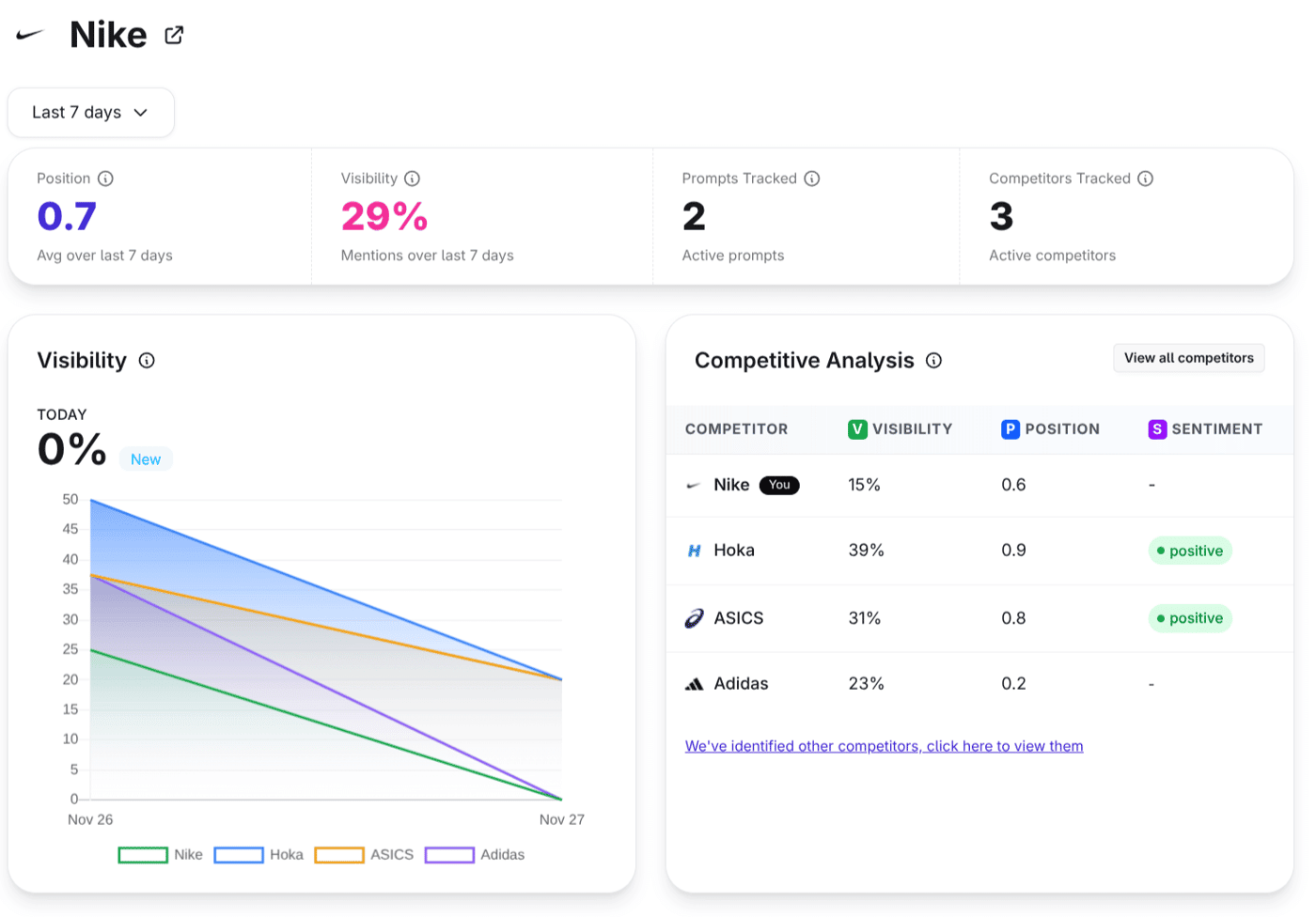
I'm very happy to launch Cartesiano.ai, a service which allows companies to track their presence across different LLMs.
There's been a few products popping up in this space the past 12 months, so the idea itself is not new, but there isn't a clear market winner yet, and most have either been backed heavily by VCs and/or are meant for more corporate users, so I'm betting on there being space for more competitors!
The Problem
Say for example you are Nike and notice that some of your inbound traffic is no longer coming from just Google, but ChatGPT. However, ChatGPT and other LLMs don't currently offer any form of analytics into what users are asking when it recommends your company or products.
To solve this, we try to think of what our target users might be asking (their prompts). So an LLM recommending Nike for example, might be the result of a user asking "What are the best marathon". With Cartesiano.ai, you can track these prompts across different LLMs, and track, over time, how often your brand/product is being mentioned, its ranking compared to other competitors, and its sentiment. It can also automatically detect new competitors you may not be aware of.
Why did I build it?
I built it because I was both looking for a side-project idea where I would have to work directly with LLMs, and one where there was already proof that a market need existed for it.
Tech-stack
From the tech-side, I've built this using:
Ruby on Rails 8 for the main user-facing web app.
Python + FastAPI + LiteLLM for the LLM processor application, which basically handles running the prompts through the different LLM providers (ChatGPT, Gemini, etc.), parsing the responses, normalizing the data, detecting sources, competitors, etc.
PostgreSQL as the main database
Hetzner for hosting (2 servers, one for the Rails and Python apps, another dedicated one for the self-hosted PostgreSQL database)
If anyone is reading this and interested in more of the tech-side, let me know and I can write a more in-depth post on it!
-
1
I like the direction this is going. There’s a big difference between tools that automate and those that actually help you think better about data. A lot of AI dashboards feel like they add layers of complexity instead of clarity, so something that’s genuinely intuitive is refreshing.
Curious how it handles edge cases where the data isn’t clean or is just plain noisy. Has anyone here used it in those kinds of situations?
-
1
Great product! I'm wondering whether there's a strategy for adding a product to Ais?
-
2
Hi Eve, there’s no way to explicitly “force” your product into AI search engines (ChatGPT, Gemini, etc.). Just like traditional SEO, the core strategy is creating genuinely useful content and optimizing your website. The difference with AI is that you also need to make your site easier for LLMs to parse and understand, which mostly comes down to better data structure and clarity. I wrote a blog post about it here: https://blog.cartesiano.ai/2025/12/06/how-to-make-your-website-llm-friendly/
-


Comment