
Clint
Invoice & Subscription Manager
I think the biggest dogma in the SaaS world might be "Don't mess with your pricing model." The caveat "Look, don't touch the prices or the packages," wherever it comes from, always carries a certain anxiety inside it. Sometimes that anxiety hides a "Who's going to define those new packages now?", and sometimes a "Ugh, how are we supposed to migrate the people on Plan X over to Plan Y now?!?" It shouldn't be this way. And for us, it isn't.
Our situation
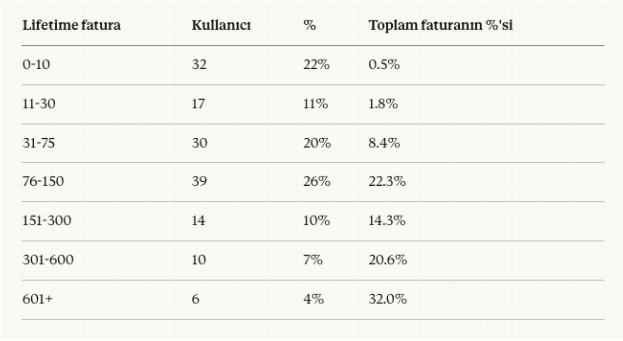
The top 10 users account for 41% of bills, the top 20 for 58%, and the top 50 for 80%. What's even more striking on a plan basis is this: starter/canceledaverage of users 573 invoices—that is, those who work the hardest and churn the most. 133 fellows/inactive users are currently at an average of 99, while only 6 are actively paying contributions (4 starter active + 2 fellow active + 1 trialing). These numbers directly impact tokenomics design in three ways.
1. The "Flat $9 Starter" model was mispriced in the most valuable segment.
The 8 users churning from Starter processed an average of 573 lifetime invoices. If these users are active for 6 months, they process approximately 95 invoices per month, and if active for 3 months, approximately 190 invoices per month — meaning a "heavy user" profile in terms of volume. This profile gained value from Clint, but the feature band below the $9 single price wasn't enough to sustain it. Tokenomics is targeting this segment. Pro ($12) or Unlimited ($24) We could have kept it in exchange for a larger package with the extra layers — or even if we couldn't, we would have at least gotten 2-3x more ARPU. Conclusion: The Pro tier is mandatory, not optional.
2. The monthly credits for the free tier should comfortably cover the median user.
Lifetime median is 67; assuming an average user's active lifespan is 6 months, that's approximately 11 bills per month. But this is lifetime data — actual usage within the active month is much higher. Safe assumption: median active user processes 15-25 bills per month. Free = 30 credits/week This perfectly matches the median, but it leaves it incomplete. Increasing the free offer to 40 credits per month.— The median user leaves a 30% margin aside while trying the product without feeling "not enough," so the upgrade signal remains organic. This also activates the 22% "under 10 bills" cohort without any effort.
3. There's a "ceiling problem" at the top — Unlimited is really necessary.
The top 6 users alone generate 32% of the total volume with 601+ lifetime invoices (top-1 user 2,252 invoices). These average 100-400 invoices per month. Pro 500 credits/week Even for the 3-4 heaviest users, it wouldn't be enough. Without Unlimited's "fair use 3,000/month soft cap," they would either churn or constantly buy top-ups (which creates friction). Unlimited is for the upper segment: a soothing top cover. It's necessary, otherwise they'll abandon the product.
Clint — Monetization v2
Credit-Based Tokenomics
Instead of a free trial, it's "all-in-one with token limits." All features are publicly available; scalability is managed with credits consumed per processed invoice. Credits are refunded when an incorrectly processed invoice is deleted.
Internal Working Document · April 2026 · Calibrated with 148 users / 18,890 invoice data
Philosophy
Pricing is an invitation, not a gateway. The free plan is not a demo, but a real starting point. The paid plan is not a leap of faith, but a natural continuation. All features are available to all users; upgrading to a higher plan is a volume decision, not a feature decision.
Auto-refund promise: Credit is refunded for every incorrectly processed invoice that is deleted. The AI's error does not affect the user's bill. This is a tangible example of the "Pricing That Asks Less Than It Gives" philosophy and a layer of trust that no one else in the industry offers.
Data summary — what it was calibrated to
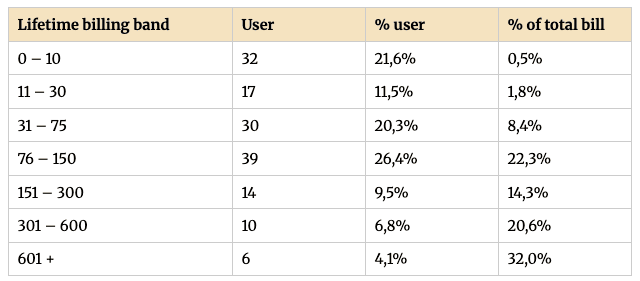
Intensity: The top 10 users generate 41% of the total volume, the top 20 58%, and the top 50 80%. Classic Pareto analysis, but a bit harsh at the extremes.
Critical observation: Although the starter/canceled cohort was the most heavily used segment with an average of 573 invoices, it churned out due to a value/cost mismatch with the single-price $9 Starter model. The new model captures this segment in the Pro/Unlimited tiers.
New packaging structure

Top-up: All plans offer top-ups of $5 = 100 credits, $9 = 200 credits, and $19 = 500 credits if used up within the month. Top-ups do not expire.
Resource weighting
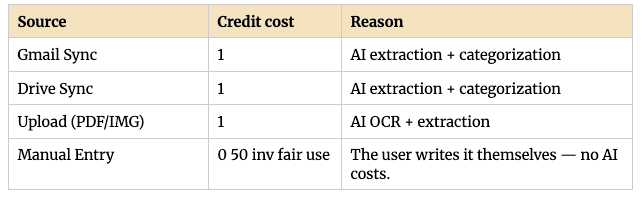
The fact that "Manual" is set to 0 embodies the promise of "truly free startup": there can always be a user who can manually manage all bills without paying anything or having any limits.
Refund & Restore logic
Basic principle: Credit is spent on "correctly processed invoices," not on "AI experiments." The cost of an incorrectly processed invoice is not passed on to the user.
Flow
1 · Delete: Instant refund. Credit returns to monthly pool (not rollover). Toast notification: "1 credit refunded."
2 · Trash (30 days):Wait. The invoice can be returned; the credit has already been refunded.
3 · Restore: Recharge. Net zero in the same month; deducted from the new month's balance in a different month.
Action-credit map

Financial impact: Assuming 95% AI accuracy, processing approximately 3,150 invoices per month would result in approximately 158 deletions and a loss of approximately 50–80 effective credits (less than 0.5 credits per user). The refund promise is financially worthless, and the brand impact is significant.
Fellow Grandfather Plan
Risk: 133 out of 148 users (90%) are in the "fellow" legacy. The group that would suffer the most brand damage if they suddenly hit the limit during the tokenomics transition — Clint's early supporters.
Solution: The Fellow plan is permanently maintained. 200 credits are gifted monthly, with no fees required. Only 2 fellows are active in the data → the practical financial burden is close to zero, and the story value is significant.
Contact message:"We started with you. We're not leaving you in the same place. The Fellow program is always free."
Old model vs New model
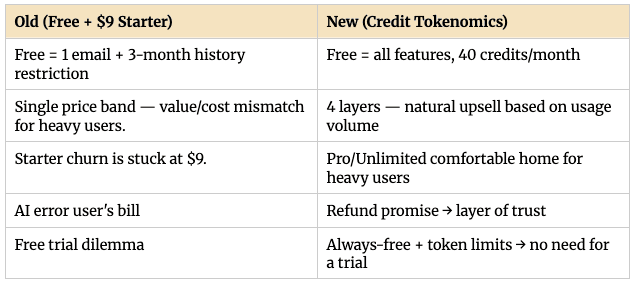
The truth will set us free and hopefully the destiny will favor the bold.

The One-Liner
Clint connects to your Gmail and Google Drive, finds every subscription and expense you forgot about, and turns financial chaos into clarity — with AI. No bank login. No screen scraping.
The Problem
You're bleeding money on subscriptions you forgot exist. The average consumer wastes $127/year on unused subscriptions. 41% of people report subscription fatigue. And the average household cut their paid subscriptions by 32% in one year — not because they wanted less, but because they lost track of what they were paying for.
The real issue isn't spending. It's visibility. You can't manage what you can't see — and your bank statement is the worst possible tool for understanding your digital spending.
What Clint Does
Clint is an AI-powered personal expense manager built around one idea: you shouldn't need to hand over your bank credentials to understand your own spending.
Instead, Clint pulls from the data you already have:
Gmail Sync — Clint scans your inbox for invoices, subscription confirmations, and payment receipts. AI categorizes and extracts the details automatically.
Google Drive Monitoring — Point Clint at a folder. Every invoice or receipt you drop in gets detected, analyzed, and filed by AI — in real time.
Manual Input — Snap a photo of a receipt, upload a PDF, or fill in a quick form. Your choice, your pace.
The result: a single, intelligent dashboard where every subscription, every invoice, and every expense lives — regardless of which bank or card you used to pay.
Core Features
AI Categorization — Every expense auto-tagged, contextualized, and trended over time. Not just "Food $45" but patterns, anomalies, and insights.
Subscription Detection — Finds recurring charges buried in your inbox that you didn't know were still active.
Canvas Views — Speed Tour, Timeline, Map — visual, editorial ways to explore your financial footprint. Not a spreadsheet. A living ledger.
Full-Text Search — Find any expense, invoice, or merchant instantly across all your data sources.
Multi-Source, Bank-Independent — Works with any bank, any card, any country. No Open Banking dependency. No single point of failure.
Why This Approach
Most personal finance apps start with the bank. Connect your account, scrape your transactions, categorize your spending. It works — until it doesn't. Bank APIs break. Screen scraping gets blocked. Coverage is patchy outside the US and UK. And users increasingly don't want to share their banking credentials with every app that asks.
Clint takes a fundamentally different approach. Your financial footprint already exists in your email (invoices, confirmations, receipts) and your file system (contracts, statements, tax docs). Clint reads what's already there — no bank handshake required.
This isn't a limitation. It's a feature. It means Clint works for:
People with multiple banks and cards (freelancers, digital nomads)
People in markets where Open Banking is weak (Turkey, MENA, LatAm)
People who simply don't trust apps with their bank login
Who It's For
Freelancers & Solo Operators — Managing Adobe CC, Notion, GitHub, Figma, Zoom, cloud storage, and a dozen other tools. Each one billing separately, each one easy to forget. Clint catches them all.
Tech Professionals — Early adopters with sprawling digital subscriptions. The kind of person who signs up for every new AI tool and forgets to cancel three of them.
Cost-Conscious Consumers — Especially in high-inflation markets like Turkey, where tracking every lira matters. Clint gives you visibility without requiring you to expose your finances to a third party.
Anyone With Subscription Fatigue — If you've ever asked "wait, am I still paying for that?" — Clint is for you.
The Team
4 founders with deep fintech and digital product experience:
Previously built SHERPA Digital Experience Studio — hundreds of digital products across Turkey and the UK
Acqui-hired by a crypto exchange; 2+ years building financial services at scale
Shipping with a Tabula Rasa production philosophy — AI-native workflows, transparent partnerships, lean execution
Where We Are
Live on the App Store. Android coming soon.
Freemium model — Free plan + $7/mo Starter with advanced AI features.
Growing user base with organic traction from freelancers and tech professionals.
What's next — Clint Card (virtual card layer for subscription control) is on the roadmap, turning Clint from "see your spending" into "control your spending."
Try Clint
Clint is free to start. Download on the App Store and connect your Gmail — you'll see your first insights in under 2 minutes. https://www.clint.website
-
1
This is a really smart approach. No bank login. No screen scraping. Just the data you already own.
Most personal finance apps are built for the US/UK market where Open Banking works. Outside that? They're useless or dangerous.
What I like:
— You're not begging for bank credentials. That's a huge trust signal.
— Works in Turkey, MENA, LatAm — markets everyone else ignores.
— Subscription detection from email is a lifesaver. I've found $500+ in forgotten charges that way.Quick questions:
1. How do you handle email privacy? Scanning Gmail is sensitive. Users will want to know what stays local vs what hits your servers.
2. Any plans for a web version? Some users prefer desktop for this kind of tool.
3. The virtual card (Clint Card) is interesting. Will that be a separate product or built into the same subscription?$7/month is an easy sell. Wish you were on Android already. 😄
Great launch.
-
2
Really appreciate the thoughtful feedback — this is exactly why I love posting here.
Let me answer your questions:
1. Email privacy: This was our #1 concern from day one. Clint never opens, reads, or stores your emails. We run exactly one search query on Gmail to find invoices, receipts, and subscription confirmations — that's it. We passed Google's CASA App Security Tier-2 audit and operate under the Gmail Restricted Scope framework, which is the strictest compliance level Google offers for third-party apps. No email content hits our servers — the processing happens on-device. Please check our data-security page on the website for more details.2. Web version: Already live at clint dot website — you can use it right now. We're also working on a more feature-rich web dashboard for deeper analytics and monthly reviews.
3. Clint Card: It'll be built into the same subscription — not a separate product. The idea is simple: if we already know your spending patterns, we can give you a smarter card that auto-categorizes in real time. Still in development, but it's one of the features I'm most excited about.
And yes — Android is coming very soon. You're not the only one asking. 😄
Thanks for the kind words. Means a lot as a solo founder building from Turkey for the rest of the world.
-
1
Appreciate the detailed response — and respect for passing the CASA Tier-2 audit. That's not easy for a solo founder.*
The 'on-device processing' is the key differentiator. Most fintech apps can't say that.
Quick follow-up: when Android launches, will it have the same feature set as iOS/web from day one?
And curious — what's been the #1 challenge in getting users to trust a privacy-first finance app?
Watching this closely.
-
1
Thanks — the CASA audit was honestly one of the most painful processes I've been through, but totally worth it. It forces you to think about security at every layer.
Android feature parity: Yes, full feature parity from day one. We're built on React Native, so both platforms share the same codebase. No watered-down Android version — everything you see on iOS and web will be there at launch.
The #1 trust challenge: Honestly? It's not convincing people that we're safe — it's overcoming the damage other apps have already done. Users have been burned by fintech apps that promise privacy but quietly sell data or require bank logins. So when we say "we never read your emails," people assume there's a catch.
What actually moves the needle is showing, not telling: the CASA audit badge, the Gmail Restricted Scope certification, and the fact that we literally can't see their data even if we wanted to. Once people try it and see how little access we actually need, the trust clicks.
The irony is — building a privacy-first finance app means your best marketing is transparency. Which is a hard thing to "growth hack." But it compounds.
Appreciate you following along.
-
1
This is gold — and one of the most honest breakdowns I've read here.
'The best marketing is transparency, which is hard to growth hack.' That's the real lesson.
What I take away from this:
— Security audits are painful, but they become your strongest marketing asset.
— Once trust is broken by other apps, you have to work 10x harder to prove you're different.
— Showing (certifications, audits) beats telling ('we care about privacy').Quick question: have you considered making the CASA audit badge and Restricted Scope certification more visible on your landing page? Above the fold? That's social proof that most fintech apps don't have.
Also curious — how long did the CASA audit actually take from start to finish?
Respect the journey
-
-
-
-

Comment