
CryptoAdvisor.Club
A virtual assistant for crypto investment

Today we've surpassed our first 1000 active users at CryptoAdvisor.Club, and we'd like to say a big THANK YOU to all of them: our beta testers for their precious feedback, our first customers for trusting us, and every one of our users for helping us validate this weird idea of encapsulating such a service behind a chatbot. :)


New year has been amazing for CryptoAdvisor.Club. We had our first paid subscriber during the holidays, only a couple days after our paid plan launching, and last week we had our first 10 paid customers, one of them subscribing to our 1 year-plan.
We're really excited about the coming news around the project, and super grateful for the reception that the product has had among our first users.
A couple of months ago we launched the CryptoAdvisor.Club beta. In the same way that we launched the service as a minimum viable product, we tried to reduce to a minimum any other "necessary add-ons" surrounding the launch (website with Notion, Integromat to automate publications, etc.). Same with the logo.
For the first versions we simply took a stock image with the Bitcoin logo, and that met two important requirements:
- It should work well in a small size: we provide our service through a Telegram Bot, and the user's avatar is a reduced-size icon
- It should work well when applying a rounded mask to it: Again, Telegram avatars have a rounded mask, and this is how most users will see our logo.
The beta logo

I made a small variation on the stock image we used initially, modifying the shape of the inner circle of the coin to make it a chat bubble. Not a big deal. At least it was an original image, and could be recognized well in the avatar.
After the first weeks, and especially with a view to the "official" launch including payment services, we saw it necessary to dedicate some time & resources to have a logo that could give the service more personality and in which we could reflect some important points.
Concepts that we consider:
- that could be related to the sector (cryptocurrencies)
- play with the capital letters C, A.
- the bot, the "conversational" part of the service (it is a differential fact)
- concepts like network / nodes / algorithm / learning / recommendations
We contacted the designer who had worked on the [Brutale] image (https://www.brutale.net/), for Albert L., and we shared these ideas and some indications about the color. We both agreed on the blue tones, and we really liked the shades of "Indigo" blue that Tailwind uses in their base palette, so we threw around.
Designer first proposals
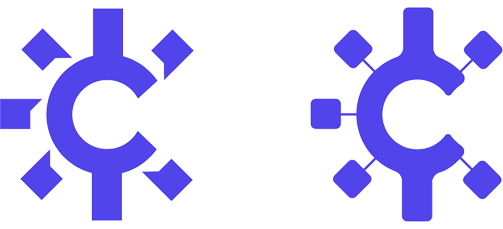
We liked the idea based on the initial, the letter C, with a bar above and below it evoking the dollar symbol $, a resource widely used also in logos of various cryptocurrencies. Not very original, but effective of course, and simple.
On the first proposal, although we liked the straight lines and we found the use of the chat bubbles around the C original, we could not avoid "filling in the blanks" that produced between those sandwiches and the central shape, unconsciously, reminding us of the Celtic cross used by some fascist groups. 😬 If we both had made that association, it was possible that others did, and we did not want to evoke that image.
The second proposal (nodes attached to the central shape creating a network around the C with the "digital currency" bars) seemed also interesting, although again an "unwanted association" arose. After sharing the logo with some people, there were several who noticed its resemblance to a shape that many of us have on our retina this year 2020: a coronavirus particle. 🦠😅
Anyhow: it didn't work for us, so we shared the feedback and asked for some more tests.
Some testing on our side
Meanwhile, we did our own tests based on the second proposal. After some exploration, we saw that perhaps we could play with the white space inside the C to represent the second initial of our name, a lowercase letter "a"
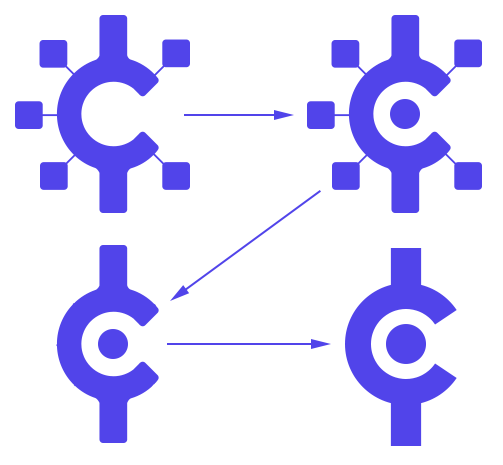
- We added a point in the center, so that the blank space could "remember" a lowercase "a".
- We remove the nodes to stay with the most basic way possible. They did not contribute to the whole and we realized that in a small size, avatar in Telegram, the small lines that joined the nodes were too small and looked like "blurs" in the background.
- We recover the straight shapes that we liked initially.
Meanwhile, we received a couple more proposals from the designer:
Second proposals from the designer

At this point, and probably conditioned by the work that we had already been progressing on our own (and the feedback that we had already begun to collect from some users and close people), none of the new proposals seemed to improve the way that we had started to drink. The first proposal because of the little personality that seemed to convey (and again those curved shapes). We both liked the second proposal and got quite a few votes as well, as memorable and original, while combining several of the points we had been discussing. The problem was that we found it too "informal", and we ended up discarding it as well.
So we keep working on the previous ideas. It took only some more iterations to get to the final version.
The final logo
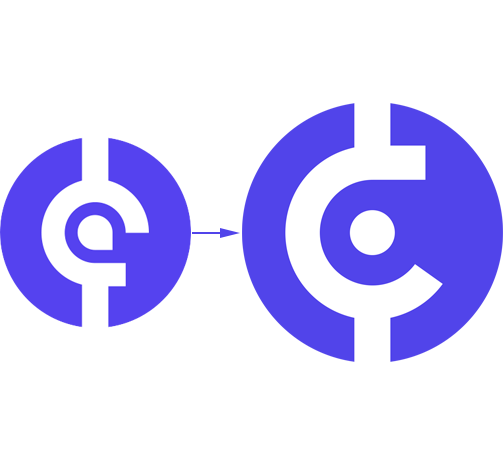
On the left you can see the proposal that we sent the designer again, as result of our explorations. We modified the shape to form a right angle at the bottom right, so that the lower case "a" we were looking for could be slightly more recognizable. It was necessary both to lengthen the base line of the C in a straight line and to close the upper part of it more. The result also reminded us of a head (our bot, Ben) looking to the right, the upper right part of the C being his nose, the lower part his chin and the inner point his "brain " (your recommendations).
On the right, the final version of the logo: balanced widths and spaces (improves its "visibility" as a small avatar) and a vertical inversion that helped to better recognize both initials in the logo.
What do you think? Which one would you have stayed with?

As result of some of our last promotional actions we get our first paid Premium subscribers, coming from one of our Telegram paid advertising campaigns and one of our organic posts on LinkedIn.
We're super happy! It gives sense to our work over the last two months and encourages us to keep improving the product, service & marketing! 💪

After first week of running some paid actions, here are some notes and numbers:
-
Facebook: Previously we set up a Page (https://facebook.com/CryptoAdvisorClub) with basic branding and included it in our Integromat workflow, so every curated news article is also published in our FB Page, in addition to our Telegram Channel and Twitter account. We created an adversing to promote traffic to our website and created a targeted audience for our promotion, based on age (30-50), location (we start focusing in spanish users) and interests (several crypto and technology related topics)
Spent:60€- Audience reached:71K- Bot subscribers:1😥
Conversion:0.0014%| CPA:60€ -
Twitter: We also included our Twitter account in the Integromat workflow, and created an advertising campaign based on this descriptive tweet: https://twitter.com/CryptoadvisorC/status/1340416574151340039 (pinned also to our TW profile page)
Spent:250€- Audience reached:113K- Bot subscribers:6😔
Conversion:0.0053%| CPA:42€ -
Telegram: I made some research for spanish speaking communities where promote directly our bot, i mean, a promotional action from Telegram itself, not linking to the website, but linking directly to our Telegram bot. At this moment we've run some advertising on 3 different spanish channels (movies & humor).
Spent:150€- Audience reached:342K- Bot subscribers:+200🎉
Conversion:0.05%| CPA:0.75€
Based on this first results (ok, only a week, but enough differences to get some first deductions) it seems clear that probably we should
- focus much more in the "Telegram-native" promotion and let the traditional paid channels for other kind of promotions (reaching wider audience, branding, etc.) in the future
- improve the website > bot journey
We'll be running our first campaign in a big english speaking crypto-focused Telegram channel with a 500K subscribers audience in the following days, with a cost very similar to our Twitter campaign. I'm really excited to see the results.

During the beta test of the product we've been offering our premium features (weekly personalized recommendations and unlimited coins in your portfolio) for free for all the testers, as a thank you for them trying our product and sharing their feedback.
After some fine-tunnings and changes thanks to their comments, and as a previous step to start with paid promotion actions, we've started offering our Premium features under a subscription, managed using Stripe. So our users can manage the whole process without leaving Telegram, through the bot and the integrated browser: checkout process, coupons, subscription management, invoices downloading.
It has been my first experience implementing a whole payment solution with Stripe (previously worked with Ingenico, Braintree, Paypal, Redsys) and I have to say it's by far the best payment solution I've tried, in terms of clarity and completeness of the technical documentation (docs, examples, etc.), the easy setup of the development sandbox from their website, and the incredible UX of the "out-of-the-box" products offered by Stripe (talking about their own checkout system and the "customer portal" they also offer). You only have to implement your webhooks to react to all the events happening in their systems, and can link to their own frontend solutions. 👌
Ok then: everything on its place now. Let's do some promotion.

Finally it's here: https://cryptoadvisor.club
We started with a Notion-based website, using Cloudflare workers (inspired by Fruition - https://fruitionsite.com/), but although it was a fast & simple way to publish our work during the beta testing process, we needed more control over the website content and implement some basic features on it:
-
Allow different bot onboarding experiences depending on the website action: We're offering different links to our bot in our website, using Telegram deeplinking options (you can send some "parameters" to your bot using the "start" command). For instance, we wanted to differentiate the regular link ("try it for free") from the premium subscription link. While the first one launches an onboarding process focused on show the user the whole features package that the bot has to offer, the second one tries to prioritize an easy and simple checkout process, offering a slight overview of the premium features the user is paying for.
-
Origin tracking for the bot: We were planning to start some paid actions to promote our bot, over different channels (Adwords, Facebook, Instagram, Twitter & Telegram channels). In order to keep track of the performance of every channel and properly calculate the cost of acquisition of every new subscriber, it was a must to be able to have some way to automatically tag website visitors and include that information in a dynamic way taking advantage of the Telegram deeplinking. It allows us to keep track of the subsequent actions of the customers, and calculate the channels' ROI when new users become paid subscribers.
-
Performance Benchmarking: We've built a model portfolio based on some value equivalent cryptos and some cash to invest. We compare the performance between a "hold & buy" strategy (buy & keep the assets over the period) and the same portfolio, but following the weekly recommendations from our algorithm. This is a very detailed and visual way to compare and better understand what we do, and why talk about the mid-long term approach when investing in cryptocurrencies.
-
Have better control over SEO aspects: we made some hacks over the original Fruition implementation to be able to incorporate some language related SEO information, canonicals, etc., but they weren't more than that: hacks. Now we have a simpler and better management of multi-language URL, hreflang for cross-linking between them and a complete sitemap including all this information automatically updated every time something changes.
Since we wanted to keep it simple and fast even if we decided to build the website by ourselves, we choose to go with TailwindCSS (a marvelous CSS framework) and his** Tailwinds UI components library** (https://tailwindui.com/components). I have to say that it worth every single penny. In only a couple of days we were able to build the initial version, migrating all the contents in the three languages. It only took some small changes over the original components to adapt the visuals to our needs.
For the backend part we used the same Symfony app that serves our API and the chatbot endpoints, since the requirements were very simple: good translation & multi-language abilities (last 5.2 version of Symfony comes with a lot of interesting features related with translations), allow a good cache configuration, so we can take advantage of Cloudflare acting as intermediate cache proxy (assets, most of contents are static...), good integration with our chosen frontend tools & libraries (We can use Tailwind to full potential with tree-shaking, watching, postcss processing, etc. thanks to integration between Symfony > Webpack > Tailwind)...
Finally, we incoporated a fine-grained user analytics tool like Hotjar, that allow us to analyze browsing sessions, see heatmaps of some of the main webpages to identify potential issues and add a "Feedback" tab to our website. This, added to the bot analytics tool we're currently using, Chatbase, result in a very valuable source of information to improve the product and the contents we're using to market it.
In the end, it was a change that took us ~1 week (including us both learning how to set up a modern frontend toolkit 😅) and allowed us to improve the clarity of the message and our brand image, and start offering our Premium subscription paid package being able to measure the performance of every channel.
What do you think? We'd love to hear your comments.

As a complement to our chatbot, we started a Telegram News Channel (https://t.me/CryptoAdvisorClub) where we will publish interesting curated news and announcements related with our CryptoAdvisor.Club bot.
The idea is to use this Telegram Channel as a medium to start building an audience, that could potentially be interested in our advisor bot, or help us spreading the word.
We set up an automated pipeline using Integromat to select two relevant news from curated sources, and pick one article every three hours from a personalized feed from a Pocket favorites folder mantained by ourselves. So, when we want to reference an article from our channel (and also from our Twitter account), we only have to add it to our Pocket account.

On October 29th we announced the launch of the service from our Twitter accounts, and started having our first beta users. In the following two days we reached our first 50 users.
These first days were really interesting and useful to us to gather feedback from our first users and start fine tunning our chatbot behaviour.

On this date, after a well deserved break after my leaving and the following process of research and interviews done before summer, my partner and I started to writing down the first lines of code.
Ben, our diligent and helpful chatbot ,would be speaking its first words by the end of the month.
We wrote about the technical side on how we built it at https://albert.garcia.gibert.es/criptoadvisor-como-se-hizo/ (in spanish)
Comment